


Views
AI in Arbitration: Will the EU AI Act Stand in the Way of Enforcement?
This guest post was written by Ezzatollah Pabakhsh, Master’s Student at the University of Antwerp
The European Union has taken an unprecedented step by regulating artificial intelligence (AI) through the EU AI Act, which is the world’s first comprehensive legal framework for AI governance. According to Recital 61, Article 6(2) and Annex III, 8(a), AI tools used in legal or administrative decision-making processes—including alternative dispute resolution (ADR), when used similarly to courts and producing legal effects—are considered high risk. These tools must comply with the strict requirements outlined in Articles 8 through 27. Read more
Clearly Inappropriate Down Under: Isaacman v King [No 2] and the Outer Limits of Long-Arm Jurisdiction
By Dr Sarah McKibbin, University of Southern Queensland
The Supreme Court of New South Wales’ decision in Isaacman v King [No 2][1] is the kind of case that tempts one to say ‘nothing to see here’, and yet it richly rewards a closer look. On a conventional application of Voth v Manildra Flour Mills[2] — the leading Australian authority on forum non conveniens — Garling J stayed proceedings that attempted to litigate a New York relationship dispute in Sydney, being ‘well satisfied’ that the NSW Supreme Court was a clearly inappropriate forum.[3] The reasons, though brief by design,[4] illuminate the transaction costs of jurisdictional overreach,[5] show how the Voth framework handles an extreme set of facts, and offer a careful case study for empirical debates about Australian ‘parochialism’ in jurisdictional decision-making. Read more
Indonesian Constitutional Court on International Child Abduction
THE INDONESIAN CONSTITUTIONAL COURT DECISION REAFFIRMED PARENTAL CHILD ABDUCTION IS A CRIMINAL OFFENCE
By: Priskila Pratita Penasthika[1]
INTRODUCTION
The Indonesian Constitutional Court Decision Number 140/PUU-XXI/2023, issued on 3 September 2024, confirms that parental child abduction is a criminal offence under Article 330(1) of the Indonesian Criminal Code. Prior to this Decision, Article 330(1) of the Criminal Code was understood as a provision that could not criminalise someone for child abduction if the abduction was committed by one of the biological parents.
After 3 September 2024, through this Constitutional Court Decision, the abduction of a child by one of the biological parents, when the parent does not have custody based on a final court decision, is reaffirmed as a criminal offence. Read more
News
Quick and easy access to German case law in private international law – One year of ‘IPRspr 2.0’ (and almost 100 years of ‘IPRspr’)
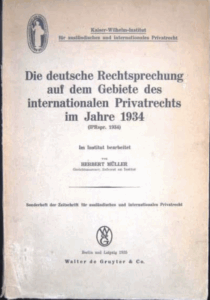

Quick and easy access to German case law in private international law – One year of ‘IPRspr 2.0’ (and almost 100 years of ‘IPRspr’)
A comprehensive and carefully curated database providing free access to German court decisions on private international law – www.iprspr.de
Ralf Michaels/Jan Peter Schmidt
Perspectives Contentieuses Internationales (PCI), Volume 4
by Fabienne Jault-Seseke
Volume 4 of the Revue Perspectives Contentieuses Internationales (PCI) has been published. Available in open access here.

It includes a special feature on ‘the International Commercial Chamber of the Paris Court of Appeal’ edited by Sandrine Clavel and Daniel Barlow. This feature provides an insight into the history of the chamber, its specific characteristics, its place in the European market for justice, and how it operates. It also includes a presentation of its case law in private international law by Marie-Elodie Ancel and François Mailhé. Case law in arbitration is the subject of three articles by Malik Laazouzi.
Widiez on Specialisation of Private International Law
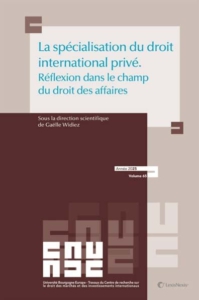
Gaëlle Widiez (Bourgogne University) has recently edited a volume entitled The Specialization of Private International Law: Reflections from the Perspective of Business Law (La spécialisation du droit international privé : Réflexion dans le champ du droit des affaires), published by LexisNexis. Read more