


Views
Major amendment to Chinese Arbitration Act after three decades
This guest post is written by Jie Zheng, Assistant Professor & Research Fellow, Shanghai University of Finance and Economics
On 12th September 2025, the 17th session of the Standing Committee of the 14th National People’s Congress passed the Amendment to the Arbitration Law of the People’s Republic of China (hereinafter “Chinese Arbitration Act”) to be effective from 1st March 2026[1], which was first adopted in 1994. Since its adoption, China has undergone enormous economic reforms and a more urgent need to align the legislation with international arbitration practices. There were only two minor revisions in 2009 and 2017 to fix technical inconsistencies with other procedural laws. In July 2021, the Ministry of Justice of China released a Draft Revision of the Arbitration Law for public consultation. [2] This was the first comprehensive reform since 1994. The draft was reviewed by the Sanding Committee of the National People’s Congress three times. Read more
Personal Jurisdiction, Consent, and the Law of Agency
I have long argued – in articles, blog posts, and amicus briefs – that it violates due process to invoke a forum selection clause to obtain personal jurisdiction over a defendant who was not a party to the agreement in which the clause appears. This position has not yet achieved universal acceptance. The state courts in New York, in particular, have repeatedly held that forum selection clauses can be used to assert personal jurisdiction over non-party defendants who are “closely related” to the parties or the transaction. In this blog post, I use a recent case—Bandari v. QED Connect Inc.—decided by Magistrate Judge Gary Stein (SDNY) to highlight some of the problems with the “closely related” test. Read more
Can a Seat Court Injunct a Foreign Non-Party to an Arbitration? Singapore High Court clarifies in Alphard Maritime v Samson Maritime (2025) SGHC 154
This guest post is posted on behalf of Kamakshi Puri, Senior Associate at Cyril Amarchand Mangaldas, Delhi, India, and dual-qualified lawyer (India and England and Wales).
The Singapore High Court recently clarified the scope of the court’s jurisdiction over foreign non-parties to the arbitration. In an application to set aside two interim injunctions, in Alphard Maritime Ltd. v Samson Maritime Ltd. & Ors. (2025) SGHC 154,[1] the court held that the the seat per se did not confer jurisdiction against non-parties to an arbitration, and that jurisdiction would first have to be established through regular service-out procedures before the seat court could grant an injunction against a non-party.
News
PAX Moot – Deadline for registration is Friday 16 January 2026 at 23:59 CET
The PAX Moot 2026 Vladimir Koutikov Round is well underway. The case was published on 13 October 2025 and is available here. The deadline for registration is 16 January 2026 at 23:59 CET.
Save the date: The oral rounds will take place from 15 to 17 April 2026 in Sofia, Bulgaria.
27th Volume of the Japanese Yearbook of Private International Law (2025)
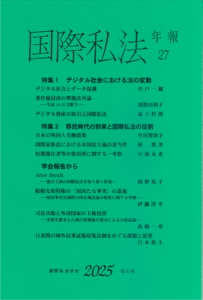
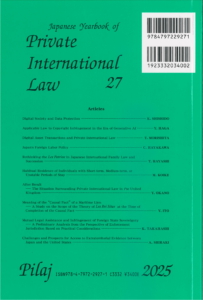
The 27th Volume (2025) of the Japanese Yearbook of Private International Law (JYPIL) (Kokusai Shiho Nenpo [Japanese]) published by the Private International Law Association of Japan (Kokusai Shiho Gakkai [Japanese]) (“PILAJ”) has recently been released.
This new volume features the following table of content.
The papers are published in Japanese; all links below direct to the papers’ English summaries.
Jiménez and Martínez on A Private International Law for Colombia
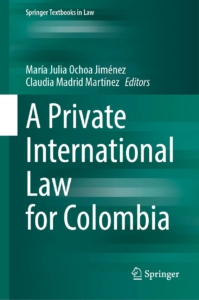
Colombian private international law research has been witnessing a notable period of renewed scholarly activity. Following a previous announcement on this blog of the publication of a volume dedicated to the Colombian Draft Project on Private International Law, a further significant contribution has now been published, this time offering a broader and more systematic perspective on the field. This new contribution takes the form of a book edited by María Julia Ochoa Jiménez (Loyola University) and Claudia Madrid Martínez (University of Antioquia), entitled “A Private International Law for Colombia”, published in the Springer Textbooks in Law series (Springer, 2025).
According to the publisher’s website, the book offers a “[c]omprehensive study of issues underlying PIL, particularly in Latin America and Colombia”, provides “[s]ystematical analysis of PIL rules in Colombia, allowing readers to understand how they deal with global issues”, and “[a]ddresses rules in force, critically examines them and, accordantly, presents and discusses a legislative proposal”. Read more