
TDM Call for Papers: Special Issue on “International Arbitration and the Space Industry”


Transnational Dispute Management (TDM) has kindly shared the following Call for Papers with us.
We are pleased to announce a forthcoming Transnational Dispute Management (TDM, ISSN 1875-4120, www.transnational-dispute-management.com) special issue on “International Arbitration and the Space Industry.”
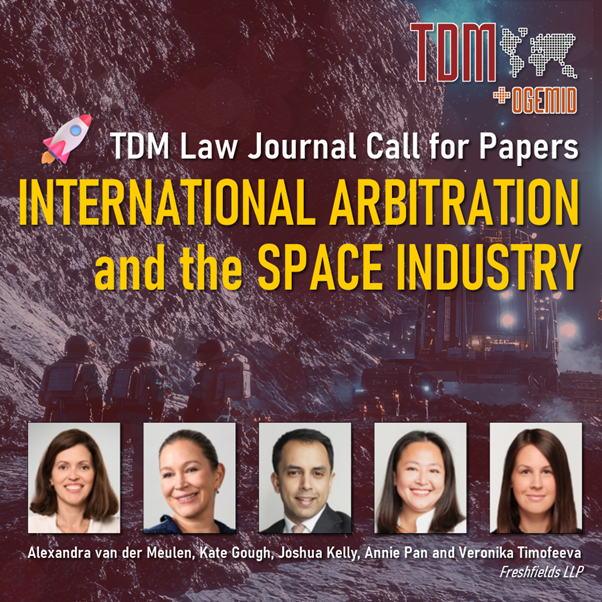
This Special Issue will be edited by Alexandra van der Meulen, Kate Gough, Joshua Kelly, Annie Pan and Veronika Timofeeva (Freshfields LLP).
Space exploration was once the traditional domain of State actors, with the government space agencies of the United States and the USSR leading the way. Today, the landscape has shifted dramatically: private companies are now at the forefront, driving innovation in areas such as satellite launches, commercial space flight and space stations, among others. According to the World Economic Forum, the global space economy is projected to reach US$1.8 trillion by 2035, growing at an average annual rate of 9%.[1]
The influence of the space industry is becoming increasingly pervasive. Once associated mainly with satellite launches and services such as satellite radio, broadcast television and GPS, these technologies now represent only a fraction of the space industry’s reach. Satellite communications technologies have only grown in sophistication over the past decade, with thousand-strong satellite constellations now delivering a wide variety of commercial and societal services to businesses and consumers. These range from satellite broadband to climate monitoring, enabling accurate environmental data collection and analysis, to supply chain and transportation applications. Aside from its commercial applications, space has also become indispensable for defense purposes, with satellites and other space-based assets providing the backbone for surveillance, communication and strategic operations.
With the rapid growth of the space industry and heightened financial stakes, an increase in space-related disputes is inevitable. In the commercial arena, these disputes are likely to center on contractual issues, such as the supply of services by satellite operators to the telecoms and defense sectors, disputes concerning launch, refueling and maintenance service, and joint venture disputes between State-owned entities and private-sector operators.
Growing private-sector investment in space-related activities is also likely to fuel investor-State disputes. States’ interests in controlling various aspects of space-related technologies and resources (such as spectrum usage) for national security or public interest reasons will inevitably rub up against the purely commercial interests of private operators. Striking the right balance between these competing interests will be critical to sustaining confidence and investment in the sector.
International arbitration is well-positioned to address space-related disputes. In doing so, the international arbitration community will have to grapple with a range of novel legal and technical issues, such as:
- Territoriality in investor-State disputes involving space law
- Specialised rules for disputes related to outer space activities
- The need for specialised treaties protecting foreign investment in the space sector
- The notion of ownership in space
- The role of international and regional space agencies in shaping space-related arbitration
- Damages assessment, particularly for novel space projects
- Multi-contract and multi-party space disputes in complex space ventures
- Space-related disputes under domestic law
- State-to-State disputes concerning space activities
- Mitigation of third-party losses from satellite collisions and space debris
- Licensing and authorization disputes (national overlap, ISDS, etc.)
- Insurance and liability regimes
- National security overlap
We invite all those with an interest in the subject to contribute articles or notes on one of the above topics or any other relevant issue. Proposals for papers (150-200 words) should be submitted to the editors by May 31, 2026, publication is expected in final quarter of 2026.
Please address all questions and proposals to Annie Pan, at annie.pan@freshfields.com, and Veronika Timofeeva, at veronika.timofeeva@freshfields.com. Please CC info@transnational-dispute-management.com when submitting your materials.
Articles accepted for publication before this deadline will also go through TDM’s on-line advance publication process, allowing your work to reach its target audience as soon as the paper completes peer review and the editing process.
The minimum word count for articles is 5,000 words (excluding footnotes, endnotes, appendices, tables, summary etc.). Articles must include a short summary of the key points addressed and any conclusions drawn (150-200 words). The layout of the articles should conform to TDM’s submission guidelines, available at: www.transnational-dispute-management.com/contribute.asp (more information available upon request).
For citations, follow OSCOLA (4th Edition): www.law.ox.ac.uk/research-subject-groups/publications/oscola
This call for papers can also be found on the TDM website here:
https://www.transnational-dispute-management.com/news.asp?key=2101
[1] https://www3.weforum.org/docs/WEF_Space_2024.pdf