


Views
EU modernises consumer dispute resolution: An overview of the new ADR Directive
By Alexia Kaztaridou (Linklaters)
On 25 September 2025, the Internal Market and Consumer Protection Committee (IMCO) of the European Parliament approved the text of the political agreement on the Alternative Disputes Resolution for Consumer Disputes Directive. This Directive establishes a framework for resolving through ADR procedures contractual domestic and cross-border consumer disputes arising from the sale of goods or provision of services between consumers and traders within an EU context. The amendments to the prior Directive aim to modernise the existing framework in light of new consumer trends, such as the growth of e-commerce, and bring significant changes across several areas, enhancing the protection for consumers and clarifying obligations for traders and ADR entities. The Directive maintains its minimum harmonisation approach, allowing Member States to provide for stronger consumer protection. Read more
US Supreme Court: Judgment in Smith & Wesson Brands, Inc. et al. v. Estados Unidos Mexicanos (Mexico) – A few takeaways

Written by Mayela Celis, Maastricht University
In June 2025, the US Supreme Court delivered its opinion in Smith & Wesson Brands, Inc. et al. v. Estados Unidos Mexicanos (Mexico) 605 U.S. 280 (2025). The Opinion is available here. We have previously reported on this case here, here and here (on the hearing).
As previously indicated, this is a much-politicized case brought by Mexico against US gun manufacturers, alleging inter alia negligence, public nuisance and defective condition. The basic theory laid out was that defendants failed to exercise reasonable care to prevent the trafficking of guns to Mexico causing harm and grievances to this country. In this regard, the complaint focuses on aiding and abetting of gun manufacturers (rather than of independent commission).
In a brilliant judgment written by Justice Kagan, the Court ruled that PLCAA bars the lawsuit filed by Mexico. Accordingly, PLCAAS’s predicate exception did not apply to this case. Read more

French Supreme Court upholds asymmetric jurisdiction clauses in Lastre follow-up
by Jean-Charles Jais, Guillaume Croisant, Canelle Etchegorry, and Alexia Kaztaridou (all Linklaters)
On 17 September 2025, the French Cour de cassation handed down its decision on the Lastre case. This followed a landmark preliminary ruling of February 2025 from the CJEU, which laid out the conditions for a valid asymmetric jurisdiction clause under article 25 of the Brussels I recast regulation.
Asymmetric jurisdiction clauses allow one party to initiate proceedings in multiple courts or any competent court, while the other party has fewer options or is restricted to a specific jurisdiction. Such clauses are common in financial agreements (read more in our previous blog post here).
In the latest development of the Lastre case in France, the French Supreme Court opted for a pro-contractual autonomy stance, favouring the validity of asymmetric jurisdiction clauses.
News
International Society of Family Law (ISFL) World Conference 2026 – Istanbul
The 19th World Conference of the International Society of Family Law (ISFL) will take place in Istanbul, Türkiye, from 9 to 12 September 2026. The conference will be hosted by Pîrî Reis University at its Marine Campus in Tuzla, offering a distinctive coastal setting for this major event.
The theme of the conference is “Family Law & Vulnerability.”
The conference will explore how family law engages with different forms of vulnerability across diverse legal systems and social contexts. Contributions addressing the theme from comparative, interdisciplinary, theoretical or practice-oriented perspectives are welcomed.
The deadline for abstract submission has been extended to 20 February 2026. Abstracts may be submitted for paper presentations (including jointly authored papers) as well as for organized panels. Detailed submission guidelines are available on the conference website.
Conference registration will open in late February 2026. Registration fees for participation in the scientific program are as follows:
- ISFL members: €400 (early bird) / €450 (regular)
- Non-members: €500 (early bird) / €550 (regular)
- Participants from low-income countries: €250 (early bird) / €300 (regular)
The early bird rates will apply until 1 May 2026. Registration fees cover access to the scientific sessions of the conference; social events will be subject to separate registration and fees.
The conference venue, Tuzla, is located on the Asian side of Istanbul and is conveniently close to Sabiha Gökçen International Airport, which serves numerous international and domestic flights. Tuzla is well connected to other parts of the city by public transport.
A list of recommended hotels on the Asian side of Istanbul will be published on the conference website in due course, providing a range of accommodation options with convenient access to the venue by public transport.
Further information on registration procedures, accommodation and the conference program will be made available on the official conference website: www.isfl2026.org.
Marola on International Jurisdiction over Infringements of Personality Rights in EU Private International Law: Book Review
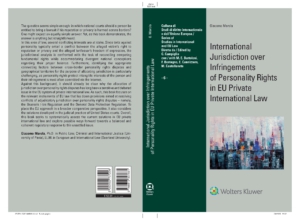
Giacomo Marola’s International Jurisdiction over Infringements of Personality Rights in EU Private International Law (2025 Wolters Kluwer) addresses a deceptively simple but persistently debated question: where should a claimant be entitled to sue when reputation, privacy, or personal data are infringed across borders? As the book makes clear from the outset, this question lies at the intersection of private international law, fundamental rights, and the realities of online communication. Personality rights disputes are structurally conflictual, typically opposing the protection of moral integrity to freedom of expression, while the Internet continues to strain jurisdictional rules built around territorial connecting factors. Against this backdrop, the book offers a timely and systematic assessment of the EU framework.
Chapter I constitutes the analytical core of the work. It provides a detailed examination of Article 7(2) of the Brussels I-bis Regulation and the Court of Justice’s case law on the ‘place of the harmful event’ in personality rights disputes. From Shevill to eDate Advertising, Bolagsupplysningen, Mittelbayerischer and Gtflix, Marola carefully examines the construction of locus actus and locus damni, focusing in particular on the publisher’s place of establishment, the persistence of the ‘mosaic’ approach, and jurisdiction based on the victim’s centre of interests. The chapter goes beyond doctrinal reconstruction by assessing these solutions against the objectives of proximity, predictability, and procedural balance, and by advancing a well-argued proposal de lege ferenda.
Chapter II places the EU approach in comparative perspective through an analysis of US jurisdictional doctrine in defamation and online tort cases. By retracing the path from Keeton and Calder to the rise and decline of the Zippo test and the renewed prominence of the ‘effects’ doctrine, the chapter sheds light on both convergences and structural differences. In doing so, it provides a useful corrective to overly enthusiastic transatlantic borrowings sometimes found in the European literature.
The final chapter turns to the General Data Protection Regulation and its interaction with the Brussels I-bis Regulation. Chapter III examines both public and private enforcement mechanisms, with particular attention to Article 79 GDPR and its implications for jurisdictional choice in data protection litigation. By integrating GDPR disputes into the broader analysis of personality rights, the book captures an increasingly central area of cross-border litigation.
Overall, the monograph combines doctrinal precision, critical insight, and pragmatic proposals, making it a valuable contribution for scholars and practitioners engaged with jurisdictional questions at the crossroads of EU private international law and fundamental rights.

AAPrIL’s Feb 2026 Seminar: Pitel on ‘Reconsidering the “Proper Party” Basis for Jurisdiction’
On Thursday 12 February 2026, the Australasian Association of Private International Law (AAPrIL) is hosting its first seminar of 2026, as Professor Stephen Pitel presents free online and in-person (Qld, Australia) on the topic, ‘Reconsidering the “Proper Party” Basis for Jurisdiction’.
Abstract:
In several jurisdictions the fact that a defendant is a ‘proper party’ to a legal proceeding constitutes a sufficient basis for taking jurisdiction over that defendant. Advocates of the proper party basis rely on considerations of fairness and efficiency to support it. Do these considerations support the proper party basis, especially if it is given a wide scope? Recently Canadian courts have been reconsidering their approach to the proper party basis, as seen (somewhat opaquely) in Sinclair v Venezia Turismo, 2025 SCC 27. This presentation will explore that reconsideration and offer thoughts for changes in other jurisdictions including Australia and New Zealand.
Chair:
Mary Keyes is Professor of Law at Griffith University, and President of AAPrIL. She is a leading scholar on questions of international jurisdiction and international family law. Mary is co-author of Private International Law in Australia, and is a member of the Working Group on Jurisdiction at the Hague Conference on Private International Law.
Presenter:
Stephen Pitel Stephen G.A. Pitel is a Professor in the Faculty of Law at Western University. His research and teaching are focused on private international law, tort law, civil procedure and legal ethics. Stephen is the author of Conflict of Laws (3rd ed. 2025) and co-author of Private International Law in Common Law Canada: Cases, Text and Materials (5th ed. 2023) and Statutory Jurisdiction: An Analysis of the Court Jurisdiction and Proceedings Transfer Act (2012). His tort law scholarship includes co-authoring Fridman’s The Law of Torts in Canada (4th ed. 2020) and Cases and Materials on the Law of Torts (11th ed. 2023). In the field of legal ethics, Stephen is a contributor to Lawyers’ Ethics and Professional Regulation (4th ed. 2021). He is a former President of the Canadian Association for Legal Ethics.
Details:
Date and time: Thursday 12 February 2026, 5:00pm to 6:00pm (AEST)*
Date and time Thursday 12 February 2026, 5:00pm to 6:00pm (AEST)
in person: Griffith University, Southbank, Brisbane: Room 4.03 Building S07. The map is available here.
RSVP (essential): Please register via this link by COB Wednesday 11 February 2026, and advise whether you are attending in person or online. Please access the Teams link here. There is no cost.
* NZ. 8:00pm-9:pm; ACT, NSW, Tas and Vic. 6:00pm-7:00pm; SA, 5:30pm-6:30pm; Qld, PNG. 5:00pm-6:00pm; NT, 4:30pm-5:30pm; WA, 3:00pm-4:00pm