
Widiez on Specialisation of Private International Law


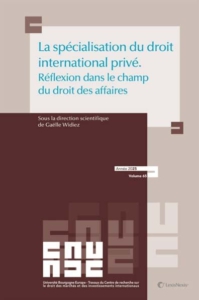
Gaëlle Widiez (Bourgogne University) has recently edited a volume entitled The Specialization of Private International Law: Reflections from the Perspective of Business Law (La spécialisation du droit international privé : Réflexion dans le champ du droit des affaires), published by LexisNexis.
The book brings together the contributions of participants in a colloquium on the same theme, held in Dijon on 29 November 2024 and organized in collaboration with the Centre Droit Éthique et Procédures (CDEP) of the University of Artois.
The book’s description reads as follows:
(AI translation)
In contemporary private international law (PIL), there has been a marked proliferation of special rules on jurisdiction and choice of law, designed to respond more closely to the specific features of particular situations. This development, however, carries the risk of relegating the general rules of the discipline to a merely subsidiary role. Such specialization in PIL manifests itself primarily in two forms: first, the emergence of “micro-categories” accompanied by specific connecting factors; and second, the refinement—indeed, at times the “over-refinement”—of general conflict rules in order to tailor the connecting factor to certain specific situations. Against this background, the objectives of the research are twofold. On the one hand, it seeks to enrich and, where appropriate, to go beyond the three justifications traditionally advanced in support of this specialization: the need to better capture the growing complexity of social and economic relations; the internationalization and Europeanization of the discipline; and the increasing role of the judge, particularly at the European level. The analysis of the common and specific reasons underlying this process of specialization in PIL will thus be further developed and consolidated. On the other hand, a detailed examination of various examples drawn from business law will make it possible to assess more closely the effectiveness of this process of specialization. In addition, the study is expected to yield valuable insights into the sources of PIL, which may in turn usefully inform the future development of conflict-of-laws rules.
En droit international privé (DIP) contemporain, on constate une prolifération de règles de conflit de juridictions et de conflit de lois spéciales qui se veulent mieux adaptées aux aspérités des cas de figure particuliers, au risque de confiner les règles générales de la matière à un rôle subsidiaire. Cette spéculation du DIP se manifeste principalement sous deux formes : l’apparition de “petites catégories” assorties d’éléments de rattachement particuliers et l’affinement, voir le “raffinement”, de la règle de conflit général afin d’adapter le rattachement à certaines situations spécifiques. Partant, l’objectif de la recherche est double. D’une part, il s’agira d’enrichir et sans doute de dépasser les trois justifications classiquement avancées au soutien de cette spécialisation : volonté de mieux appréhender la complexification croissante des relations sociales et économiques, internationalisation/européanisation de la discipline et accroissement du rôle du juge, spécialement au niveau européen. La réflexion sur les raisons communes et spécifiques de ce processus de spécialisation du DIP sera étoffée et consolidée. D’une part, l’étude par le biais de divers exemples de droit des affaires permettra d’analyser au plus près l’efficacité du processus de spécialisation. De plus, il devrait s’en extraire de précieuses informations sur les sources du DIP qui pourraient utilement éclairer la fabrique des règles de conflit de demain.
The Table of contents includes the following:
Gaëlle WlDIEZ
Propos introductifs (3)
Nicolas BALAT
Réflexions générales sur la spécialisation (9)
PREMIÈRE PARTIE – La spécialisation des règles de DIP relatives à la protection des personnes et de la planète
Olivera BOSKOVIC
La spécialisation des règles de droit international privé en matière d’atteintes à l’environnement (17)
Marie NIOCHE
Directive « vigilance » et spécialisation du droit international privé (31)
Marion HO-DAC
Le contentieux international généré par l’intelligence artificielle (57)
Marie-Élodie ANCEL
Le contentieux international des données personnelles : réflexion à partir d’une règle de compétence« spécifique» au sein du RGPD (79)
DEUXIÈME PARTIE – La spécialisation des règles de DIP relatives à la régulation du marché
Valérie PIRONON
Le contentieux international de la concurrence (99
Juliette MOREL-MAROGER
La spécialisation des règles de droit international privé relatives à la régulation du marché. Le contentieux financier international (113)
Constantin RINGOT-NAMER
Le contentieux international en produits défectueux (129)
Béligh ELBALTI
La spécialisation du droit international privé : point de vue du monde Arabe et de l’Asie (145)
Sarah LAVAL
La spécialisation des règles de conflit de lois : l’exemple du droit international privé américain (175)
Cyril NOURISSAT
La spécialisation du droit international privé : le point de vue de l’Union européenne (187)