


Views
Investment Awards vs Sovereign Immunity: Navigating the Enforcement Maze
By Cara North, Counsel, Ashurst
The intersection of foreign State immunity and the enforcement of international arbitral awards has been a hotly contested issues in recent years. First the question was whether a State has waived immunity from court processes concerning recognition and enforcement of arbitral awards by ratifying the 1965 Convention of Settlement of Investment Disputes (ICSID Convention) – to which the answer has been yes in Australia and the England and Wales (among other jurisdictions). More recently, the question has been whether a State’s ratification of the 1958 New York Convention on the Recognition and Enforcement of Foreign Arbitral Awards (New York Convention) constitutes an implicit waiver of sovereign immunity, to which the High Court of Australia most recently held no.
In CCDM Holdings, LLC v The Republic of India [2026] HCA 9, the High Court of Australia unanimously held that ratification of the New York Convention does not, of itself, waive foreign State immunity under the Foreign States Immunities Act 1985 (Cth). The decision aligns Australia with the current position in the United States, Canada, and England and Wales, reinforcing an emerging common law consensus in that regard.
Courtroom Attendance as a Forum Conveniens Factor in Hamilton v Barrow
This post is written by Timon Milan Solár, Doctoral researcher, Faculty of Law, Trnava University, Slovakia.
In October 2025, the High Court of England and Wales (King’s Bench Division) handed down its judgment in Hamilton v Barrow [2025] EWHC 2593 (KB). The case concerned a failed unregulated investment scheme that collapsed in 2017, leaving investors without the possibility of recovering their investments, which ranged from £2,930 to £410,969. At first glance, the decision discusses important procedural questions, including abuse of process and champerty. However, on closer inspection, it also raises an interesting issue of English private international law that has gone overlooked. Can courtroom attendance be a factor in the forum conveniens test?
Greenpeace Anti-SLAPP Suit Blocked by International Antisuit Injunction
This post was written by Hannah Buxbaum, Martin Luther King Jr. Professor of Law, UC Davis School of Law. The post is cross-posted from the Transnational Litigation Blog with kind permission.
In 2019, Energy Transfer, the developer of the Dakota Access Pipeline, sued Greenpeace International, a Dutch foundation, in North Dakota state court. Last year, Greenpeace responded with an anti-SLAPP (Strategic Litigation Against Public Participation) lawsuit against Energy Transfer in Dutch court. In the latest twist in this lengthy dispute, the North Dakota Supreme Court issued an antisuit injunction last week blocking (partially) that anti-SLAPP suit.
The injunction is unusual in two respects. First, it does not actually bar Greenpeace from pursuing the Dutch action; rather, it purports to limit the issues that Greenpeace can raise in that litigation. Second, it was entered after judgment had already been reached in the North Dakota lawsuit. Read more
News
RabelsZ: Issue 2/2026
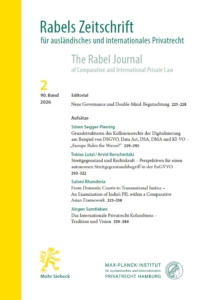 The latest issue of RabelsZ has just be released. It contains the following articles as well as an editorial with important information regarding the journal’s future governance structure and publication process. All content is Open Access: CC BY 4.0.
【Out Now – Open Access】Commercial Private International Law in Southern Africa: Comparative and International Perspectives: Essays in Honour of Professor Christopher F Forsyth KC
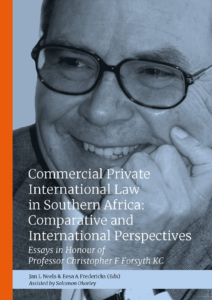
Professor Christopher F. Forsyth is undoubtedly one of the leading figures in private international law in Africa, particularly in Southern Africa, where his scholarship has had a profound and lasting influence. His seminal work, Private International Law – The Modern Roman-Dutch Law Including the Jurisdiction of the High Courts (5th ed., Juta, 2012), is not only an indispensable reference for scholars and researchers, but also an authoritative work before Southern African courts, where it is frequently cited with approval.