


Views
Refusal to Enforce in Egypt of a Californian (U.S.) Judgment for Lack of Reciprocity: What Has Gotten into the Egyptian Supreme Court?

I. Introduction
Sometimes, reading court decisions leaves a strange sense of confusion, especially when the decision rendered not only contradicts a well-established line of case law, but also when the court, in the very same decision, reveals internal contradictions. Several months ago, I critically discussed on this blog a rather unusual decision of the Egyptian Supreme Court (محكمة النقض/maḥkamat an-naqḍ), in which the enforcement of a Canadian judgment was denied on the ground that reciprocity had not been established with Canada. In my comments on that decision, I expressed “significant concerns” regarding the incoherent manner in which reciprocity was addressed by the Supreme Court.
PRC Double Interest neither Double nor Penal: Australian Courts Clear Its Name When Enforcing Chinese Judgments

This post was kindly prepared by Dr. Meng Yu, lecturer at China University of Political Science and Law, and co-founder of China Justice Observer.
[ABSTRACT]
Recent Australian case law clarifies that the “double interest” mechanism in the People’s Republic of China (hereafter ‘PRC’) monetary judgments functions as a compensatory post-judgment interest framework rather than an unenforceable penalty. This consolidates Australia’s position as a highly attractive and creditor-friendly forum for enforcing Chinese judgments. See Zhengzhou Lvdu Real Estate Group Co v Shu [2024] NSWSC 58 (6 February 2024), Fu v Pang [2025] VSC 597 (16 September 2025), and Shanghai Chenggong Industrial Co Ltd v Zhihua Chen [2025] NSWSC 1112 (27 October 2025).
The AIFC Court, Gazprom v Naftogaz and the Emergence of a New Conduit Jurisdiction Debate
This post is written by Dr. Nicolás Zambrana-Tévar LLM(LSE) PhD(Navarra), Associate Professor School of Law KIMEP
Introduction
In May 2026, the Court of First Instance of the Astana International Financial Centre (AIFC) recognised and enforced a Swiss ICC arbitral award rendered in favour of Naftogaz against Gazprom. The award arose out of the disputes between the parties concerning the transit of Russian gas through Ukraine after the start of the war.
News
AMEDIP: Annual seminar to take place from 15 to 16 October 2026 (in Spanish)
The Mexican Academy of Private International and Comparative Law (AMEDIP) will be holding its XLIX Seminar entitled “Towards a new codification of Private International Law in Mexico” (Hacia una nueva codificación del Derecho Internacional Privado en México) from 15 to 16 October 2026. The venue of the seminar will be the Universidad Autónoma de Yucatán (Mérida, Mexico).
This edition of the seminar will primarily focus on the draft bill on Private International Law for the state of Yucatán, an initiative presented by AMEDIP to the authorities of that state. This draft breaks from previous practice, according to which state PIL rules are contained in civil codes, by suggesting the adoption of a standalone Act (available here). Read more
Out now: Private International Law and Children’s Rights Law by Tine Van Hof
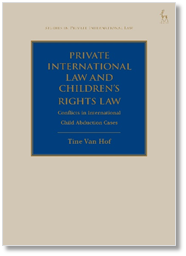
The publisher’s blurb, including a discount code, is as follows:
Private International Law and Children’s Rights Law
Conflicts in International Child Abduction Cases
Tine Van Hof
This book examines the relationship between two legal fields when courts decide on cross-border child abduction. While private international law prioritises the child’s prompt return and applies the best interests principle in abstracto, children’s rights law demands an in concreto, individualised assessment of the child’s best interests. These differing approaches can lead to legal friction in practice.
Through a detailed analysis of legal instruments and supranational case law, the book explores how these conflicts arise and how they might be resolved.
Offering clear recommendations for lawmakers, international organisations, and courts, the book provides a roadmap for fostering constructive relationships between legal fields. It is an essential resource for scholars of private international law, judges and practitioners in cross-border family law, and policymakers working at the intersection of international law and children’s rights.
Tine Van Hof is a legal researcher at the University of Antwerp, Belgium.
Jun 2026 | 9781509977055 | 288pp | Hbk | RRP: £90
Discount Price: £72
Order online at www.hartpublishing.co.uk – use the code GLR BD8 to get 20% off!
Sign up to our email list to receive updates about our new titles.
New Empirical Study in Comparative Law: “The Reasons Highest Courts Give: England, France, Germany; 1880–89 and 2007–16”
This post has kindly been provided by Markus Lieberknecht (University of Osnabrück).
It is our great pleasure to bring to readers’ attention the publication of the article “The Reasons Highest Courts Give: England, France, Germany; 1880–89 and 2007–16”, co-authored by Holger Spamann (Harvard Law School), Stefan Vogenauer and Jasper Kunstreich (MPI Hamburg), Heinrich Nemeczek (Scalable Capital) and Markus Lieberknecht (Osnabrück University), in The Journal of Legal Studies.
One of the core debates in comparative law concerns the characteristics, extent, and development of the common/civil law divide. In this context, it is a familiar trope that common and civil lawyers reason differently, but that the systems are converging. However, the empirical basis for such claims is thin to nonexistent. To address this paucity of data-backed research, we present the first systematic quantitative comparison of three paragon jurisdictions of common law (England) and civil law (France and Germany), and across two centuries (1880–89 vs. 2007–16). Specifically, we analyze the use of legal authorities (cases, statutes, and literature) in 40 representative opinions of each apex court in each of the two decades we surveyed.