


Views
Chinese courts made decision taking into account of the Hague Choice of Court Convention
China has signed the Hague Choice of Court Convention on 12 September 2017, but has not yet ratified this Convention. The Hague Choice of Court Convention has not entered into force in China. However, Shanghai High Court has already relied on the Hague Choice of Court Convention to make decision.
In Cathay United Bank v Gao, Shanghai High Court, (2016) Hu Min Xia Zhong No 99, the appellant, a Taiwan commercial bank, and the respondent, a Chinese citizen resident in Shanghai, entered into a Guarantee contract. It included a clause choosing Taiwan court as the competent court to hear disputes arising out of the contract. This clause did not specify whether it was exclusive or not. Chinese law does not provide how to decide exclusivity of a choice of court agreement. Facing the legal gap, Shanghai High Court took into account Article 3 of the Hague Choice of Court Convention 2005 and decided that choice of court agreements should be exclusive unless the parties stated otherwise. The Shanghai High Court thus declined jurisdiction in favour of Taiwan Court.
This decision was made on 20 April 2017, even before China signed the Hague Choice of Court Convention. Since the Hague Choice of Court Convention has not entered into force in China, it should not be directly applied by Chinese courts in judicial practice. The question is whether Chinese courts could ‘take into account’ of international conventions not being effective in China to make decision. Although Article 9 of the Chinese Supreme Court’s Judicial Interpretation of Chinese Conflict of Laws Act allows the Chinese courts to apply international conventions, which have not entered into effect in China, to decide the parties’ rights and obligations, such an application is subject to party autonomy. In other words, parties should have chosen the international convention to govern their rights and obligations. Article 9 does not apply to international judicial cooperation conventions that do not deal with individuals’ substantive rights and are not subject to party autonomy. Perhaps, a more relevant provision is Article 142(3) of the PRC General Principle of Civil Law, which provides that international customs or practice may be applied to matters for which neither the law of the PRC nor any international treaty concluded or acceded to by China has any provisions. Arguably, the Hague Choice of Court Convention represents common practice adopted internationally and forms a source to fill the gap in the current Chinese law.
EU Member State sees opportunities in Brexit: Belgium is establishing a new English-language commercial court
Expecting higher demands for international commercial dispute resolution following Britain’s departure from the EU, Belgium plans to set up a new English-language commercial court, the Brussels International Business Court (BIBC), to take cases away from the courts and tribunals in London. This decision was announced on 27 Oct 2017. This BIBC is designed to address disputes arising out of Brexit and major international commercial disputes. The court will take jurisdiction based on parties’ choice, and will do the hearing and deliver judgments in English. The parties would have no right to appeal. BIBC combines elements of both traditional courts and arbitration. See comments here.
Although Brexit may cause uncertainty to litigants in the UK, a survey suggests that the EU judicial cooperation scheme is not the main reason for international parties choosing London to resolve their disputes. The top two factors that attract international litigants to London are the reputation and experience of English judges and combination of choice of court clauses with choice of law clauses in favor of English law, followed by efficient remedies, procedural effectiveness, neutrality of the forum, market practice, English language, effective UK-based counsel, speed and enforceability of judgments. Furthermore, Brexit will not affect the New York Convention and would less likely affect London as an arbitration centre. It may be more reasonable to suggest that the main purpose of BIBC is not to compete with London at the international level, but to offer additional judicial tool and become a new commercial dispute resolution centre within the EU to attract companies and businesses to Brussels.
CJEU on the place of the damage under Article 7(2) of Brussels Ia as regards violation of personality rights of a legal person
First personal impressions presented by Edina Márton, LLM, PhD (Saarbruecken)
For jurisdictional purposes, the localisation of cross-border violations of personality rights under European instruments, such as Regulation (EU) No 1215/2012 (Brussels Ia), has attracted the attention of a considerable number of scholars and often led to different legal solutions in the national judicial practice. At EU level, besides Shevill (C-68/93; ECLI:EU:C:1995:61) as well as eDate and Martinez (C-509/09 and C-161/20; ECLI:EU:C:2011:685), since 17 October 2017, a third judgment in case Bolagsupplysningen (C-194/16; ECLI:EU:C:2017:766) has given further clarification in this area. In the recently delivered judgment, the ECJ specified one of the two limbs of the connecting factor “where the harmful event occurred or may occur” under Article 7(2) of Brussels Ia, namely the place of the alleged damage. Read more
News
Out Now: Fabrizio Marrella, “Diritto del commercio internazionale / International Business Law”, 3rd edition 2023
The third edition of Fabrizio Marrella’s textbook on international business law has recently published by Wolters Kluwers/Cedam.
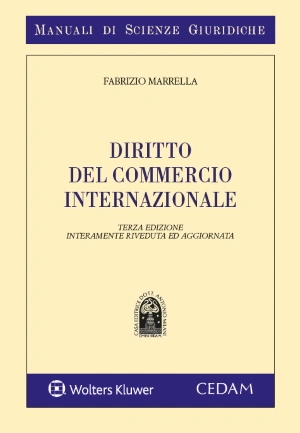
The author (Vice-Rector and Chair of International Law at “Cà Foscari” University of Venice, Italy) has kindly provided the following summary for our readers:
After an historical introduction and a clear systematic analysis of key actors and sources of International Business Law, the book focuses on transnational contracts and commercial relationships of companies by deepening international sales (including the first applications of Incoterms ® 2020), contracts of international transport, insurance, commercial distribution, payments and bank guarantees. The leading methodology used by the Author is that of private international law and best operational practices.
The book also sets out the regulation of foreign direct investment in the light of the latest new regulatory and case-law developments. In the final part, the work examines, in one section, ADR mechanisms together with international arbitration and, in the final section, the most relevant international civil procedure rules for businesses.
The book can be found at the publisher’s website here.
Dutch Journal of PIL (NIPR) – issue 2023/2
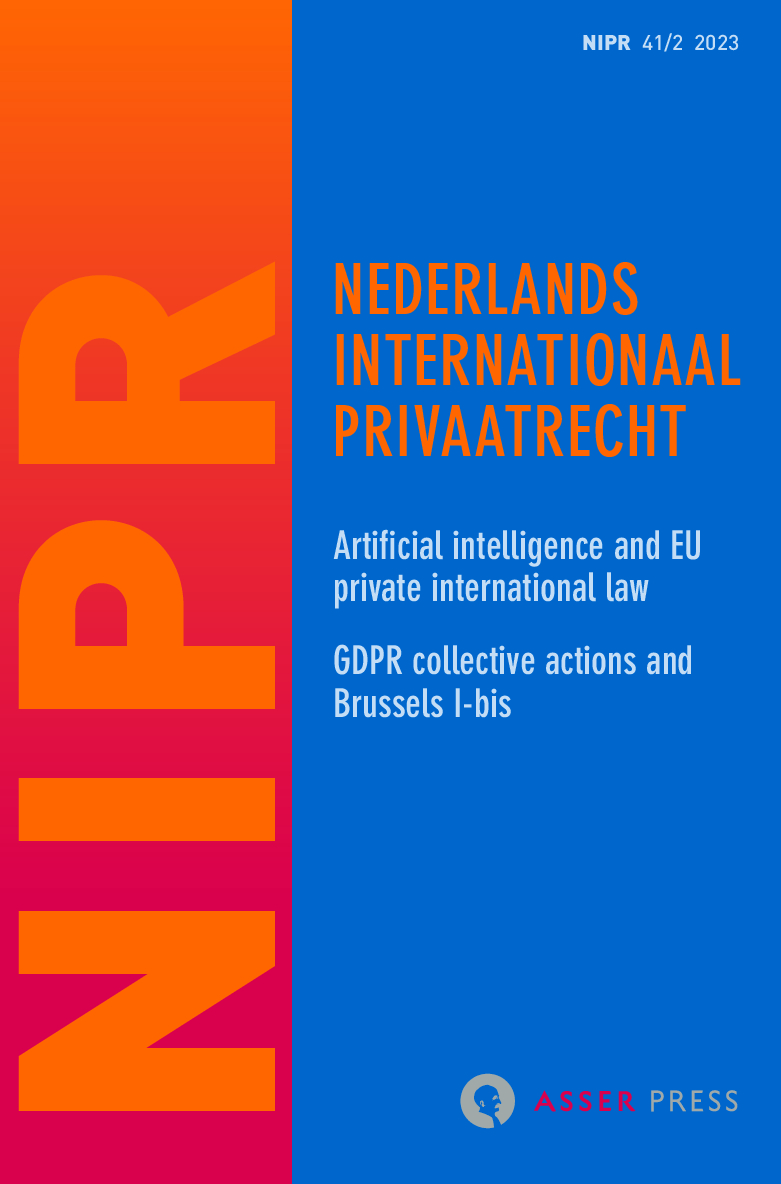
The latest issue of the Dutch Journal on Private International Law (NIPR) has been published.
NIPR 2023 issue 2
Editorial
C.G. van der Plas / p. 197
Articles
K.C. Henckel, Issues of conflicting laws – a closer look at the EU’s approach to artificial intelligence / p. 199-226
Abstract
While newly emerging technologies, such as Artificial intelligence (AI), have a huge potential for improving our daily lives, they also possess the ability to cause harm. As part of its AI approach, the European Union has proposed several legislative acts aiming to accommodate and ensure the trustworthiness of AI. This article discusses the potential private international law impact of these legislative proposals. In doing so, it – inter alia – addresses how the newly proposed legislative acts interact with existing private international law instruments, such as the Rome II Regulation. In addition, it questions whether there is a need for specific rules on the private international law of AI.
Out Now: Interim Measures in Cross-Border Civil and Commercial Disputes
A new volume by Deyan Draguiev on Interim Measures in Cross-Border Civil and Commercial Disputes, based on his PhD thesis supervised by Peter Mankowski, has just been published with Springer.

The blurb reads as follows:
The book focusses on applying a holistic overview of interim measures and associated procedures in the context of cross-border private law (civil and commercial) disputes that are the subject of international litigation and arbitration proceedings. It reexamines key features of said problem and outlines novel findings on interim relief in the area of international dispute resolution. The book analyses the rules of EU law (EU law regulations such as the Regulation Brussels Ibis and the rest of the Brussels regime) as the single system of cross-border jurisdictional rules, as well as the rules of international arbitration (both commercial and investment). In the process, it conducts a complete mapping of interim measures problems and explores the criteria for granting relief under national laws. For this purpose, it includes an extensive comparative law overview of many jurisdictions in Europe, Asia, Africa, the Americas, etc., to reveal common standards for granting interim relief.
Interim relief is a salient problem in dispute resolution, and serious international disputes usually require requests for such measures. This makes a more complete understanding all the more important. For scholars and practitioners alike, there are various ways to seek relief; precisely this complexity calls for a more complex and multilayered analysis, which does not (as is usually the case) adopt the perspective of either litigation or arbitration, but instead weighs the pros and cons and considers the viability and reliability of the different options, viewed from all angles.