
Conflict of Laws
  • About
  • Editorial board
  • Subscription
  • Submission
  • Materials
  • Contact
  • Click to open the search input field Click to open the search input field Search
  • Menu Menu

Dutch Journal of PIL (NIPR) – issue 2023/2

July 11, 2023/in News/by Ekaterina Pannebakker
image_pdfimage_print

The latest issue of the Dutch Journal on Private International Law (NIPR) has been published.


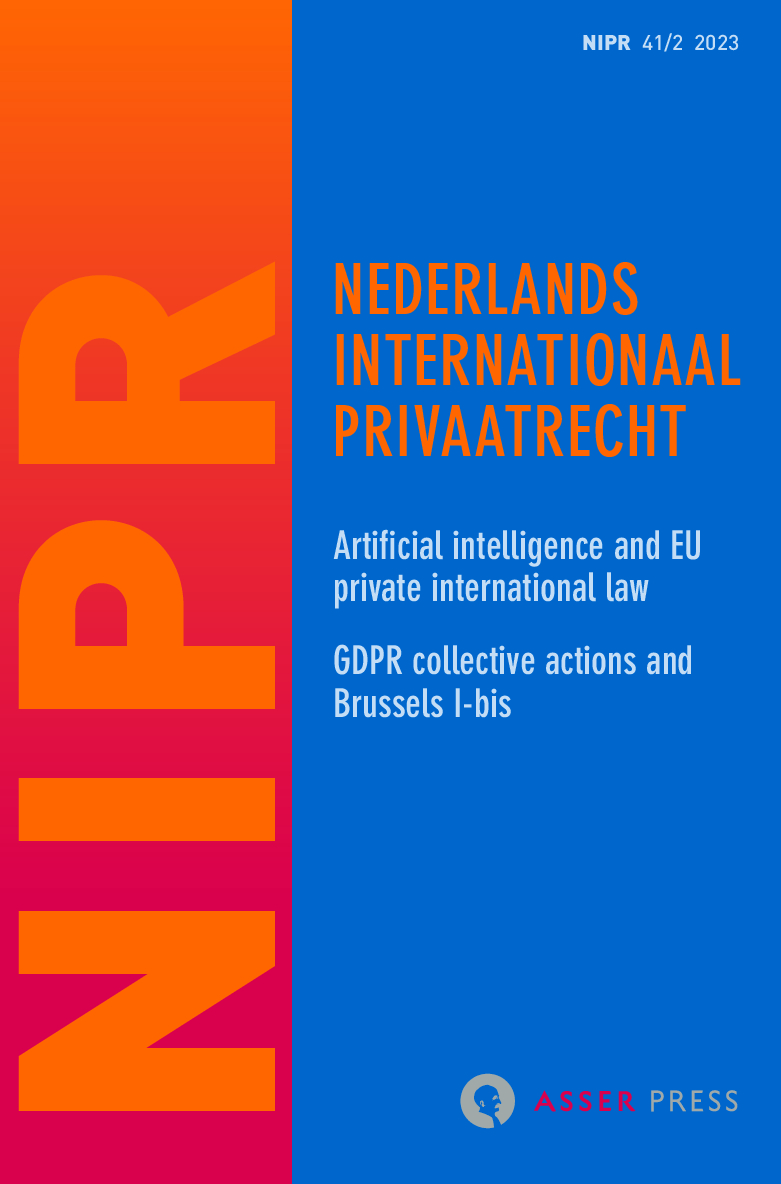
NIPR 2023 issue 2


Editorial

C.G. van der Plas / p. 197


Articles

K.C. Henckel, Issues of conflicting laws – a closer look at the EU’s approach to artificial intelligence / p. 199-226

Abstract

While newly emerging technologies, such as Artificial intelligence (AI), have a huge potential for improving our daily lives, they also possess the ability to cause harm. As part of its AI approach, the European Union has proposed several legislative acts aiming to accommodate and ensure the trustworthiness of AI. This article discusses the potential private international law impact of these legislative proposals. In doing so, it – inter alia – addresses how the newly proposed legislative acts interact with existing private international law instruments, such as the Rome II Regulation. In addition, it questions whether there is a need for specific rules on the private international law of AI.

Silva de Freitas, The interplay of digital and legal frontiers: analyzing jurisdictional rules in GDPR collective actions and the Brussels I-bis Regulation / p. 227-242

Abstract

The General Data Protection Regulation (GDPR) has provided data subjects with the possibility to mandate representative organizations to enforce rights on their behalf. Furthermore, the GDPR also contains its own jurisdictional scheme for the enforcement of the rights of data subjects. In this context, judicial and scholarly discussions have arisen as to how the procedural provisions contained in the GDPR should interact for properly assigning jurisdiction in GDPR-related collective actions. In this article, I will address this question to argue that both jurisdictional grounds provided by the GDPR are available for representative organizations to file collective actions: the Member State in which the controller or processor is established and the Member State in which the data subjects reside. Furthermore, in order to exemplify the impact of national law on such interaction, I will also assess how some legal provisions contained in the WAMCA may impinge upon the rules on jurisdiction contained in the GDPR.


Share this entry
  • Share on Facebook
  • Share on X
  • Share on WhatsApp
  • Share on Pinterest
  • Share on LinkedIn
  • Share on Tumblr
  • Share on Vk
  • Share on Reddit
  • Share by Mail
https://conflictoflaws.net/News/2020/08/CoL_Banner-1.png 0 0 Ekaterina Pannebakker https://conflictoflaws.net/News/2020/08/CoL_Banner-1.png Ekaterina Pannebakker2023-07-11 18:32:552023-07-12 05:58:47Dutch Journal of PIL (NIPR) – issue 2023/2
Categories

  • Views
  • News

Most Recent Posts

  • Support in cross-border transactions by Adults: Contract law vs capacity law August 12, 2026
  • Recognition of Italian Extrajudicial Divorces in Tunisia — Between Methodological Uncertainty and the Need to Preserve Continuity of Personal Status Across Borders August 9, 2026
  • Private International Law and European Society August 4, 2026
  • The New Zealand Supreme Court’s judgment in Kea Investments Ltd v Wikeley on anti-enforcement relief August 3, 2026
  • Beyond Domicile: The BHP Litigation and the Functional Interconnection of Public and Private International Law August 3, 2026
  • Conflicts of jurisdiction in Senegal: lesson from the Senegalese Supreme Court on Lis Pendens and the Exequatur of foreign judgments July 27, 2026
  • Adoption in the proposal for a European Parenthood Regulation July 21, 2026
  • Copyright, Targeting and Geo-Blocking: The CJEU Stirs the Pot July 15, 2026
  • A Follow-Up: The German Judges Association’s Response to the HCCH Draft Text of a Future Convention on Parallel Proceedings and Related Actions July 15, 2026
  • Private International Law Dimensions of Singapore’s New Legislation to Combat Online Harms July 14, 2026
  • The 1961 HCCH Apostille Convention: Why All African Countries Should Ratify It? — Insights from Judicial Practice in Africa July 14, 2026
  • The enforcement of an advance on costs for substitute performance at the expense of a Russian debtor in German-French legal relations July 2, 2026
  • “Yes, in principle, but not quite there yet…” – Some Observations on the Public Consultation on the HCCH Draft Text of a Future Convention on Parallel Proceedings and Related Actions June 29, 2026
  • Judgment Mobility Rules in India’s Private International Law Regime: No place for a revision au fond? June 26, 2026
  • Nothing to See Here: The CJEU’s Decision in Case C-232/25 Idzinski June 18, 2026
Link to: Out Now: Interim Measures in Cross-Border Civil and Commercial Disputes Link to: Out Now: Interim Measures in Cross-Border Civil and Commercial Disputes Out Now: Interim Measures in Cross-Border Civil and Commercial Disputes Link to: Reappreciating the Composite Approach with Anupam Mittal v Westbridge II Link to: Reappreciating the Composite Approach with Anupam Mittal v Westbridge II Reappreciating the Composite Approach with Anupam Mittal v Westbridge II
Scroll to top Scroll to top Scroll to top