


Views
Bob Wessels, International Insolvency Law: Part II European Insolvency Law, 4th edition 2017, Wolters Kluwer
Written by Lukas Schmidt, Research Fellow at the Center for Transnational Commercial Dispute Resolution (TCDR) of the EBS Law School, Wiesbaden, Germany
With International Insolvency Law Part II having been published, Bob Wessels’ 10 volume series ‘Insolventierecht’ (Insolvency Law) is now completed in its 4th edition. The publication comprehensively deals with the European Insolvency Regulation Recast as entered into force on 26 June 2017, while International Insolvency Law: Part I Global Perspectives on Cross-Border Insolvency Law, already published at the end of 2015, covers the core concepts of Cross-Border Insolvency Law, other regional frameworks than the EIR and relevant instruments of soft law. Read more
Deference to Foreign Sovereign Submissions
As previously reported here, the United States Court of Appeals for the Second Circuit issued a decision in 2016 reversing a $147.8 million price-fixing judgment against two Chinese manufacturers of Vitamin C. The plaintiffs alleged that the Chinese manufacturers engaged in price fixing and supply manipulation in violation of U.S. antitrust laws. In its first ever appearance as an amicus before a U.S. court, the Chinese government filed a formal statement asserting that Chinese law required the Chinese manufacturers to set prices and reduce the quantities of Vitamin C sold abroad. Relying on this statement, the Second Circuit held that because the Chinese manufacturers could not comply with both Chinese law and the U.S. antitrust laws, principles of international comity compelled dismissal of the case.
This case raises a host of interesting questions. First, did the Second Circuit reach the right result? Second, is this a comity case or a foreign sovereign compulsion case? Third, what level of deference is due to a foreign sovereign that appears in private litigation to explain their country’s laws? Fourth, should U.S. judges defer to such an explanation?
In June 2017, the United States Supreme Court called for the views of the United States. This past Tuesday, the Solicitor General (SG) filed this brief in response to the Court’s order.
In this submission, the SG explains that the Court should grant review of the Second Circuit’s decision in order to review the court of appeals’ holding that the Chinese government’s submission conclusively established the content of Chinese law. According to the SG, “a foreign government’s characterization of its own law is entitled to substantial weight, but it is not conclusive.” The SG argues that the case warrants the Court’s review because “[t]he degree of deference that a court owes to a foreign government’s characterization of its own law is an important and recurring question, and foreign sovereigns considering making their views known to federal courts should understand the standards that will be applied to their submissions.”
Should the Court grant review, the question of what standard should be applied to foreign sovereign submissions will be key. This is a question I have explored here.
It will be interesting to see whether the Court accepts the SG’s request to review the Second Circuit’s decision.
Jurisdiction, Conflict of Laws and Data Protection in Cyberspace
Report on the Conference held in Luxembourg on 12 October 2017, by Martina Mantovani, Research Fellow MPI Luxembourg
On 12 October 2017, the Brussels Privacy Hub (BPH) at the Vrije Universiteit Brussel and the Department of European and Comparative Procedural Law of the Max Planck Institute Luxembourg held a joint conference entitled “Jurisdiction, Conflicts of Law and Data Protection in Cyberspace”. The conference, which was attended by nearly 100 people, included presentations by academics from around the world, as well as from Advocate General Henrik Saugmandsgaard Øe of the Court of Justice of the European Union. The entire conference was filmed and is available for viewing on the YouTube Channel of the Max Planck Institute Luxembourg (first and second parts) Read more
News
Seminar Report on Personal identity and status continuity – a focus on name and gender in the conflict of laws
Written by Thalia Kruger (University of Antwerp) and Laura Carpaneto (University of Genoa)
On 1 June 2023 the European Law Institute (ELI) and the Swiss Institute of Comparative Law (SICL) held the third session of a conference on personal identity and status continuity. The focus of this third session was on names and gender in the conflict of laws. The programme included recent amendments to Swiss legislation, the portability and recognition of names, and new gender statuses in private international law.
AMEDIP: Annual seminar to take place from 8 to 10 November 2023 (in Spanish)
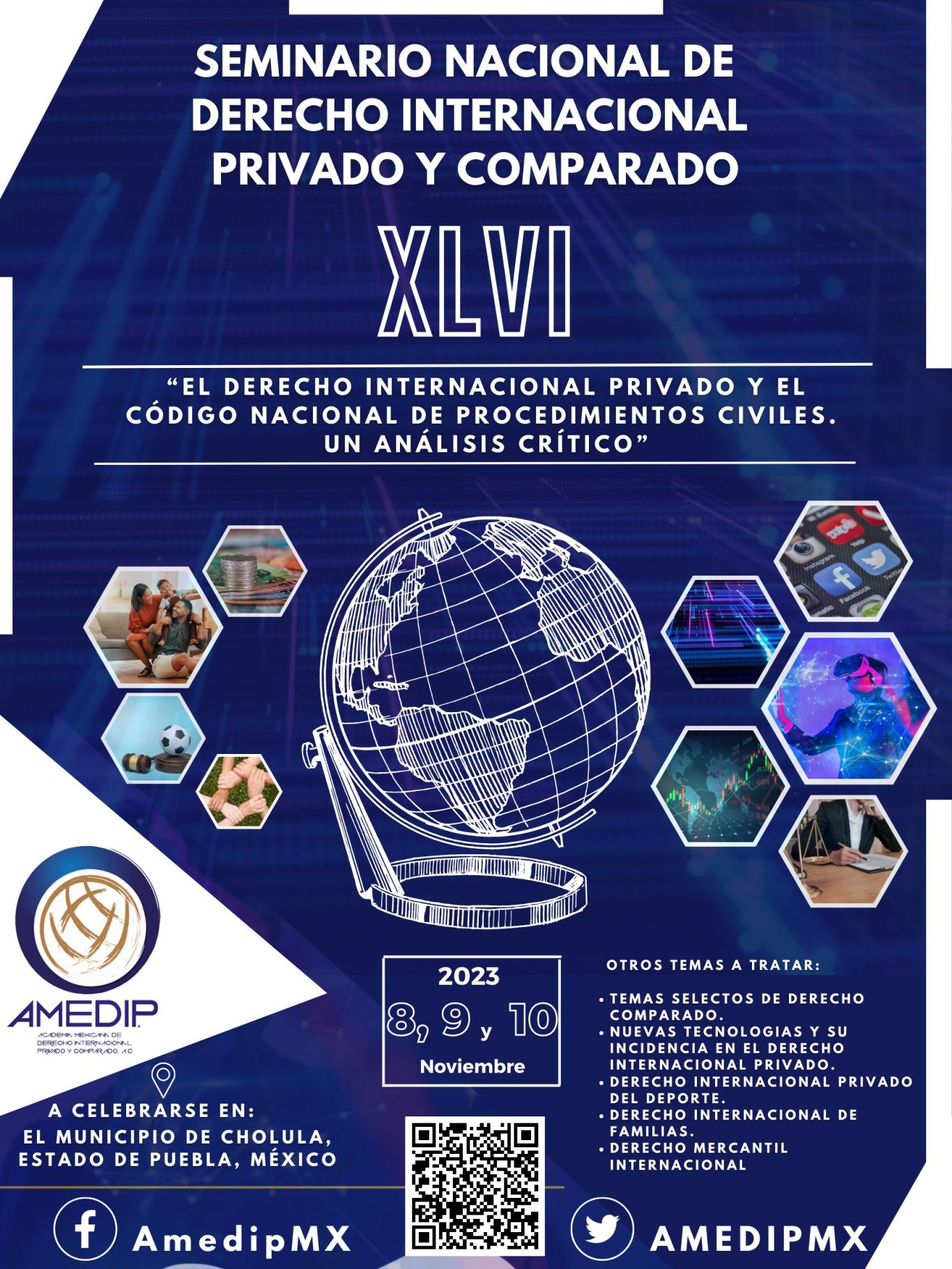
The Mexican Academy of Private International and Comparative Law (AMEDIP) will be holding its annual XLVI Seminar entitled “Private International Law and the National Code of Civil Procedure. A critical analysis” (el Derecho Internacional Privado y el Código Nacional de Procedimientos Civiles. Un análisis crítico) from 8 to 10 November 2023. The venue of the seminar will be the Hotel Posada Señorial in Puebla, Mexico (and also online).
The main objective of this seminar will be to analyse the recently adopted Mexican National Code of Civil and Family Procedure (we previously posted about this development here), as well as the interrelationship between the new technologies and Private International Law.
Potential speakers are invited to submit a paper in Spanish, English or Portuguese by 31 August 2023. Papers must comply with the criteria established by AMEDIP and will be evaluated accordingly. Selected speakers will be required to give their presentations preferably in Spanish as there will be no interpretation services but some exceptions may be made by the organisers upon request for presentations in English and Portuguese.
There is a fee for participation both in person and online. For more information (incl. prices, hotel, venue etc.), click here.
Save the Date: EU Insolvency Law and Third Countries: Which Way(s) Forward?, 26–28 Oct 2023
On 26–28 October 2023, the University of Kiel will be hosting a conference on ‘EU Insolvency Law and Third Countries: Which Way(s) Forward?’. It is part of a research project coordinated by Professors Alexander Trunk (University of Kiel) and Jasnica Garasic (University of Zagreb), which is endorsed by UNCITRAL and supported by the Fritz Thyssen Foundation. It is conducted in cooperation with representatives of the European Commission and the Hague Conference on Private International Law.
At the conference, the first results from the project will be presented and discussed with a larger professional and academic public. The conference will also include a Young Researchers Forum on the morning of 26 October.
The organizers have kindly shared the following documents with us:
Further information can also be found at the project website.