


Views
Book Review: L. d’Avout’s La Cohérence Mondiale Du Droit (Brill)
 The general course in private international law delivered at the Hague Academy of International Law by Louis d’Avout during the 2022 Summer Session was published in the Academy’s Pocket Books Series (1 032 pages). Louis d’Avout is Professor at Université Paris Panthéon-Assas. In addition to his numerous scholarly works, readers of this blog may recall that his special course on “L’entreprise et les conflits internationaux de lois” was also published in the Academy’s Pocket Books Series in 2019. The general course is title « La cohérence mondiale du droit » (“The Global Coherence of Law”). The publication of a general course in private international law—particularly in the Academy’s Pocket Books Series—deserves the attention of the readers of this blog. The aim of this review is, modestly, to offer a glimpse into this important work so readers who are sufficiently francophone may be encouraged to read it directly, while those who are not are offered a brief overview of the author’s approach. Read more

Trial Supervision System No Longer Impediment in Hong Kong’s Recognition and Enforcement of Chinese Mainland Judgments
1. Introduction
For more than 20 years after the handover, Hong Kong courts had regularly noted difficulties with the ‘trial supervision system’  (also known as ‘retrial procedure’
  ) in the Chinese Mainland when attempting to recognise and enforce Mainland judgments under the common law, as the trial supervision system was thought to mean that these judgments fail to meet the ‘final and conclusive’ requirement. Such thinking was criticised by scholars as problematic.[1] To address the issue, statutory regimes on the reciprocal recognition and enforcement of judgments between the Chinese Mainland and Hong Kong have been implemented. More recent studies documented changes in the judicial attitude of Hong Kong courts,[2] but there was a lack of definitive rulings to clarify the legal position. This article focuses on the most recent Hong Kong cases which confirmed that the trial supervision system in the Chinese Mainland has no automatic impact on the recognition and enforcement of Mainland judgments in Hong Kong. A party alleging that the trial supervision system has affected the finality and conclusiveness of a Mainland judgment must prove the likelihood of a retrial being ordered through factual and/or expert evidence.
REFLECTIONS ON RECENT DEVELOPMENTS IN AFRICAN PRIVATE INTERNATIONAL LAW
I. INTRODUCTION
This is the second symposium relating to private international law in Africa to be hosted on this blog, following a series that has run consistently since 2 February 2026. The first symposium, which focused on private international law in Nigeria, took place on 14 December 2020 and was jointly hosted on Afronomics and this blog. It was organised by Professor Richard Frimpong Oppong and me.
Professor Beligh Elbalti and I are deeply grateful to the scholars who agreed to participate in this symposium at short notice, including Dr Solomon Okorley, Dr Theophilus Edwin Coleman, Dr Elisa Rinaldi, Miss Anam Abdul-Majid, Mr Kitonga Mulandi, Dr Boris Awa, and Dr Abubakri Yekini.
The idea for this second symposium originated with my dear colleague, Professor Beligh Elbalti, and I am thankful to him for involving me in the leadership and organisation of this project. The symposium finds its true genesis in a larger edited volume we are currently preparing on the recognition and enforcement of foreign judgments in Africa, which examines developments across no fewer than twenty-six African jurisdictions. Read more
News
SLAPP-Directive implemented in Belgium
The SLAPP (Strategic Lawsuits Against Public Participation) Directive of the EU (2024/1069 of 11 April 2024) is transposed in Belgian law by the Act of 30 May 2026. The Act was published in the Belgian Official Journal on 12 June 2026 (see the French version and the Dutch version), and will enter into force on 22 June 2026.
The main features of the Act are:
Out Now: Status and Family Relationships in European PIL

The new extensive Volume Status and Family Relationships in Private International Law was just published by Edward Elgar Publishing.
Edited by Silvia Marino (University of Insubria, Como), Anna Wysocka-Bar (Jagiellonian University, Kraków) and Javier Carrascosa González (University of Murcia), the volume, builds on the presentations delivered at the 2024 EAPIL Winter School, held in Como in February 2024. It is the second book in the European Association of Private International Law series.
African Review of International Law – Inaugural Issue & Call for Contributions
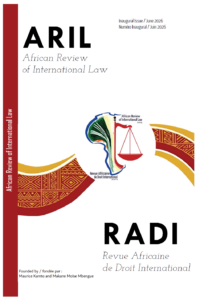
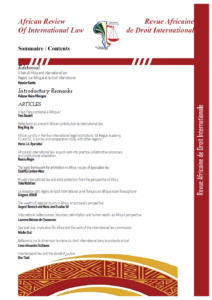
Many thanks to Boris Awa (Kigali Independent University ULK, Kigali, Rwanda) for the tip-off
The birth of a new academic journal is always good news, especially when its stated aim is “to become one of the leading scientific publications on international law” and when it is “primarily intended as a forum for African international lawyers’ reflection and research on issues of interest to Africa.” This is precisely the ambition pursued by the newly launched African Review of International Law (ARIL) / Revue africaine de droit international (RADI), published by the African Society of International Law (AfSIL).