Views
Cross-Border Personal Data Transfers: The Remaining Issues Following the Indonesian Constitutional Court Decision
Written by Dr Priskila Pratita Penasthika, Assistant Professor, Faculty of Law, Universitas Indonesia
INTRODUCTION
The Indonesian Personal Data Protection Law, Law Number 27 of 2022 (Indonesian PDP Law), came into effect on 17 October 2022. Before its enactment, data protection rules in Indonesia were fragmented across different sector-specific laws and regulations. The Indonesian PDP Law aims to unify these laws and regulations, providing greater clarity and ensuring consistent personal data protection across all sectors in the country. The Indonesian PDP Law sets out normative provisions on personal data protection; however, detailed, practical rules have yet to be specified in the implementing regulations. As of now, the drafting of these implementing regulations is still underway. Read more
HUK-COBURG II: A Case on Mandatory Overriding Law or Jurisdiction?
By Ross Pey, Western University, Canada
1. Introduction
In Case C-86/23 E.N.I. and Y.K.I. v HUK-COBURG-Allgemeine Versicherung AG II (‘HUK-COBURG II’), the principal issue that arose was whether a Bulgarian compensation provision may be interpreted as having mandatory effect. In suggesting that it does not, the Court required the facts to have sufficiently close links with the forum. (Hereinafter the ‘sufficient connexion test’) Ostensibly, a freestanding sufficient connexion test could be viewed as a disguised jurisdictional control of the forum rather than part of a mandatory law analysis. In doing so, parallels to renvoi and forum non conveniens are drawn. Read more
Book Review: L. d’Avout’s La Cohérence Mondiale Du Droit (Brill)
 The general course in private international law delivered at the Hague Academy of International Law by Louis d’Avout during the 2022 Summer Session was published in the Academy’s Pocket Books Series (1 032 pages). Louis d’Avout is Professor at Université Paris Panthéon-Assas. In addition to his numerous scholarly works, readers of this blog may recall that his special course on “L’entreprise et les conflits internationaux de lois” was also published in the Academy’s Pocket Books Series in 2019. The general course is title « La cohérence mondiale du droit » (“The Global Coherence of Law”). The publication of a general course in private international law—particularly in the Academy’s Pocket Books Series—deserves the attention of the readers of this blog. The aim of this review is, modestly, to offer a glimpse into this important work so readers who are sufficiently francophone may be encouraged to read it directly, while those who are not are offered a brief overview of the author’s approach. Read more
News
Reminder: Deadline for submitting proposals to the JPIL Conference in Zurich (30 June 2026)
As announced previously, the next Journal of Private International Law Conference will take place in Zurich on 1–3 April 2027. With the deadline for submitting proposals for papers to present at the conference, 30 June 2026, approaching fast, the organizers would like to remind everyone of the opportunity to submit a proposal. The same deadline also applies for the travel grants offered by the University of Zurich.
More information can be found on the conference website.
Crossing Dialogues, Disciplines and Borders: How far can Private International Law go? (Call for papers)
International Symposium | 9–10 October 2026 | Faculty of Law, University of Coimbra (Portugal)

The University of Coimbra Institute for Legal Research (UCILeR), in collaboration with the Associação de Estudos Europeus de Coimbra (AEEC – Coimbra Association of European Studies), is organizing the International Symposium “Crossing Dialogues, Disciplines and Borders: How far can Private International Law go?”, to be held on 9 and 10 October 2026 at the Colégio da Trindade, Coimbra, Portugal.
Organised by Dulce Lopes and Afonso Patrão , the event brings together leading scholars, early-career researchers, and practitioners to debate the evolving role and limits of Private International Law (PIL) in novel situations that increasingly challenge its traditional scope.
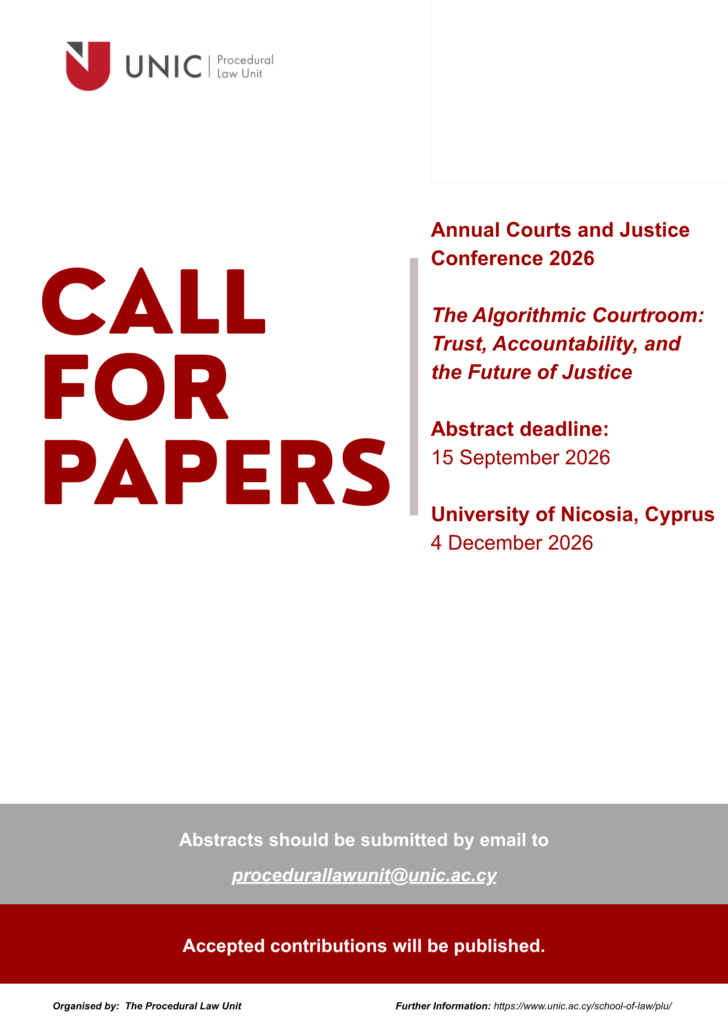
Call for Papers: Annual Courts and Justice Conference 2026 (4 Dec 2026, University of Nicosia)
This Call for Papers was shared with us by Procedural Law Unit of the University of Nicosia, Cyprus.