


Views
How European is European Private International Law? – Impressions from Berlin
Written by Tobias Lutzi, DPhil Candidate and Stipendiary Lecturer at the University of Oxford
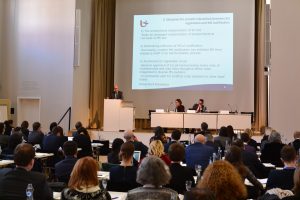 Last weekend, more than a hundred scholars of private international law followed the invitation of Jürgen Basedow, Jan von Hein, Eva-Maria Kieninger, and Giesela Rühl to discuss the ‘Europeanness’ of European private international law. Despite the adverse weather conditions, only a small number of participants from the UK – whose presence was missed all the more dearly – were unable to make it to Berlin. Thus, the Goethe-Saal of the Max Planck Society’s Harnack House was packed, and so was the conference programme, which spanned over two full days. Read more
This one is next: the Netherlands Commercial Court!
By Georgia Antonopoulou, Erlis Themeli, and Xandra Kramer, Erasmus University Rotterdam (PhD candidate, postdoc researcher and PI ERC project Building EU Civil Justice)
Following up on our previous post, asking which international commercial court would be established next, the adoption of the proposal for the Netherlands Commercial Court by the House of Representatives (Tweede Kamer) today answers the question. It will still have to pass the Senate (Eerste Kamer), but this should only be a matter of time. The Netherlands Commercial Court (NCC) is expected to open its doors on 1 July 2018 or shortly after. Read more
A European Law Reading of Achmea
Written by Prof. Burkhard Hess, Max Planck Institute Luxembourg.
An interesting perspective concerning the Achmea judgment of the ECJ[1] relates to the way how the Court addresses investment arbitration from the perspective of European Union law. This paper takes up the judgment from this perspective. There is no doubt that Achmea will disappoint many in the arbitration world who might read it paragraph by paragraph while looking for a comprehensive line of arguments. Obviously, some paragraphs of the judgment are short (maybe because they were shortened during the deliberations) and it is much more the outcome than the line of arguments that counts. However, as many judgments of the ECJ, it is important to read the decision in context. In this respect, there are several issues to be highlighted here: Read more
News
PhD Studentship in Private International Law at University College London
Written by Ugljesa Grusic, Associate Professor at University College London, Faculty of Laws
Dr Ugljesa Grusic and Prof Alex Mills are pleased to announce that, alongside the UCL Faculty of Laws Research Scholarships which are open to all research areas, this year we have an additional scholarship specifically for doctoral research in private international law. The scholarship covers the cost of tuition fees (home status fees) and provides a maintenance stipend per annum for full time study at the standard UKRI rate. The annual stipend for 2023/24 (as a guide) was £20,622. The recipient of the scholarship will be expected to contribute to teaching private international law in the Faculty for up to 6 hours per week on average, and this work is remunerated in addition to the stipend received for the scholarship.
Out Now: Programme of the Hague Academy of International Law’s Summer Courses 2024
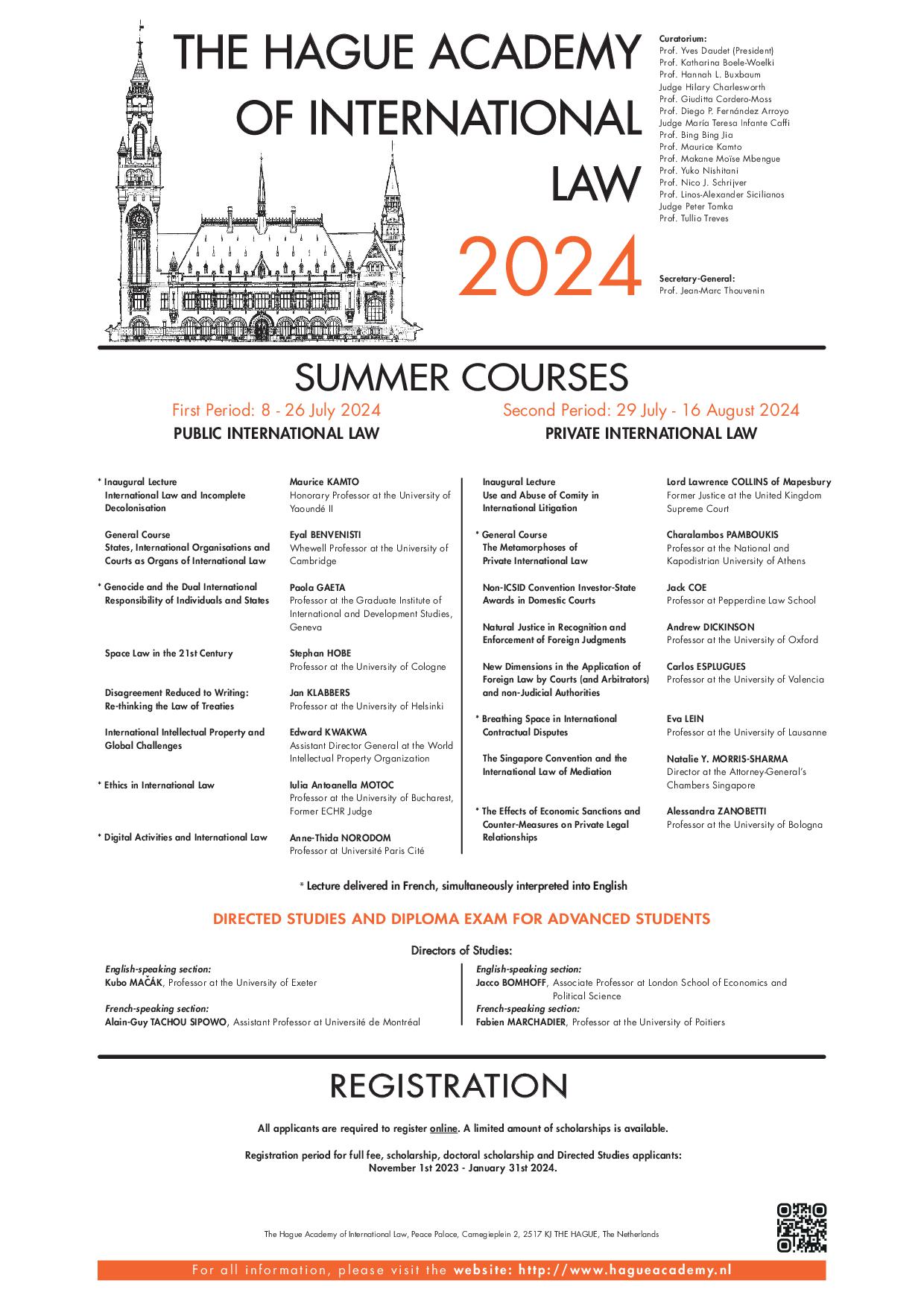 Recently, the Hague Academy of International Law published the 2024 programme of its renowned Summer Courses in Public International Law (8-26 July) and Private International Law (29 July – 16 August).
Asian Private International Law Academy Conference 2023 on 9 and 10 December
The Asian Private International Law Academy (APILA) will be holding its second conference at Doshisha University, Kyoto, on 9 and 10 December 2023. The keynote addresses will be delivered by Professor Emerita Linda Silberman on 9 December and Professor Gerald Goldstein on 10 December. The first day of the conference will comprise presentation and discussion of works-in-progress. The conference will devote most of 10 December to discussion and finalisation of the Asian Principles on Private International Law (APPIL) on three topics: (1) recognition and enforcement of foreign judgments, (2) direct jurisdiction, and (3) general choice of law rules. Persons interested in attending or wishing further information should email reyes.anselmo@gmail.com to that effect. Please note that, while APILA can assist attendees by issuing letters of invitations in support of Japanese visa applications, APILA’s available funding is limited. In the normal course of events, APILA regrets that it will not be able to provide funding for travel and accommodation expenses.