


Views
Draft Withdrawal Agreement 19 March 2018: Still a Way to Go
Today, the European Union and the United Kingdom have reached an agreement on the transition period for Brexit: from March 29 of next year, date of disconnection, until December 31, 2020. The news are of course available in the press, and the Draft Withdrawal Agreement of 19 March 2018 has already been published… coloured: In green, the text is agreed at negotiators’ level and will only be subject to technical legal revisions in the coming weeks. In yellow, the text is agreed on the policy objective but drafting changes or clarifications are still required. In white, the text corresponds to text proposed by the Union on which discussions are ongoing as no agreement has yet been found. For ongoing judicial cooperation in civil and commercial matters (Title VI of Part III, to be applied from December 31, 2020: see Art. 168), this actually means that subject to “technical legal revisions”, the following has been accepted:
- Art. 62: The EU and the UK are in accordance as to the application by the latter (no need to mention the MS for obvious reasons) of the Rome I and Rome II regulations to contracts concluded before the end of the transition period, and in respect of events giving rise to damage, and which occurred before the end of the transition period.
- Art. 64: There is also agreement as to the handling of ongoing cooperation procedures, whereby requests for service abroad, the taking of evidence and in the frame of the European Judicial Network are meant.
- Art. 65: There is agreement as well as to the way Council Directive 2003/8/EC (legal aid), Directive 2008/52/EC on certain aspects of mediation in civil and commercial matter, and Council Directive 2004/80/EC (relating to compensation to crime victims) will apply after the transition period.
Conversely, no agreement has been found regarding Art. 63, i.e., how to deal with jurisdiction, recognition and enforcement of judicial decisions, and related cooperation between central authorities (but whatever is agreed will also be valid in respect of the provisions of Regulation (EU) No 1215/2012 as applicable by virtue of the agreement between the European Community and the Kingdom of Denmark, see Art. 65.2, in green).
In the light of this it may be not really worth to start the analysis of the Title as a whole: Art. 63 happens to be the less clear provision. Some puzzling expressions such as “as well as in the Member States in situations involving the United Kingdom” are common to approved texts, but may change in the course of the technical legal revision. So, let’s wait and see.
NoA: Another relevant provision agreed upon – in green- is Art. 124, Specific arrangements relating to the Union’s external action. Title X of Part III, on pending cases and new cases before the CJEU, remains in white.
And: On the Draft of February 28, 2018 see P. Franzina’s entry here. The Draft was transmitted to the Council (Article 50) and the Brexit Steering Group of the European Parliament; the resulting text was sent to the UK and made public on March 15.
Religious Conversion and Custody – Important New Decision by the Malaysian Federal Court
A saga that has kept Malaysians engaged for years has finally founds its conclusion. A woman, named (rather improbably, at least for European observers) Indira Gandhi, was fighting with her ex husband over custody. The ex-husband had converted to Islam and had extended the conversion to their three children, with the consequence that the Syariah courts gave him sole custody. What followed was a whole series of court decisions by civil courts on the one hand and Syariah courts on the other, focusing mainly on the jurisdictional question which set of courts gets to decide matters of religious status and which law—Islamic law or civil law—determines the question. The Malaysian Federal Court now quashed the conversion as regards the children, thereby claiming, at least for children, a priority of the Constitution and the jurisdiction of civil courts.
Although the case is mostly discussed in the context of religious freedom and (civil) judicial review, it also raises core issues of conflict of laws. Malaysia is a country with an interpersonal legal system, which leaves jurisdiction over certain matters of Islamic law to the Syariah courts. Indira Gandhi’s ex-husband here used this system, effectively, for a form of forum shopping: converting to Islam enabled him, ostentatiously, to opt into a system more favorable to his own situation. The background, from the perspective of conflict of laws, is that the decisive connecting factor, namely a person’s religion, is open to manipulation in a way in which other connecting factors are not. According to Article 121 of the Federal Constitution, the civil courts have no jurisdiction over matters of the Syariah Courts. On the other hand, Art. 12(4) of the Constitution provides that a minor’s religion is determined by his parent or guardian, a provision the Syariah Courts neglected here. Letting the Constitution trump leads to a desirable result in this case, but it does not, by itself, resolve the underlying conflict-of-laws issues. Here, as in comparable situations, the doctrinal problem appears to lie first in the issue of unilateral determination of personal status and second in a conflation of issues of jurisdiction and applicable law.
The case is Indira Gandhi v. Pengarah Jabatan Agama Islam Perak u.a., [2018] 1 LNS 86 (Federal Court of Malaysia); it is available here. A short summary is here, another one, including a useful timeline of events, is here. For a very helpful analysis of the case and its background and implications by Jaclyn L. Neo, focusing especially on questions of jurisdiction and judicial review, see here. A longer discussion by Dian A.H. Shah focuses also on two other cases and more broadly on the issues of religious freedom: Dian A.H. Shah, Religion, conversions, and custody: battles in the Malaysian appellate courts, in Law and Society in Malaysia: Pluralism, Religion and Ethnicity (Andrew Harding/Dian A.H. Shah eds., 2018). The affair is also discussed in Yvonne Tew‘s article ‘Stealth Theocracy,’ which is forthcoming with the Virginia Journal of International Law.
Mutual trust and judicial cooperation in the EU’s external relations – the blind spot in the EU’s Foreign Trade and Private International Law policy?
Further to the splendid conference How European is European Private International Law? at Berlin on 2 and 3 March 2018, I would like to add some thoughts on an issue that was briefly raised by our fellow editor Pietro Franzina in his truly excellent conference presentation on “The relationship between EU and international Private International Law instruments”. Pietro rightly observed an “increased activity on the external side”, meaning primarily the EU’s PIL activities on the level of the Hague Conference.
At the same time, there seems to be still a blind spot for the EU’s Private International Law policy when it comes to the design of the EU’s Free Trade Agreements (FTAs). Although there is an increasingly large number of such agreements and although “trade is no longer just about trade” (DG Trade) but additionally about exchange or even export of values such as “sustainability”, human rights, labour and environmental standards and the rule of law, there seems to be no policy by DG Trade to include in its many FTAs a Chapter on judicial cooperation with the EU’s respective external trade partners.
To my knowledge there are only the following recent exceptions: The Association Agreements with Georgia and Moldova. Both Agreements entered into force on 1 July 2016.
Article 21 (Georgia) and Article 20 (Moldova) provide:
“Legal cooperation: 1. The Parties agree to develop judicial cooperation in civil and commercial matters as regards the negotiation, ratification and implementation of multilateral conventions on civil judicial cooperation and, in particular, the conventions of the Hague Conference on Private International Law in the field of international legal cooperation and litigation as well as the protection of children.”
Article 24 of the Association Agreement of 29 May 2014 with the Ukraine reads slightly differently:
“Legal cooperation: 1. The Parties agree to further develop judicial cooperation in civil and criminal matters, making full use of the relevant international and bilateral instruments and based on the principles of legal certainty and the right to a fair trial.2. The Parties agree to facilitate further EU-Ukraine judicial cooperation in civil matters on the basis of the applicable multilateral legal instruments, especially the Conventions of the Hague Conference on Private International Law in the field of international Legal Cooperation and Litigation as well as the Protection of Children.”
All other FTAs, even those currently under (re-) negotiation, do not take into account the need for the management of trust in the judicial cooperation of the trade partners in their deepened and integrated trade relations. Rather, foreign trade law and PIL seem to have remained separate worlds, although the business transactions that are to take place and increase within these trade relations obviously rely heavily on both areas of the law.
Some thoughts on why there is no integrated approach to foreign trade and PIL in the EU, why this is a deficiency that should be taken care of and how this could possibly be done are offered here.
News
New issue alert: RabelsZ 87 (2023), Issue 3
 The latest issue of RabelsZ has just been released. It contans the following articles:
Horatia Muir Watt: Alterity in the Conflict of Laws. An Ontology of the In-Between
[18th Ernst Rabel Lecture, 2022] [OPEN ACCESS], 433–464, DOI: 10.1628/rabelsz-2023-0063
New Book Releases: “Private International Law and Competition Litigation in a Global Context” & “Third Party Funding in International Arbitration”
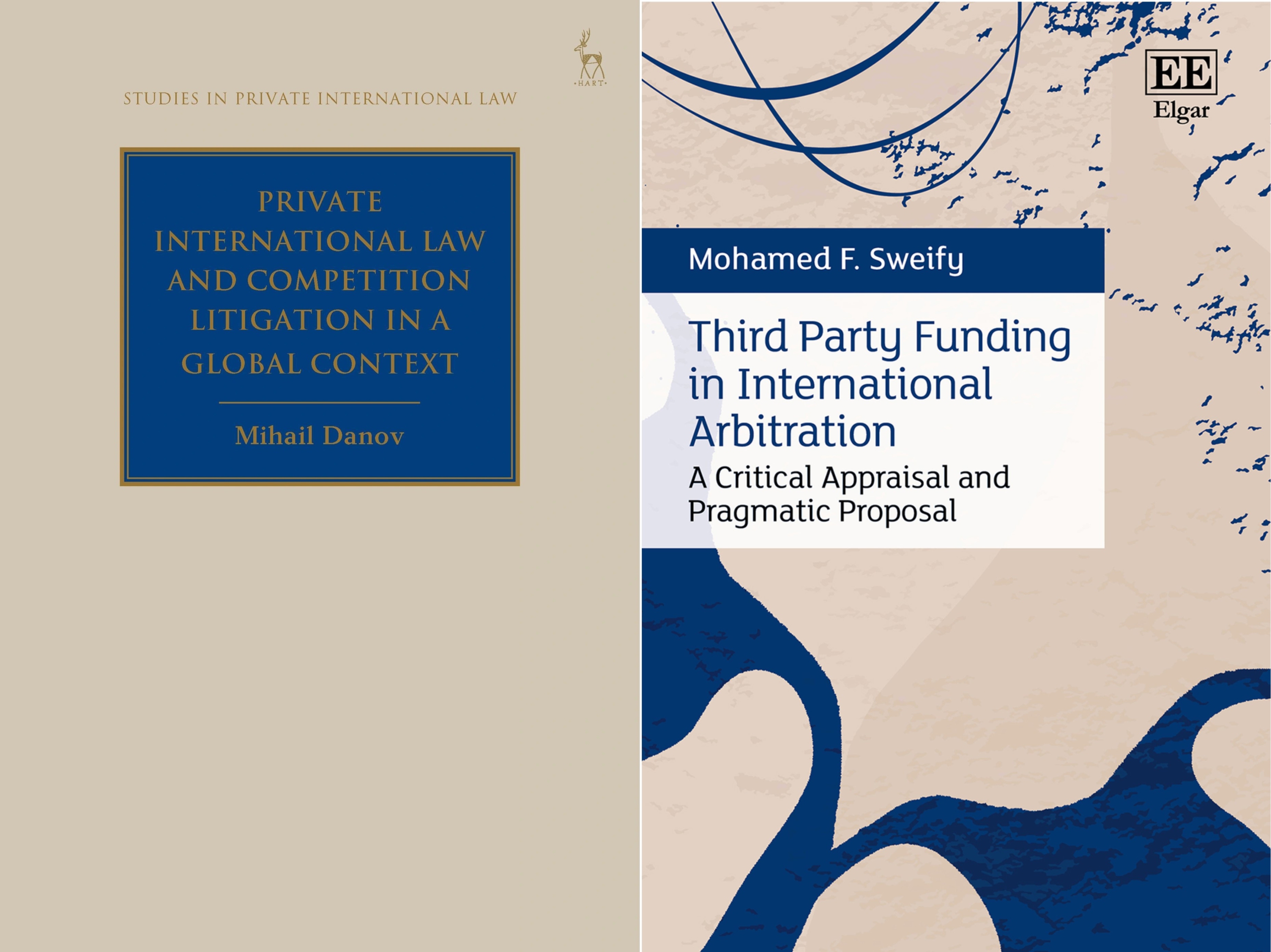
Two books on international litigation and arbitration have recently been published that might be of interest to the CoL Community and PIL research.
The first book by Mihail Danov (University of Exeter) is the latest contribution to Hart’s renowned “Studies in Private International Law” series (Volume 37) and examines the challenging interaction of “Private International Law and Competition Litigation in a Global Context“. The blurb reads as follows:
Journal du Droit International Clunet – issue 2023/3
The third issue of the Journal du Droit international-Clunet of 2023 was released in July. It contains three articles and many case notes.
The first article Regard québécois sur le projet de Code de droit international priv é français (A view from Quebec on the project of a french private international law Code) is authored by Prof. Sylvette Guillemard (Université Laval). The abstract reads as follows: