


Views
Who can bite the Apple? The CJEU can shape the future of online damages and collective actions
Written by Eduardo Silva de Freitas (Erasmus University Rotterdam), member of the Vici project Affordable Access to Justice, financed by the Dutch Research Council (NWO), www.euciviljustice.eu.
Introduction
In the final weeks leading up to Christmas in 2023, the District Court of Amsterdam referred a set of questions to the CJEU (DC Amsterdam, 20 December 2023, ECLI:NL:RBAMS:2023:8330; in Dutch). These questions, if comprehensively addressed, have the potential to bring clarity to longstanding debates regarding jurisdictional conflicts in collective actions. Despite being rooted in competition law with its unique intricacies, the issues surrounding the determination of online damage locations hold the promise of illuminating pertinent questions. Moreover, the forthcoming judgment is expected to provide insights into the centralization of jurisdiction in collective actions within a specific Member State, an aspect currently unclear. Recalling our previous discussion on the Dutch class action under the WAMCA in this blog, it is crucial to emphasize that, under the WAMCA, only one representative action can be allowed to proceed for the same event. In instances where multiple representative foundations seek to bring proceedings for the same event without reaching a settlement up to a certain point during the proceedings, the court will appoint an exclusive representative. This procedural detail adds an additional layer of complexity to the dynamics of collective actions under the WAMCA.
One, Two, Three… Fault? CJEU Rules on Civil Liability Requirements under the GDPR
Marco Buzzoni, Doctoral Researcher at the Luxembourg Centre for European Law (LCEL) and PhD candidate at the Sorbonne Law School, offers a critical analysis of some recent rulings by the Court of Justice of the European Union in matters of data protection.
In a series of three preliminary rulings issued on 14th December and 21st December 2023, the Court of Justice of the European Union (‘CJEU’) was called upon again to rule on the interpretation of Article 82 of the General Data Protection Regulation (‘GDPR’). While these rulings provide some welcome clarifications regarding the civil liability of data controllers, their slightly inconsistent reasoning will most likely raise difficulties in future cases, especially those involving cross-border processing of personal data.
Colonialism and German PIL (4) – Exploiting Asymmetries Between Global North and South
This post is part of a series regarding Colonialism and the general structure of (German) Private International Law, based on a presentation I gave in spring 2023. See the introduction here.
As mentioned in the introduction, this series does not intent to automatically pass judgment on a norm or method influenced by colonialism as inherently negative. Instead, the aim is to reveal these influences and to initiate a first engagement with and awareness of this topic and to stimulate a discussion and reflection.
The first post (after the introduction) dealt with classic PIL and colonialism. This second considered structures and values inherent in German or European law, implicitly resonating within the PIL and, thus, expanding those values to people and cases from other parts of the world. The third category discusses an imagined hierarchy between the Global North and Global South that is sometimes inherent in private international law thinking. The fourth and for the moment last (but not least) category deals with PIL rules that allow or at least contribute to the exploitation of a power asymmetry between parties from the Global North and the Global South. For example, this power and negotiation asymmetry, in conjunction with generous rules on party autonomy, can lead to arbitration and choice of law clauses being (ab)used to effectively undermine rights of land use under traditional tribal law.
After the first post, in the comment section a discussion evolved regarding the (non-)application of tribal law. One question asked for an example. This post can also (hopefully) serve as such an example.
News
Revue Critique de droit international privé – issue 2025/1
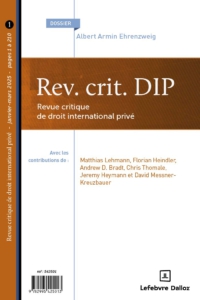 Written by Hadrien Pauchard (assistant researcher and doctoral student at Sciences Po Law School)
The first issue of the Revue Critique de droit international privé of 2025 has just been released. It gathers six contributions honouring Albert Armin Ehrenzweig and his legacy, as well as seven case notes and numerous book reviews.
The doctrinal part of the volume is devoted to the proceedings of the Albert Armin Ehrenzweig Conference organized in June 2024 at the University of Vienna, fifty years after the passing away of the great author. The contributions commemorate both the man and the scientist, testifying to the relevance of Albert A. Ehrenzweig’s scholarship to contemporary private international law. They are published in French in the printed version of the Revue (also available online here), and will be available shortly in English (here).
Out Now: Dickinson, Natural Justice in Recognition and Enforcement of Foreign Judgments, Recueil des cours, Tome 446
Last summer, Andrew Dickinson (Professor of the Conflict of Laws, University of Oxford, and former editor of ConflictofLaws.net) delivered a special course at the summer course of the Hague Academy of International Law entitled ‘Natural Justice in Recognition and Enforcement of Foreign Judgments’. It has now been published as Volume 446 of the Recueil des cours / Collected Courses.
The blurb reads as follows:
This special course assesses the utility of ideas of ‘natural law’ and ‘natural justice’ as tools to explain, rationalise and develop the rules governing the recognition and enforcement of foreign judgments currently applied by the world’s legal orders.
After introducing the topic, the first part of the course consider how influential 17th and 18th century accounts of the law of nature sought to account for the relations existing between all human beings, as well as the creation of political societies with law-making powers, the global ordering of those societies and the role of adjudication as a means of resolving disputes within and among them. This provides the historical and intellectual background for what follows.
The principal part of the course considers how writers on the conflict of laws in this period drew upon and utilised these ideas, as the rules that we apply today to regulate foreign judgments began to take shape. This leads to a study of the further evolution of the legal landscape in the 19th century, highlighting the use of natural law reasoning by judges and commentators to explain and justify the effectiveness of individual exercises of adjudicatory authority beyond their original domains, as well as the later rejection of natural law thinking in favour of models centred on ideas of sovereignty and territoriality, which continue to dominate today.
Having completed this historical survey, the course examines the specific legacy of natural law reasoning in the common law world, involving the use of principles of ‘natural justice’ to deny recognition of unjust foreign judgments, as well as the counterparts of these principles in other legal systems and international treaties.
Drawing on the preceding material, the concluding chapter considers the case for renaturalising the law in this area, and the implications of following this path.
More information on the book can be found here.
It is available to subscribers to the Recueil des cours here.
AMEDIP: Annual seminar to take place from 22 to 24 October 2025 (in Spanish)

The Mexican Academy of Private International and Comparative Law (AMEDIP) will be holding its XLVIII Seminar entitled “Reflections regarding the Inter-American system in the 50th Anniversary of the CIDIP-I and the latest developments of Private International Law in Mexico” (Reflexiones en torno al sistema interamericano en el 50 Aniversario de la CIDIP-I y la actualidad del Derecho Internacional Privado en México) from 22 to 24 October 2025. The venue of the seminar will be the Universidad Autónoma de Querétaro (Querétaro, Mexico). Read more