


Views
Court-to-court referrals and reciprocity between Chinese and Singapore courts
By Catherine Shen, Asian Business Law Institute
In 2023 Su 05 Xie Wai Ren No. 8 dated March 14, 2025, the Suzhou Intermediate People’s Court of Jiangsu Province in China (Suzhou Court) recognized and enforced civil judgment HC/S194/2022 under file number HC/JUD47/2023 by the Supreme Court of Singapore (Singapore Judgment). The judgment by the Suzhou Court (Suzhou Judgment) was announced in September 2025 by the Supreme People’s Court of China (SPC) as among the fifth batch of Belt and Road Initiative (BRI) model cases. Read more

CJEU, Case C-540/24, Cabris Investment: Jurisdiction Clause in Favour of EU Court is Subject to Art. 25 Brussels Ia even if both Parties are Domiciled in the Same Third State
By Salih Okur, University of Augsburg
On 9 October 2025, the CJEU, in Case C-540/24 (Cabris Investment), had to decide whether Art. 25 Brussels Ia applies to “an agreement conferring jurisdiction in which the contracting parties, who are domiciled in the United Kingdom and therefore (now) in a third State, agree that the courts of a Member State of the European Union are to have jurisdiction over disputes arising under that contract, falls within the scope of that provision, even if the underlying contract has no further connection with that Member State chosen as the place of jurisdiction.“
Unsurprisingly, the Court held that it does.
Pre-print article on SSRN on “Mirin” and the Future of Cross-Border Gender Recognition
I recently published the pre-print version of an article on SSRN that was accepted by the International Journal of Law, Policy and the Family. The article is called ““Mirin” and Beyond: Gender Identity and Private International Law in the EU“. The article is part of a special issue dealing with questions of gender identity that (probably) will come out at the beginning of 2026.
As it deals with matters of private international law (regarding gender identity) and the CJEU decision “Mirin”, I thought it might be interesting for the readers of this blog to get a short summary of the article. If it sparks your interest, of course, I would be glad if you consider reading the whole text – and to receive feedback and further thoughts on this topic. 🙂
News
HCCH Monthly Update: April 2026
Meetings & Events
From 30 March to 1 April, the Experts’ Group (EG) on Central Bank Digital Currencies (CBDCs) held its fifth meeting. Pursuant to its mandate, the EG continued to make progress in its study of the jurisdiction and applicable law issues raised by the cross-border use and transfers of CBDCs, including the desirability and feasibility of a possible future instrument on these issues, with particular attention to their use in payments with a cross-border or international element. More information is available here.
Consensual Justice in Focus: Reflections from the First ASGiC National Congress
 On 16–17 April 2026, the elegant setting of Villa Ruspoli in Florence hosted the First National Congress of ASGiC – the Society for the Study of Consensual Justice, titled Giustizia e cooperazione: il valore del consenso (Justice and Cooperation: The Value of Consent). Marked by a large and engaged participation, the event offered a valuable opportunity for both the Society’s members and a wider community of scholars and practitioners to reflect on the role of consent in contemporary conceptions of justice.
The Congress opened with introductory remarks by the Society’s President, Silvana Dalla Bontà, who set out the themes and objectives guiding the initiative. Against this backdrop, the keynote lectures delivered by Tommaso Greco, Andrea Simoncini, and Filippo Danovi developed a first, coherent reflection on consensual justice, identifying a variety of core concepts – trust, consent, justice, solidarity, Constitution, language, and dialogue – that are likely to orient the Society’s future research and activities.
Out now: Multinationals and Human Rights in Asia
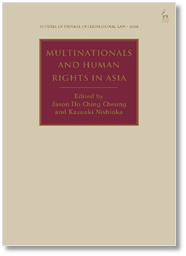
Multinationals and Human Rights in Asia
Edited by Jason Ho Ching Cheung and Kazuaki Nishioka
This book investigates the availability in Asian jurisdictions of civil remedies against multinational businesses for human rights abuses.
It assesses whether the norms of the 2011 UN Guiding Principles on Business and Human Rights have taken root in Asia by first considering the international state of play. It then presents case studies of corporate governance and human rights in Asia, before examining emerging issues, and considering how Asia has dealt and can deal with corporate responsibility in connection with those matters. By way of conclusion, the book offers an action plan for implementing the UN Guiding Principles in Asia.