


Views
Draft General Law on Private International Law aims to bring Brazil from the 19th into the 21st century
Guest post by Gustavo Ferraz de Campos Monaco, Full Professor of Private Internacional Law – University of São Paulo
In Brazilian law, the regulation of conflicts of laws is still based on a legislation from 1942, during a dictatorial regime, which explains its inspiration from the Italian fascist regime. The values prevailing in Brazilian society back then were quite different from those we hold today, especially in matters concerning family relationships. At that time, the family unit was viewed as having a single domicile, and questions related to the definition of parenthood were unthinkable outside traditional presumptions.
On at least two occasions over the past 83 years, attempts to draft new regulations were undertaken by leading figures in the field – Haroldo Valladão, Jacob Dolinger, and João Grandino Rodas – but both initiatives failed during the process, without the Plenary of the Legislative Houses having expressed an opinion on the merits of the projects. Read more
Brazilian Supreme Court on the Hague Child Abduction Convention
Guest post by Janaína Albuquerque, International Family Lawyer; Research Associate at the NOVA Centre for the Study of Gender, Family and the Law; Legal Coordinator at Revibra Europa. Janaína represented Revibra, Instituto Maria da Penha and Instituto Superação da Violência Doméstica as amici curiae in the cases discussed below.
The Brazilian Supreme Court has recently delivered a landmark judgment in two Direct Actions of Unconstitutionality (Ações Diretas de Inconstitucionalidade, or ADIs), namely ADI 4245 and ADI 7686, concerning the application of the 1980 Hague Convention on the Civil Aspects of International Child Abduction(1980HC). Despite their denomination, these actions did not aim to invalidate the Convention, but rather to harmonize its interpretation with the principles enshrined in the Brazilian Federal Constitution.[1] Read more
EU modernises consumer dispute resolution: An overview of the new ADR Directive
By Alexia Kaztaridou (Linklaters)
On 25 September 2025, the Internal Market and Consumer Protection Committee (IMCO) of the European Parliament approved the text of the political agreement on the Alternative Disputes Resolution for Consumer Disputes Directive. This Directive establishes a framework for resolving through ADR procedures contractual domestic and cross-border consumer disputes arising from the sale of goods or provision of services between consumers and traders within an EU context. The amendments to the prior Directive aim to modernise the existing framework in light of new consumer trends, such as the growth of e-commerce, and bring significant changes across several areas, enhancing the protection for consumers and clarifying obligations for traders and ADR entities. The Directive maintains its minimum harmonisation approach, allowing Member States to provide for stronger consumer protection. Read more
News
Bonn (Germany), 24/25 September 2026, Conference International Filiation Law in the EU
As already announced, there will be an international conference “International Filiation Law in the EU” dealing with questions of filiation law resulting from the EU Parenthood Proposal.
AMEDIP’s upcoming webinar: The HCCH Work Agenda in 2026. Opportunities and Challenges for AMEDIP presented by Ignacio Goicoechea (30 April 2026 – in Spanish)
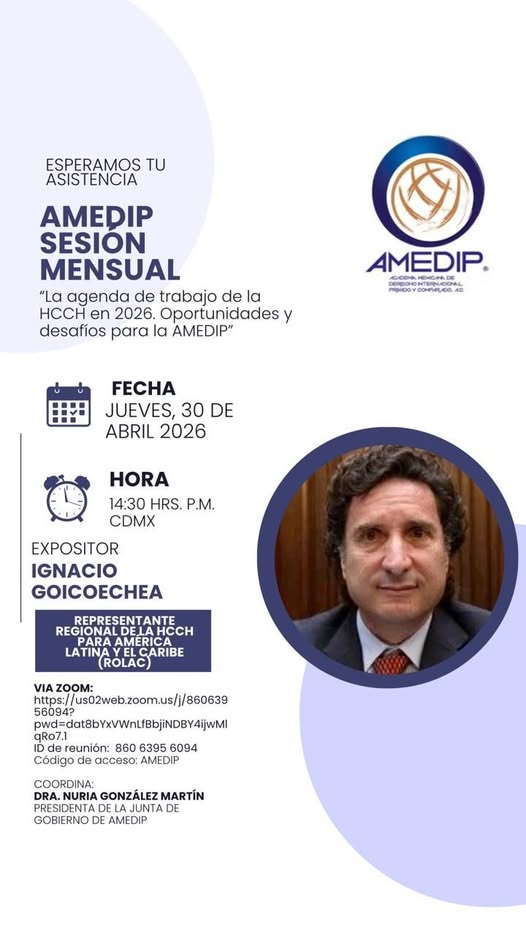
The Mexican Academy of Private International and Comparative Law (AMEDIP) is holding a webinar on Thursday 30 April 2026 at 14:30 (Mexico City time – CST), 22:30 (CEST time). The topic of the webinar is: The HCCH Work Agenda in 2026. Opportunities and Challenges for AMEDIP, which will be presented by Ignacio Goicoechea, Representative of the HCCH Regional Office for Latin America and the Caribbean (ROLAC) (in Spanish). Read more
Launch ECJC ‘Civil Justice Conversations’ – Online Research Seminar Series
Contributed by Adriani Dori
Online Research Seminar Series: Call for expressions of interest
Submission Deadline: Rolling base
Open to: Scholars, practitioners, and early-career researchers
Contact details: ecjc@law.eur.nl
Following the publication of the handbook European Civil Procedure (De Gruyter 2026), the European Civil Justice Centre (ECJC) is pleased to announce a new initiative.
ECJC ‘Civil Justice Conversations’
The ECJC ‘Civil Justice Conversations’ is a new series of online research seminars designed to foster scholarly exchange and collaboration in the field of European civil justice.