


Views
UKSC on Traditional Rules of Jurisdiction: Brownlie v Four Seasons Holdings Incorporated
Shortly before Christmas the UKSC released its decision on jurisdiction in Brownlie v Four Seasons Holdings Incorporated (available here). Almost all the legal analysis is obiter dicta because, on the facts, it emerges that no claim against the British Columbia-based holding corporation could succeed (para 15) and the appeal is allowed on that basis. I suppose there is a back story as to why it took a trip to the UKSC and an extraordinary step by that court (para 14) for the defendant to make those facts clear, but I don’t know what it is. On the facts there are other potential defendants to the plaintiffs’ claim and time will tell whether jurisdictional issues arise for them.
The discussion of the value of the place of making a contract for jurisdiction purposes is noteworthy. In para 16 two of the judges (Sumption, Hughes) are critical of using the traditional common law rules on where a contract is made for purposes of taking jurisdiction. This has been the subject of debate in some recent Canadian decisions, notably the difference in approach between the Court of Appeal for Ontario and the Supreme Court of Canada in Lapointe Rosenstein Marchand Melançon LLP v Cassels Brock & Blackwell LLP, 2016 SCC 30 (available here). The SCC was fine with using the traditional rules for this purpose. In Brownlie, I do not think it is clear as to what view the other three judges take on this point.
Even more interestingly, the UKSC judges split 3-2 on how to understand the idea of damage in the forum as a basis for jurisdiction. Three judges (Hale, Wilson, Clarke) retain the traditional broad common law view – the position in many Canadian provinces prior to Club Resorts Ltd v Van Breda, 2012 SCC 17 (available here) – that ongoing suffering in the forum in respect of a tort that happened abroad is sufficient. Two judges (Sumption, Hughes) reject that approach and adopt a more narrow meaning of damage in the forum (it must be direct damage only).
This 3-2 split is closer even than it might first seem, since Lord Wilson (para 57) suggests that in a different case with fuller argument on the point the court might reach a different result.
Canadian law does not get a fair description in the UKSC decision. The court notes twice (para 21 and para 67) that Canada’s common law uses a broad meaning of damage for taking jurisdiction. Club Resorts, and the change to the law it represents on this very issue, is not mentioned. This is yet another illustration of the importance of being careful when engaging in comparative law analysis.
Conflicts – Between Domestic and Indigenous Legal Systems?
In Beaver v Hill, 2017 ONSC 7245 (available here) the applicant sought custody, spousal support and child support. All relevant facts happened in Ontario. Read more
NIKI continued (now in Austria)
Written by Lukas Schmidt, Research Fellow at the Center for Transnational Commercial Dispute Resolution (TCDR) of the EBS Law School, Wiesbaden, Germany
The Regional Court Korneuburg has opened a main insolvency proceeding – not a secondary insolvency proceeding that the German provisional administrator has applied for – on the assets of NIKI Luftfahrt GmbH in Austria (see here). Therefore, it obviously shares the view of the Regional Court of Berlin that NIKI’s COMI is located in Austria and not Germany. Read more
News
The 2023 NGPIL Lecture Series
Originally posted today on the NGPIL website.
On the 23rd November 2023, 5pm (WAT/Lagos/Abuja) the NGPIL will host our guest speaker Professor Wale Olawoyin SAN, FCIArb at this year’s conference. The event will explore the coming into force of the Arbitration and Conciliation Act 2023 and how, from a private international law perspective, the arbitration appeal process in Nigeria can be enhanced. Discussions will build on practice thus far, and will allow practitioners, judges and academics alike to develop knowledge and insight into its utility.
To register: https://us06web.zoom.us/webinar/register/WN_q5pY1JWARiaUxi1TIw8xBQ

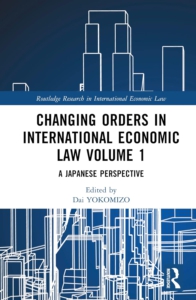
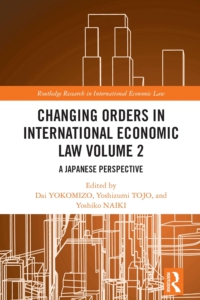
Out Now: Dai YOKOMIZO, Yoshizumi TOJO, Yoshiko NAIKI (eds.), Changing Orders in International Economic Law: A Japanese Perspective, Vol. 1 and Vol. 2, Routledge, 2023.
These two volumes celebrate the 30th anniversary of the Japan Association of International Economic Law (JAIEL), which was founded in 1991. The Volumes include 30 contributions written by eminent Japanese scholars from different background, in particular, private international law, public international law, international economic law, competition law, intellectual property law etc.
Seminar information: U.S Extraterritorial Jurisdiction– Myths and Reality
Professor William S. Dodge, John D. Ayer Chair in Business Law; Martin Luther King Jr. Professor of Law, University of California, Davis, School of Law, will give a seminar entitled ‘U.S. Extraterritorial Jurisdiction-Myths and Reality’ at the Wuhan University School of Law on 15 Oct. at 15:00-16:30pm Beijing Time. This seminar will be chaired by Professor Sophia Tang, the Associate Dean of the Wuhan University Academy of International Law and Global Governance. Associate Professor Wenliang Zhang at the Renmin University, Associate Professor Xiongbin Qiao, Associate Professor Yong Gan, and Associate Professor Wenwen Liang at the Wuhan University will act as discussants. You can attend the seminar online through Tencent Meeting. Please follow the information below:
Time?2023/10/15 15:00-17:00 (GMT+08:00) Beijing Time
Meeting link?
https://meeting.tencent.com/dm/KADluwLhfmfc
Tencent Meeting ID: 991-898-184
Password: 89456