Views
NIKI continued (now in Austria)
Written by Lukas Schmidt, Research Fellow at the Center for Transnational Commercial Dispute Resolution (TCDR) of the EBS Law School, Wiesbaden, Germany
The Regional Court Korneuburg has opened a main insolvency proceeding – not a secondary insolvency proceeding that the German provisional administrator has applied for – on the assets of NIKI Luftfahrt GmbH in Austria (see here). Therefore, it obviously shares the view of the Regional Court of Berlin that NIKI’s COMI is located in Austria and not Germany. Read more
US Court Refused to Apply the Chosen Chinese Law due to Public Policy Concern
In Fu v. Fu, 2017 IL App (1st) 162958-U, a father brought a claim against his son to revoke an unconditional gift of $590,000 that he donated to his son for the later to pursue an EB-5 Visa to immigrate to the US. Both parties are Chinese citizens and the defendant is currently a resident of Massachusetts. The gift agreement was entered into in China, drafted in Chinese and contained a clause specifying PRC law should apply. The money was held by the International Bank of Chicago. The plaintiff brought the action in Illinois.
Under the US Law (Title 8 of the Code of Federal Regulations, § 204.6) a foreign national must invest at least $500,000 in the US to be considered for an EB-5 Visa, and must ‘show that he has invested his own capital obtained through lawful means.’ (Matter of Ho, 22 I&N Dec. 206, 210 (AAO 1998)) After a few denied EB-5 approval, the plaintiff sought to recover the money, by claiming that the defendant was estranged from his parents, including the donor and refused to support them, and the purpose of the gift contract was for the defendant to obtain an EB-5 Visa but the defendant failed to do so.
Under the Illinois law, a valid gift requires ‘delivery of the property by the donor to the donee, with the intent to pass the title to the donee absolutely and irrevocably, and the donor must relinquish all present and future dominion and power over the subject matter of the gift.” (Pocius v. Fleck, 13 Ill. 2d 420, 427 (1958)). Furthermore, the gift agreement between the parties also used the language that the gift was ‘unconditional’. However, the plaintiff argued that under the PRC law, gifts may be revocable after the transfer of ownership, if the donee ‘has the obligation to support the donor but does not fulfil it’, or a donnee ‘does not fulfill the obligations as stipulated in the gift agreement.’ (PRC Contract Law, Art 192)
The Appellate Court of Illinois First Judicial District affirmed the judgment of the circuit court of Cook County that the gift agreement was irrevocable. The plaintiff failed to successfully prove Chinese law. And even if the plaintiff properly pled PRC law, such interpretation was ‘oppressive, immoral, and impolitic’. Under the US law on EB-5 Visa application, the foreign citizen must prove ownership of those funds to be eligible for an EB-5 Visa. The signed agreement stating the gift ‘unconditional’ would help the defendant to prove he legally owned the funds to acquire an EB-5 visa. If the governing PRC law indeed allows a gift to be given unconditionally and revoked after delivery and acceptance, as argued by the plaintiff, it would facilitate a deception on the US Government and is against public policy.
The full judgment can be found here.
NIKI continued
Written by Lukas Schmidt, Research Fellow at the Center for Transnational Commercial Dispute Resolution (TCDR) of the EBS Law School, Wiesbaden, Germany
The Spanish airline Vueling Airlines S.A. is still intending to acquire large parts of the NIKI business. Vueling is part of the European aviation group IAG, which also includes British Airways, Iberia, Aer Lingus and LEVEL. The provisional insolvency administrator of NIKI Luftfahrt GmbH, therefore, will continue to drive forward the sales process. Vueling has provided interim financing of up to € 16.5 million to finance the NIKI business until the closing of the purchase agreement. This funding is only sufficient for a few weeks. Read more
News
Call for Paper: Private International Law and Business Compliance in Asia Pacific
This national conference will be held on 21 February 2024 at The University of Sydney Law School in Australia.
Business compliance in international transactions across the Asia-Pacific region holds immense importance for organizations seeking to expand their activities within this dynamic and evolving landscape. Multinational corporations operating in Asia Pacific often confront unique compliance challenges due to the swiftly changing regulatory and geopolitical environment in the region.
The 2023 NGPIL Lecture Series
Originally posted today on the NGPIL website.
On the 23rd November 2023, 5pm (WAT/Lagos/Abuja) the NGPIL will host our guest speaker Professor Wale Olawoyin SAN, FCIArb at this year’s conference. The event will explore the coming into force of the Arbitration and Conciliation Act 2023 and how, from a private international law perspective, the arbitration appeal process in Nigeria can be enhanced. Discussions will build on practice thus far, and will allow practitioners, judges and academics alike to develop knowledge and insight into its utility.
To register: https://us06web.zoom.us/webinar/register/WN_q5pY1JWARiaUxi1TIw8xBQ

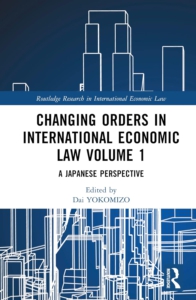
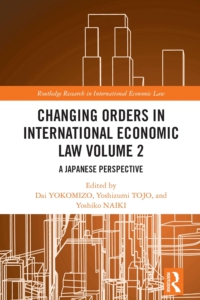
Out Now: Dai YOKOMIZO, Yoshizumi TOJO, Yoshiko NAIKI (eds.), Changing Orders in International Economic Law: A Japanese Perspective, Vol. 1 and Vol. 2, Routledge, 2023.
These two volumes celebrate the 30th anniversary of the Japan Association of International Economic Law (JAIEL), which was founded in 1991. The Volumes include 30 contributions written by eminent Japanese scholars from different background, in particular, private international law, public international law, international economic law, competition law, intellectual property law etc.