


Views
The ECtHR rules on the compatibility with the right to respect for private and family life of the refusal of registration of same-sex marriages contracted abroad
By a judgment Orlandi and Others v. Italy delivered on December 14 the ECtHR held that the lack of legal recognition of same sex unions in Italy violated the right to respect of private and family life of couples married abroad.
The case concerned the complaint of six same sex-couples married abroad (in Canada, California and the Netherlands). Italian authorities refused to register their marriages on the basis that registration would be contrary to public policy. They also refused to recognize them under any other form of union. The complaints were lodged prior to 2016, at a time when Italy did not have a legislation on same-sex unions.
The couples claimed under articles 8 (right to respect of private and family life) and 14 (prohibition of discrimination) of the Convention, taken in conjunction with article 8 and 12 (right to marry), that the refusal to register their marriages contracted abroad, and the fact that they could not marry or receive any other legal recognition of their family union in Italy, deprived them of any legal protection or associated rights. They also alleged that “the situation was discriminatory and based solely on their sexual orientation” (§137).
Recalling that States are still free to restrict access to marriage to different sex-couples, the Court indicated that nonetheless, since the Oliari and others v. Italy case, States have an obligation to grant same-sex couples “a specific legal framework providing for the recognition and the protection of their same-sex unions” (§192).
The Court noted that the “the crux of the case at hand is precisely that the applicants’ position was not provided for in domestic law, specifically the fact that the applicants could not have their relationship – be it a de facto union or a de jure union recognized under the law of a foreign state – recognized and protected in Italy under any form” (§201).
It pointed out that although legal recognition of same-sex unions had continued to develop rapidly in Europe and beyond, notably in American countries and Australia, the same could not be said about registration of same-sex marriages celebrated abroad. Giving this lack of consensus, the Court considered that the State had “a wide margin of appreciation regarding the decision as the whether to register, as marriage, such marriages contracted abroad” (§204-205).
Thus, the Court admitted that it could “accept that to prevent disorder Italy may wish to deter its nationals from having recourse in other States to particular institutions which are not accepted domestically (such as same-sex marriage) and which the State is not obliged to recognize from a Convention perspective” (§207).
However, the Court considered that the refusal to register the marriages under any form left the applicants in “a legal vacuum”. The State has failed “to take account of the social reality of the situation” (§209). Thus, the Court considered that prior to 2016, applicants were deprived from any recognition or protection. It concluded that, “in the present case, the Italian State could not reasonably disregard the situation of the applicants which correspond to a family life within the meaning of article 8 of the Convention, without offering the applicants a means to safeguard their relationship”. As a result, it ruled that the State “failed to strike a fair balance between any competing interests in so far as they failed to ensure that the applicants had available a specific legal framework providing for the recognition and the protection of their same-sex union” (§ 210).
Thus, the Court considered that there had been a violation of article 8. It considered that, giving the findings under article 8, there was no need to examine the case on the ground of Article 14 in conjunction with article 8 or 12. (§212).
Functioning of the ODR Platform: EU Commission Publishes First Results
Written by Emma van Gelder and Alexandre Biard, Erasmus University Rotterdam (PhD and postdoc researchers ERC project Building EU Civil Justice)
On 13 December 2017, the European Commission published a report on the functioning of the Online Dispute Resolution (ODR) Platform for consumer disputes, and the findings of a web-scraping exercise of EU traders’ websites that investigated traders’ compliance with their information obligations vis-à-vis consumers. Read more
Conference Report: Contracts for the Supply of Digital Content and Digital Services, A legal debate on the proposed directive, ERA Brussels, 22 November 2017
Written by Antonella Nolten, Research Fellow at the EBS Law School, Wiesbaden, Germany
On 22 November 2017 the Academy of European Law (ERA) hosted a conference on the recent developments on the Proposal for a Digital Content Directive in Brussels. Read more
News
Application Now Open: The Hague Academy of International Law’s Advanced Course in Hong Kong – 1st Edition (2023)
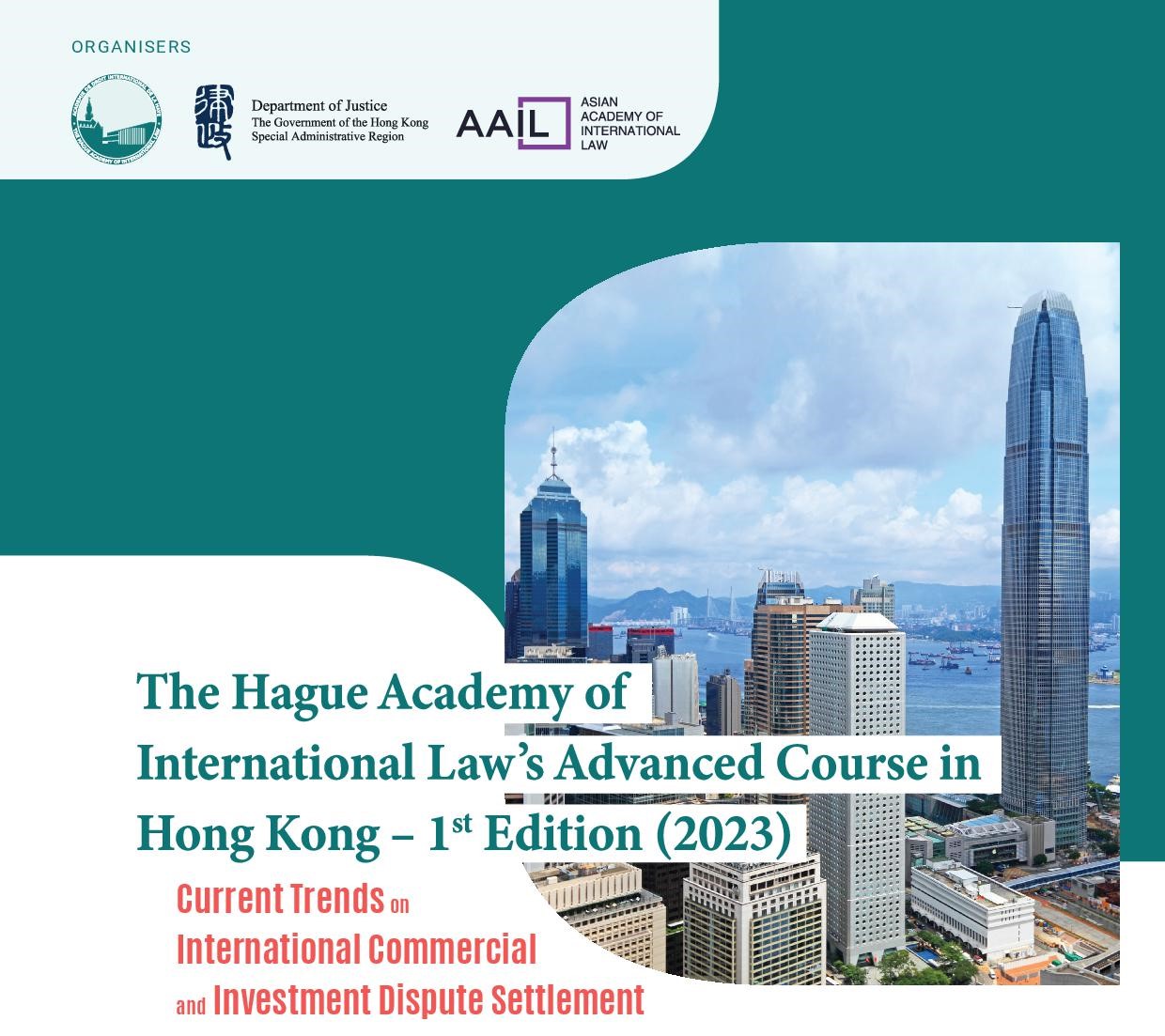 The first edition of the HAIL Advanced Courses in Hong Kong, organised in cooperation with with the Asian Academy of International Law and (AAIL) and the Hong Kong Department of Justice, will take place on 11-15 December 2023 with a focus on “Current Trends on International Commercial and Investment Dispute Settlement“.
Read more
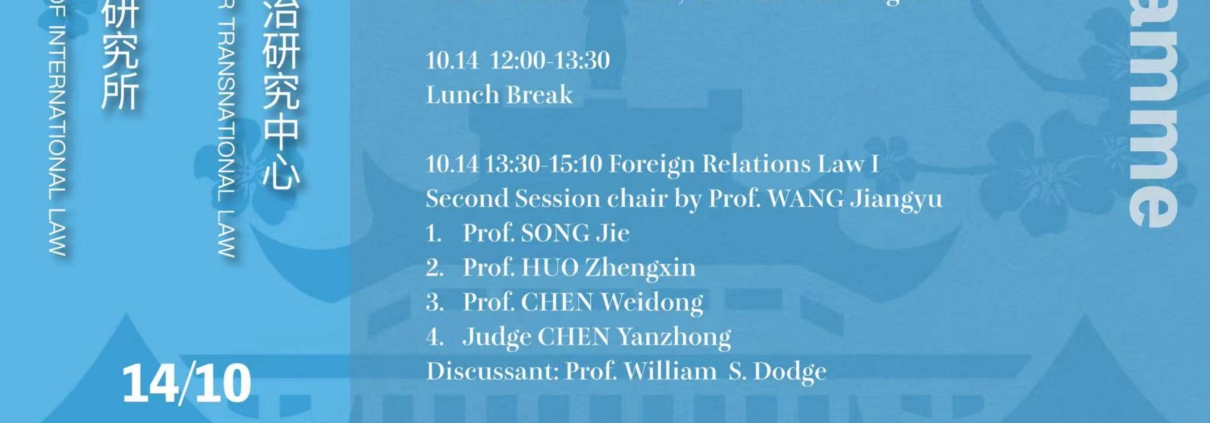
International Symposium on Legalisation of Foreign Relations in China
Legalisation of Foreign Relations in China, 14 Oct 2023, Wuhan University
Wuhan University and Fudan University are co-organising an International Symposium “Legalisation of Foreign Relations in China” (in English) on 14 Oct 2023. This symposium will discuss the two most important developments in Chinese law relating to foreign relations, i.e. the Foreign Relations Law and the Foreign State Immunities Law. Some presented articles will be published in the special session of the Chinese Journal of Transnational Law. This symposium will be held in person and online. Everyone is welcome. For more information and the program, please follow the event page. This event can be attended in-person or online. No registration is required.
INTERNATIONAL SYMPOSIUM ON LEGALISATION OF FOREIGN RELATIONS IN CHINA
Time: 9:30 am (Beijing time), 14 Oct 2023
Join the Zoom meeting
https://zoom.us/j/87645264148?pwd=xlbP90sgAmV0R4kFT6nkmxbL5nVlHA.1
Meeting ID: 876 4526 4148
Password: 032908
Virtual Workshop (in English) on October 10: Diego Fernández Arroyo on “Transnational Commercial Arbitration as Private International Law Feature”

On Tuesday, October 10, 2023, the Hamburg Max Planck Institute will host its 37th monthly virtual workshop Current Research in Private International Law at 11:00-12:30 (CEST). Diego P. Fernández Arroyo (Sciences Po Law School) will speak, in English, about
Transnational Commercial Arbitration as Private International Law Feature
A significant part of private international law (PrIL) disputes is nowadays solved by means of arbitration. At the same time, the range of arbitrable issues has been growing up for decades. Consequently, arbitration is no longer ignored by PrIL scholars, who, nevertheless, hesitate about how to deal with it. Many of them are only attracted by the fact that arbitral tribunals are often confronted to ordinary problems of determining the law applicable to a particular issue. Through the lens of this classical-PrIL approach, they identify sometimes conflict-of-law rules in arbitration instruments. Without denying any interest to this option, we will try to provide a more comprehensive view, starting by revising the very respective notion of arbitration and PrIL as well as their interaction, and concluding to challenge the excessive role played by the seat of the arbitration.
The presentation will be followed by open discussion. All are welcome. More information and sign-up here.
If you want to be invited to these events in the future, please write to veranstaltungen@mpipriv.de.