Views
Chinese courts made decision taking into account of the Hague Choice of Court Convention
China has signed the Hague Choice of Court Convention on 12 September 2017, but has not yet ratified this Convention. The Hague Choice of Court Convention has not entered into force in China. However, Shanghai High Court has already relied on the Hague Choice of Court Convention to make decision.
In Cathay United Bank v Gao, Shanghai High Court, (2016) Hu Min Xia Zhong No 99, the appellant, a Taiwan commercial bank, and the respondent, a Chinese citizen resident in Shanghai, entered into a Guarantee contract. It included a clause choosing Taiwan court as the competent court to hear disputes arising out of the contract. This clause did not specify whether it was exclusive or not. Chinese law does not provide how to decide exclusivity of a choice of court agreement. Facing the legal gap, Shanghai High Court took into account Article 3 of the Hague Choice of Court Convention 2005 and decided that choice of court agreements should be exclusive unless the parties stated otherwise. The Shanghai High Court thus declined jurisdiction in favour of Taiwan Court.
This decision was made on 20 April 2017, even before China signed the Hague Choice of Court Convention. Since the Hague Choice of Court Convention has not entered into force in China, it should not be directly applied by Chinese courts in judicial practice. The question is whether Chinese courts could ‘take into account’ of international conventions not being effective in China to make decision. Although Article 9 of the Chinese Supreme Court’s Judicial Interpretation of Chinese Conflict of Laws Act allows the Chinese courts to apply international conventions, which have not entered into effect in China, to decide the parties’ rights and obligations, such an application is subject to party autonomy. In other words, parties should have chosen the international convention to govern their rights and obligations. Article 9 does not apply to international judicial cooperation conventions that do not deal with individuals’ substantive rights and are not subject to party autonomy. Perhaps, a more relevant provision is Article 142(3) of the PRC General Principle of Civil Law, which provides that international customs or practice may be applied to matters for which neither the law of the PRC nor any international treaty concluded or acceded to by China has any provisions. Arguably, the Hague Choice of Court Convention represents common practice adopted internationally and forms a source to fill the gap in the current Chinese law.
EU Member State sees opportunities in Brexit: Belgium is establishing a new English-language commercial court
Expecting higher demands for international commercial dispute resolution following Britain’s departure from the EU, Belgium plans to set up a new English-language commercial court, the Brussels International Business Court (BIBC), to take cases away from the courts and tribunals in London. This decision was announced on 27 Oct 2017. This BIBC is designed to address disputes arising out of Brexit and major international commercial disputes. The court will take jurisdiction based on parties’ choice, and will do the hearing and deliver judgments in English. The parties would have no right to appeal. BIBC combines elements of both traditional courts and arbitration. See comments here.
Although Brexit may cause uncertainty to litigants in the UK, a survey suggests that the EU judicial cooperation scheme is not the main reason for international parties choosing London to resolve their disputes. The top two factors that attract international litigants to London are the reputation and experience of English judges and combination of choice of court clauses with choice of law clauses in favor of English law, followed by efficient remedies, procedural effectiveness, neutrality of the forum, market practice, English language, effective UK-based counsel, speed and enforceability of judgments. Furthermore, Brexit will not affect the New York Convention and would less likely affect London as an arbitration centre. It may be more reasonable to suggest that the main purpose of BIBC is not to compete with London at the international level, but to offer additional judicial tool and become a new commercial dispute resolution centre within the EU to attract companies and businesses to Brussels.
CJEU on the place of the damage under Article 7(2) of Brussels Ia as regards violation of personality rights of a legal person
First personal impressions presented by Edina Márton, LLM, PhD (Saarbruecken)
For jurisdictional purposes, the localisation of cross-border violations of personality rights under European instruments, such as Regulation (EU) No 1215/2012 (Brussels Ia), has attracted the attention of a considerable number of scholars and often led to different legal solutions in the national judicial practice. At EU level, besides Shevill (C-68/93; ECLI:EU:C:1995:61) as well as eDate and Martinez (C-509/09 and C-161/20; ECLI:EU:C:2011:685), since 17 October 2017, a third judgment in case Bolagsupplysningen (C-194/16; ECLI:EU:C:2017:766) has given further clarification in this area. In the recently delivered judgment, the ECJ specified one of the two limbs of the connecting factor “where the harmful event occurred or may occur” under Article 7(2) of Brussels Ia, namely the place of the alleged damage. Read more
News
New article published in African Journal of International and Comparative Law
A new conflict of laws article was just published today on the African Journal of International and Comparative Law. It is titled: CSA Okoli, A Yekini & P Oamen, “The Igiogbe Custom as a Mandatory Norm in Conflict of Laws: An Exploration of Nigerian Appellate Court Decisions.”
The abstract reads as follows:
Under the Igiogbe custom of the Bini Kingdom of Edo State Nigeria, the eldest surviving son exclusively inherits the ancestral home of his deceased father. This custom is a mandatory norm in conflict of laws. Litigation on the custom has been described as a matter of life and death. There is a widely shared view among academic writers, practitioners, and judges that this customary law is absolute. Contrary to this popular view, this work argues that the Igiogbe custom can be displaced by statute and other customary or religious laws. To substantiate this position, this article examines all the reported appellate court decisions on the Igiogbe custom and other connected principles. It is often taken for granted that every Bini man is subject to customary law, thereby leading to the overriding application of the Igiogbe custom. Recent developments in case law suggest otherwise. There is a conflict of personal law question that is often ignored in most litigation concerning the Igiogbe. Careful consideration of this question can potentially lead to the application of other systems of succession law (statutory, religious, and other customary laws) other than the Igiogbe custom. Besides, these conflict of laws techniques and constitutional human rights norms can be used to strike the appropriate balance between competing interests and reasonable legitimate expectations of the deceased and their heirs.
Call for papers: 2024 NGPIL Conflict of Laws’ Essay Prize
Originally posted in the NGPIL website
The Nigeria Group on Private International Law “(NGPIL”) invites submissions for the annual NGPIL Conflict of Laws’ Competition. The winner will be awarded for the best essay on any aspect of Nigerian conflict of laws. Entries will be accepted from the following: an undergraduate and/or postgraduate scholar studying in Nigeria, or any Nigerian lawyer five years call or below practising and residing in Nigeria. The essay should be unpublished at the time of submission. Submitted essays should be in the English language. Submitted essays should also be within five to eight thousand words. Competitors may be citizens of any nation, age or gender but must be an undergraduate and/or postgraduate scholar studying in Nigeria, or any lawyer below five years post-call experience practising and residing in Nigeria.
The first prize is 150,000 Naira (NGN), and the winner of the competition will be encouraged to publish the paper in any high-quality peer reviewed journal on private international law (conflict of laws). The second prize is 90,000 Naira (NGN), and third prize is 60,000 Naira (NGN). The prize is sponsored by and will be awarded by NGPIL.
Submissions to the Prize Committee must be received no later than January 15, 2024. Entries should be submitted by email in Word or pdf format. The winner will be announced no later than 2 months after the deadline. Decisions of the NGPIL on the winning essay and on any conditions relating to this prize are final. Submissions and any queries should be addressed by email to ngpilaw@gmail.com. All submissions will be acknowledged by e-mail.
Previous Winners
Oluwabusola Fagbemi (Winner for the 2022/2023 session)
Solomon Adegboyo (Winner for the 2021/2022 session)
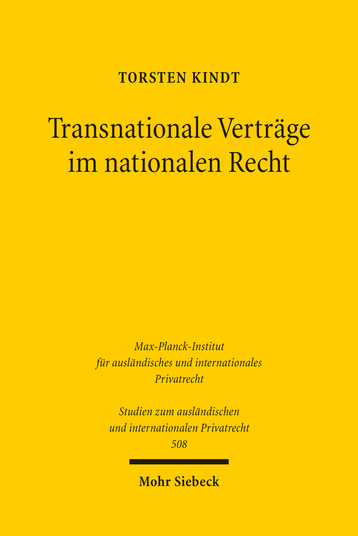
Out Now: Torsten Kindt, Transnationale Verträge im nationalen Recht
It is a truth universally acknowledged that a significant portion of international commerce is organized around instruments and structures that do not emanate from national states and laws but from private entities. Traditionally, most legal scholars addressing this phenomenon could be sorted into one of two camps: those who want to limit the notion of ‘law’ to the state and see instances of private ordering primarily as social, rather than legal phenomena; and those who consider national law already as a abstract concept with limited and decreasing importance for the reality of international business. Torsten Kindt belongs to neither of those two camps. With his recently published book, based on his doctoral thesis, he attempts to fill the gap left between the two seemingly irreconcilable positions, with a special focus on the transnational dimension of private ordering.