
Conflict of Laws
  • About
  • Editorial board
  • Subscription
  • Submission
  • Materials
  • Contact
  • Click to open the search input field Click to open the search input field Search
  • Menu Menu

Out Now: Torsten Kindt, Transnationale Verträge im nationalen Recht

September 30, 2023/2 Comments/in News/by Tobias Lutzi
image_pdfimage_print

It is a truth universally acknowledged that a significant portion of international commerce is organized around instruments and structures that do not emanate from national states and laws but from private entities. Traditionally, most legal scholars addressing this phenomenon could be sorted into one of two camps: those who want to limit the notion of ‘law’ to the state and see instances of private ordering primarily as social, rather than legal phenomena; and those who consider national law already as a abstract concept with limited and decreasing importance for the reality of international business. Torsten Kindt belongs to neither of those two camps. With his recently published book, based on his doctoral thesis, he attempts to fill the gap left between the two seemingly irreconcilable positions, with a special focus on the transnational dimension of private ordering.
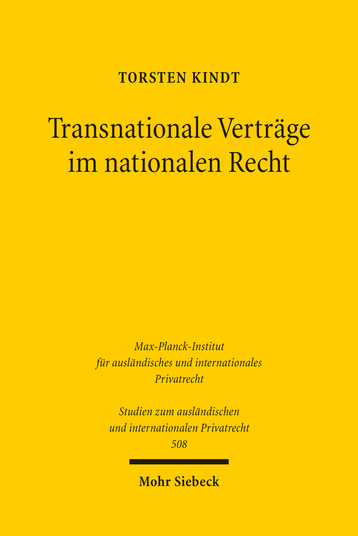
Kindt develops his argument in two steps. In the first part of the book (chapters 1 and 2), he takes a closer look at three instruments of particular importance for the financial sector that have largely been developed by private actors and independently from state law: letters of credit, syndicated loans, and credit derivatives. He focuses on the structural similarities between those instruments in order to demonstrate, in particular, the surprising degree to which they still incorporate and react to state law.

In the second part of the book (chapters 3 to 6), Kindt then introduces the concept of the ‘transnational contract’ – a contract corresponding to, and executed in accordance with, an internationally accepted model document negotiated and supervised by members of the relevant sector or industry – in order to discuss the ways in which existing state law can, in turn, incorporate the reality of the previously discussed instruments. For each area of law discussed – choice of law, contract law, and international civil procedure – Kindt identifies a variety of avenues for such incorporation, including, e.g. a (very) generous approach to choice-of-law and choice-of-court clauses that are linked or correspond to a model document.

Listing all the other intersections between transnational contracts and state law discussed by Kindt would exceed the limits of this post. Fortunately, though, the book itself is available open access, offering to the reader not only a wealth of insights into the private ordering of international finance but also a spirited and stimulating discussion of its present and potential future incorporation into national and international private law. It is highly recommended to anyone working on international business law, legal pluralism, and anything in between.


Share this entry
  • Share on Facebook
  • Share on X
  • Share on WhatsApp
  • Share on Pinterest
  • Share on LinkedIn
  • Share on Tumblr
  • Share on Vk
  • Share on Reddit
  • Share by Mail
https://conflictoflaws.net/News/2020/08/CoL_Banner-1.png 0 0 Tobias Lutzi https://conflictoflaws.net/News/2020/08/CoL_Banner-1.png Tobias Lutzi2023-09-30 22:37:342023-09-30 22:37:51Out Now: Torsten Kindt, Transnationale Verträge im nationalen Recht
2 replies
  1. Guangjian Tu says:
    October 1, 2023 at 11:25 am

    My feeling?private ordering can be more effective than state in many instances eg Visa card, internet, ucp600 (letters of credit), incoterms, even arbitration.

  2. Guangjian Tu says:
    October 1, 2023 at 11:25 am

    My feeling?private ordering can be more effective than state in many instances eg Visa card, internet, ucp600 (letters of credit), incoterms, even arbitration.

Comments are closed.

Categories

  • Views
  • News

Most Recent Posts

  • Conflicts of jurisdiction in Senegal: lesson from the Senegalese Supreme Court on Lis Pendens and the Exequatur of foreign judgments July 27, 2026
  • Adoption in the proposal for a European Parenthood Regulation July 21, 2026
  • Copyright, Targeting and Geo-Blocking: The CJEU Stirs the Pot July 15, 2026
  • A Follow-Up: The German Judges Association’s Response to the HCCH Draft Text of a Future Convention on Parallel Proceedings and Related Actions July 15, 2026
  • Private International Law Dimensions of Singapore’s New Legislation to Combat Online Harms July 14, 2026
  • The 1961 HCCH Apostille Convention: Why All African Countries Should Ratify It? — Insights from Judicial Practice in Africa July 14, 2026
  • The enforcement of an advance on costs for substitute performance at the expense of a Russian debtor in German-French legal relations July 2, 2026
  • “Yes, in principle, but not quite there yet…” – Some Observations on the Public Consultation on the HCCH Draft Text of a Future Convention on Parallel Proceedings and Related Actions June 29, 2026
  • Judgment Mobility Rules in India’s Private International Law Regime: No place for a revision au fond? June 26, 2026
  • Nothing to See Here: The CJEU’s Decision in Case C-232/25 Idzinski June 18, 2026
  • Refusal to Enforce in Egypt of a Californian (U.S.) Judgment for Lack of Reciprocity: What Has Gotten into the Egyptian Supreme Court? June 15, 2026
  • PRC Double Interest neither Double nor Penal: Australian Courts Clear Its Name When Enforcing Chinese Judgments June 10, 2026
  • The AIFC Court, Gazprom v Naftogaz and the Emergence of a New Conduit Jurisdiction Debate June 6, 2026
  • Montana Supreme Court Decides International Child Custody Case June 3, 2026
  • China’s Countering Improper Foreign Extraterritorial Jurisdiction Regulation Blocked EU’s Extraterritorial Data Acquisition May 29, 2026
Link to: Vulnerability: a Matter of Perspective(s) Link to: Vulnerability: a Matter of Perspective(s) Vulnerability: a Matter of Perspective(s) Link to: Judicial Application of the 1980 HCCH Convention in Morocco Link to: Judicial Application of the 1980 HCCH Convention in Morocco Judicial Application of the 1980 HCCH Convention in Morocco
Scroll to top Scroll to top Scroll to top