


Views
The ECtHR rules on the compatibility with the right to respect for private and family life of the refusal of registration of same-sex marriages contracted abroad
By a judgment Orlandi and Others v. Italy delivered on December 14 the ECtHR held that the lack of legal recognition of same sex unions in Italy violated the right to respect of private and family life of couples married abroad.
The case concerned the complaint of six same sex-couples married abroad (in Canada, California and the Netherlands). Italian authorities refused to register their marriages on the basis that registration would be contrary to public policy. They also refused to recognize them under any other form of union. The complaints were lodged prior to 2016, at a time when Italy did not have a legislation on same-sex unions.
The couples claimed under articles 8 (right to respect of private and family life) and 14 (prohibition of discrimination) of the Convention, taken in conjunction with article 8 and 12 (right to marry), that the refusal to register their marriages contracted abroad, and the fact that they could not marry or receive any other legal recognition of their family union in Italy, deprived them of any legal protection or associated rights. They also alleged that “the situation was discriminatory and based solely on their sexual orientation” (§137).
Recalling that States are still free to restrict access to marriage to different sex-couples, the Court indicated that nonetheless, since the Oliari and others v. Italy case, States have an obligation to grant same-sex couples “a specific legal framework providing for the recognition and the protection of their same-sex unions” (§192).
The Court noted that the “the crux of the case at hand is precisely that the applicants’ position was not provided for in domestic law, specifically the fact that the applicants could not have their relationship – be it a de facto union or a de jure union recognized under the law of a foreign state – recognized and protected in Italy under any form” (§201).
It pointed out that although legal recognition of same-sex unions had continued to develop rapidly in Europe and beyond, notably in American countries and Australia, the same could not be said about registration of same-sex marriages celebrated abroad. Giving this lack of consensus, the Court considered that the State had “a wide margin of appreciation regarding the decision as the whether to register, as marriage, such marriages contracted abroad” (§204-205).
Thus, the Court admitted that it could “accept that to prevent disorder Italy may wish to deter its nationals from having recourse in other States to particular institutions which are not accepted domestically (such as same-sex marriage) and which the State is not obliged to recognize from a Convention perspective” (§207).
However, the Court considered that the refusal to register the marriages under any form left the applicants in “a legal vacuum”. The State has failed “to take account of the social reality of the situation” (§209). Thus, the Court considered that prior to 2016, applicants were deprived from any recognition or protection. It concluded that, “in the present case, the Italian State could not reasonably disregard the situation of the applicants which correspond to a family life within the meaning of article 8 of the Convention, without offering the applicants a means to safeguard their relationship”. As a result, it ruled that the State “failed to strike a fair balance between any competing interests in so far as they failed to ensure that the applicants had available a specific legal framework providing for the recognition and the protection of their same-sex union” (§ 210).
Thus, the Court considered that there had been a violation of article 8. It considered that, giving the findings under article 8, there was no need to examine the case on the ground of Article 14 in conjunction with article 8 or 12. (§212).
Functioning of the ODR Platform: EU Commission Publishes First Results
Written by Emma van Gelder and Alexandre Biard, Erasmus University Rotterdam (PhD and postdoc researchers ERC project Building EU Civil Justice)
On 13 December 2017, the European Commission published a report on the functioning of the Online Dispute Resolution (ODR) Platform for consumer disputes, and the findings of a web-scraping exercise of EU traders’ websites that investigated traders’ compliance with their information obligations vis-à-vis consumers. Read more
Conference Report: Contracts for the Supply of Digital Content and Digital Services, A legal debate on the proposed directive, ERA Brussels, 22 November 2017
Written by Antonella Nolten, Research Fellow at the EBS Law School, Wiesbaden, Germany
On 22 November 2017 the Academy of European Law (ERA) hosted a conference on the recent developments on the Proposal for a Digital Content Directive in Brussels. Read more
News
Podcast series in international and transnational law
Rishi Gulati, Associate Professor in International Law and Barrister, is hosting a new podcast series focusing on hot topics in international and transnational law, as well as domestic law developments with transnational impact. Significant developments impacting the legal profession are also discussed from time to time.
The podcasts are not only designed for a legal audience but also for the broader public using accessible language. They are also intended to be a teaching tool with the 50 or so minute episodes delving systematically on the issues discussed. Each episode invites a highly knowledgeable guest who can bring a unique perspective to the issue. A special attempt is made to include voices from all regions of the world.
Series 1 has now wrapped up and has seven episodes. The first three episodes concern challenges faced by the International Criminal Court, WTO and UN Human Rights Treaty Bodies respectively. The fourth episode discusses the impact of AI on the legal profession, a highly topical issue given the rise of generative AI. The fifth episode discusses the UK’s new subsidy control regime and the Levelling Up agenda. The sixth episode discusses animal rights law, with the final episode in Series 1 dealing with AI and international law from a substantive perspective. Series 2 will return after a short break!
You can subscribe to the podcast in various ways, including via SoundCloud, Spotify, and Google Podcasts
The Arab Yearbook of Public and Private International Law – Call for Submission
Finally!!! A yearbook dedicated to public and private international law in the Arab world has recently been established by BRILL and is expected to be launched in the fall of 2024 called “The Arab Yearbook of Public & International Law” (the Yearbook).
One can only warmly welcome this initiative. It will certainly provide a space for fruitful discussions and a forum where experts from the Arab world and abroad can exchange views, all for the sake of the further development of these areas of law in the Arab region.
The Yearbook’s official website provides the following description:
Conference Report: Global Law and Sustainable Development; Medellín, Colombia. 26-27 April, 2023
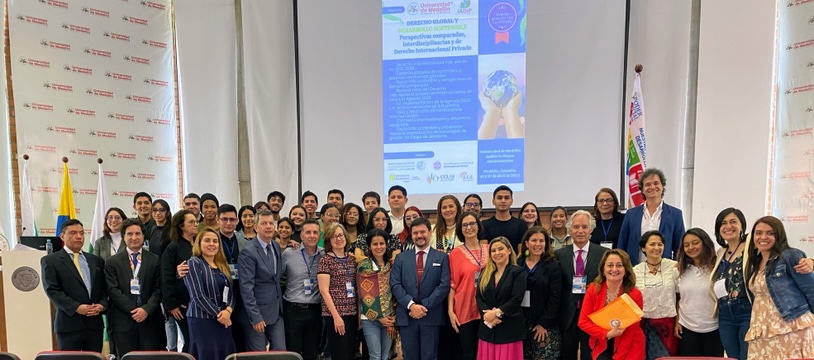
(authored by Verónica Ruiz Abou-Nigm)
Global Law and Sustainable Development. Conference Report.
On 26-27 April 2023 at the University of Medellín, Colombia, private international law scholars organised and hosted a conference that pushed the boundaries of the discipline and engaged with interdisciplinary and comparative perspectives around the theme of Global law and Sustainable Development. The conference, in Spanish, was organised by the University of Medellín and the Antioquian Institute of Private International Law (IADIP), and supported by D.E.C. Consultores, Edinburgh Law School, the Centre for C