
Conference Report: Global Law and Sustainable Development; Medellín, Colombia. 26-27 April, 2023


(authored by Verónica Ruiz Abou-Nigm)
Global Law and Sustainable Development. Conference Report.
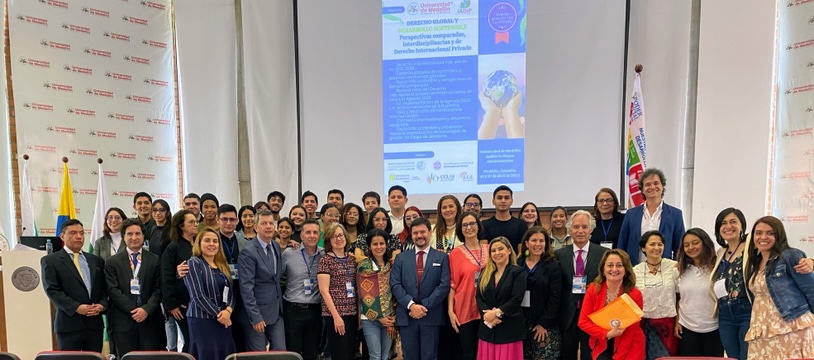
On 26-27 April 2023 at the University of Medellín, Colombia, private international law scholars organised and hosted a conference that pushed the boundaries of the discipline and engaged with interdisciplinary and comparative perspectives around the theme of Global law and Sustainable Development. The conference, in Spanish, was organised by the University of Medellín and the Antioquian Institute of Private International Law (IADIP), and supported by D.E.C. Consultores, Edinburgh Law School, the Centre for C
ontemporary Latin American Studies of the University of Edinburgh (CCLAS), the Law School of University of Los Andes, and the Max Planck Institute for Comparative and International Private Law.
The conference opened with a warm welcome by José Luis Marín Fuentes and the Dean of the Law School of the University of Medellín, Alvaro García Restrepo, followed by an in memoriam honouring Professor Jürgen Basedow (1949-2023). Professor Basedow was highly admired by the Latin American Private International Law community, many of whom gathered at this conference.
The keynote address by Ralf Michaels and Verónica Ruiz Abou-Nigm on Law and Sustainability beyond the SDGs 2030 set the scene on the role of private law and private international law in the quest for sustainability and provided insightful threads for broader reflection that were revisited by the conference participants throughout the discussions during this two-day conference.
The keynote address was followed by a first panel on Global Supply Chains and Global Law, chaired by Ruiz Abou-Nigm with presentations from María Mercedes Albornoz (Mexico); Jeannette Tramhel (OAS), and Juan Amaya (Colombia). Albornoz explored conceptual issues around global supply and global value chains, exploring the role of private international law in enabling the contractual web that supports these. Tramhel focused on the agricultural sector and international private law issues relevant to SDG 2: Cero Hunger. She noted the governance gap in relation to urgent issues around food security, raising awareness of the critical need for immediate intervention in this sector and highlighting the importance of transnational law developments for social, economic and environmental sustainability in the food industry. In turn, Amaya explained the importance of traceability, and conceptualised social traceability, with illustrations based on interesting judicial cases pending resolution in the Global North in relation to alleged unsustainable practices in the Global South by Global North MNCs.
The first afternoon panel on Comparative Law Perspectives on Sustainable Development was chaired by Nuria González Martín (Mexico) with presentations from Eleonora Lozano (Colombia); Laura Carballo Piñeiro (Spain) and Alberto Alonso (Spain). Lozano shared her research on tax law and sustainable development, with very enlightening results based on her work on fiscal sustainability from a law and economics perspective. Carballo focused on the role of private international law in relation to some of the objectives in SDGs 10 and 8, particularly focusing on labour migration, and sharing the work of a research group that is currently working on sustainable circular labour migration at the crossroads of private international law, labour law and migration law perspectives. The final speaker in this panel, Alonso, explored criminal law issues connected to SDG 16.
The final session on the first day was a round-table discussion on the new challenges for private international law in Latin America coordinated by Albornoz with the participation of Ignacio Goicoechea (HCCH-ROLAC), Maria Julia Ochoa (Colombia/Spain), Claudia Madrid Martínez (Colombia) and Marcos Dotta (Uruguay). Undoubtedly this was a great way to conclude the first day with a lively discussion about the several challenges facing the region, as well as the importance of capacity building in private international law tailored to the needs of the region, reflecting on the role of institutions like the HCCH, national authorities, academia and the private sector in this endeavour.
The second day opened with an interactive presentation of Karen Leiva Chavarría from the Justice Department of Costa Rica, presented by Goicoechea. Costa Rica has been a pioneer in the inclusion of markers of transnational access to justice in its annual reporting on SDG 16, and a leader in the region in relation to the work of judicial authorities in connection with the UN Agenda 2030. The presentation emphasised the role of the profession, and addressed, in particular, the soon-to-be-lawyers in the audience, from the University of Medellín and other local universities.
The next panel on the SDGs and International Dispute Resolution, chaired by Carballo Piñeiro, included the presentations of Lenin Moreno Navarro (Ecuador), Eugenio Hernández Bretón (Venezuela), Lidia Mercado (Panamá) and Nuria González Martín (Mexico). The panellists discussed issues around international commercial litigation, arbitration and mediation, and reflected upon the tensions inherent in pursuing sustainability in relation to the needs for development in the region, particularly in relation to dispute resolution services.
A panel on International Contracts and Sustainable Development followed in the afternoon. This panel was chaired by Madrid Martínez and included the presentations of Rosario Espinosa Calabuig (Spain), Nestor Londoño (Colombia), Maria Blanca Noodt Taquela (Argentina) and Anabela Sousa Gonçalves (Portugal). The panellists tackled a wide range of issues around sustainability in a variety of international contracts, from contractual issues in the cruise industry in shipping, to case studies of sustainability costs in extractive industries in Argentina, to more general private international law methodologies relevant to international contracts including issues of applicable law and jurisdiction clauses.
The final round-table brought to the conference enlightening interdisciplinary perspectives on applied research in sustainable development and urbanism. Medellín is well-known worldwide for the transformative role that social urbanism has had in the past decades. This round-table, chaired by Ruiz Abou-Nigm, included a team of researchers from Medellín, who work in a collaborative project with the CCLAS (University of Edinburgh). Wilmar Castro Mere, Françoise Coupe de Restrepo, Ani Zapata Berrio and Carlos Velásquez shared their experiences of co-production of applied research on risk management in local communities. This was a truly insightful discussion bringing to life many of the issues that had been discussed in theory throughout the conference, particularly in relation to the role of different actors, norms, and communities in governance, as well as key considerations of social inclusion, capacity building, and the key role of cooperation between academia and the public and private sectors as well as civil society in the UN Agenda 2030.
The conference ended with a warm farewell from our fantastic local host, José Luis Marín Fuentes, who spared no efforts to make this conference a truly remarkable international event that provided much food for thought and opened new avenues for international collaboration in pursuance of the SDGs.