


Views
The Supreme Court deals the death blow to US Human Rights Litigation
Written by Bastian Brunk, research assistant and doctoral student at the Institute for Comparative and Private International Law at the University of Freiburg (Germany)
On April 24, the Supreme Court of the United States released its decision in Jesner v Arab Bank (available here; see also the pre-decision analysis by Hannah Dittmers linked here and first thoughts after the decision of Amy Howe here) and, in a 5:4 majority vote, shut the door that it had left ajar in its Kiobel decision. Both cases are concerned with the question whether private corporations may be sued under the Alien Tort Statute (ATS). Read more
No handshake, no citizenship – but with a second wife, everything’s fine?
Two recent judgments of European courts have highlighted the difficulty in finding the right balance between the cultural assimilation of Muslim immigrants demanded by national laws on citizenship and the necessary degree of tolerance towards foreign laws and customs. In a widely reported decision of 11 April 2018, the French Council of State (Conseil d’Etat) ruled that a naturalisation of an Algerian-born woman could be revoked because she had refused to shake hands with a male public servant during the naturalisation ceremony. Read more
Child Abduction and Habitual Residence in the Supreme Court of Canada
The Supreme Court of Canada, in Office of the Children’s Lawyer v Balev (available here), has evolved the law in Canada on the meaning of a child’s habitual residence under Article 3 of the Hague Convention. The Convention deals with the return of children wrongfully removed from the jurisdiction of their habitual residence.
A majority of the court identifies [paras 4 and 39ff] three possible approaches to habitual residence: the parental intention approach, the child-centred approach, and the hybrid approach. The parental intention approach determines the habitual residence of a child by the intention of the parents with the right to determine where the child lives. This approach has been the dominant one in Canada. In contrast, the hybrid approach, instead of focusing primarily on either parental intention or the child’s acclimatization, looks to all relevant considerations arising from the facts of the case. A majority of the court, led by the (now retired) Chief Justice, holds that the law in Canada should be the hybrid approach [paras 5 and 48]. One of the main reasons for the change is that the hybrid approach is used in many other Hague Convention countries [paras 49-50].
The dissent (three of the nine judges) would maintain the parental intention approach [para 110]. One of its central concerns is the flexibility and ambiguity of the hybrid approach [para 111], which the judges worry will lead to less clarity and more litigation. Wrongful removal cases will become harder to resolve in a timely manner [paras 151-153].
The majority did not apply the law to the facts of the underlying case, it having become moot during the process of the litigation [para 6]. The court rendered its decision to provide guidance going forward. The dissent would have denied the appeal on the basis that the child’s habitual residence was in Germany (as the lower courts had held).
The court briefly addresses the exception to Article 3 in what is commonly known as “Article 13(2)” (since it is not numbered as such) – a child’s objection to return – setting out its understanding of how to apply it [paras 75-81 and 157-160].
The Supreme Court of Canada has recently adopted the practice of preparing summaries of its decisions (available here for this decision) to make them more accessible to the media and the public. These are called “Cases in Brief”.
News
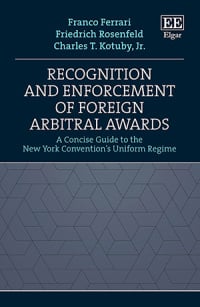
Review of: Recognition and Enforcement of Foreign Arbitral Awards (Ferrari, Rosenfeld, & Kotuby Jr.)
Franco Ferrari, Friedrich Rosenfeld, & Charles T. Kotuby Jr., Recognition and Enforcement of Foreign Arbitral Awards: A Concise Guide to the New York Convention’s Uniform Regime
Cheltenham, Edward Elgar, 2023
178 pp. Hardback : £72 eBook: £20
Out Now: The Brussels I-bis Regulation (Lazic & Mankowski)
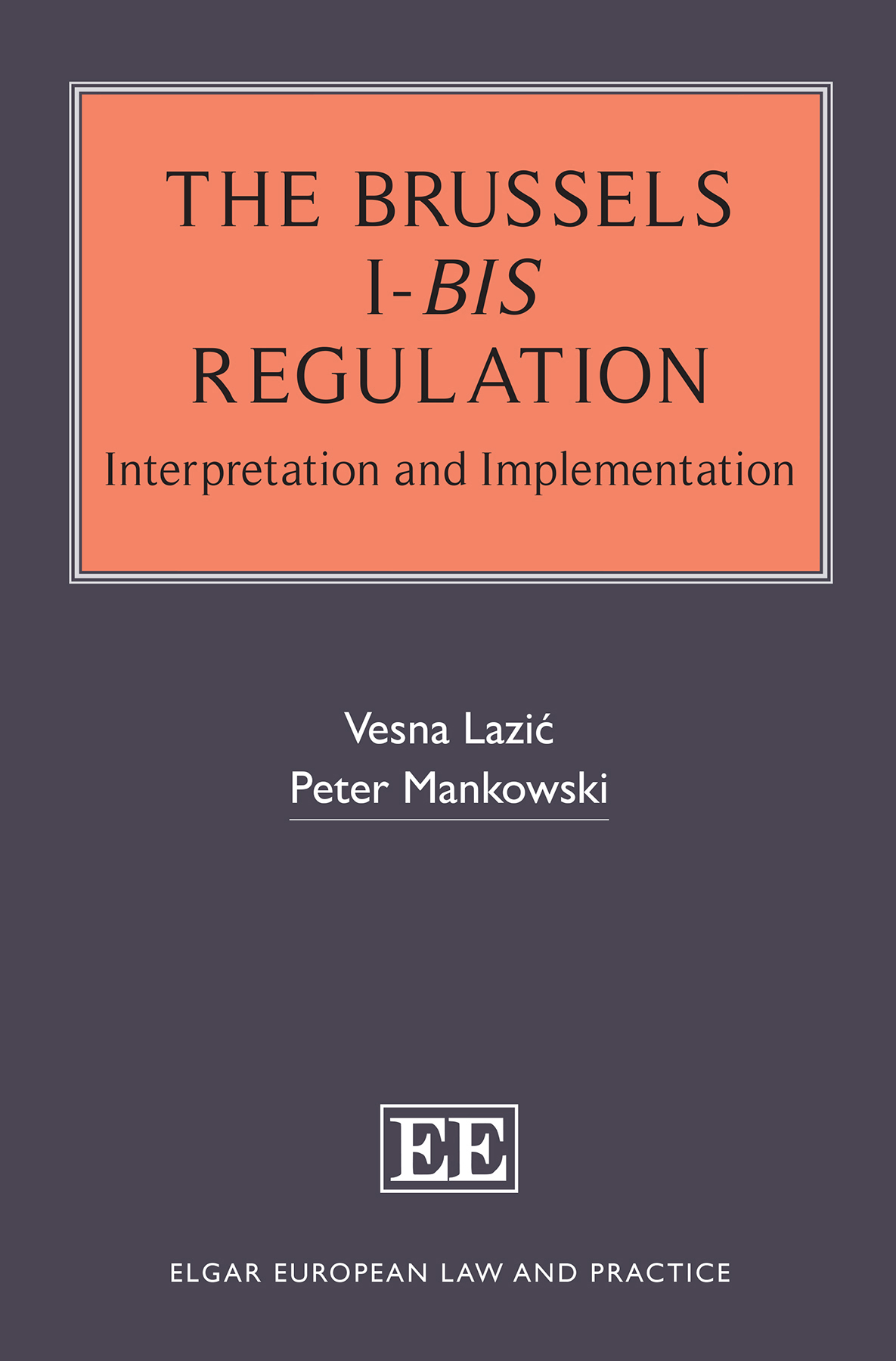
Vesna Lazic and Peter Mankowski, The Brussels I-bis Regulation: Interpretation and Implementation, Edward Elgar 2023 (602 pp)
This impressive book on the Brussels I-bis Regulation has just been published. It results from a project headed by Vesna Lazic (Utrecht University/T.M.C. Asser Institute) and the late Peter Mankowski (formerly University of Hamburg), in co-operation with Lucia Pein (Hamburg University), entitled ‘Regulation Brussels Ia: a standard for free circulation of judgments and mutual trust in the European Union’ (JUDGTRUST) funded by the European Commission’s Justice Programme (JUST-AG-2017/JUST-JCOO-AG-2017). The research for this project consisted among others of a questionnaire and national reports from all the Member States on the application of the Regulation. This book provides an extensive overview of the CJEU rulings and analysis of case law, which will be of great importance for future reference and the ongoing evaluation and revision of the Brussels I-bis Regulation.
Anchor defendants and exclusive distribution agreements under Article 8(1) of the Bru I bis Regulation – CJEU in Beverage City Polska, C-832/21
How does the anchor defendant mechanism operate in the realm of EU trade marks and actions on trade mark infringement? Is the existence of an exclusive distribution agreement between the defendants sufficient to rely on this mechanism? Those are the questions that the Court of justice addresses in its judgment handed down this morning in the case Beverage City Polska, C-832/21.