
Review of: Recognition and Enforcement of Foreign Arbitral Awards (Ferrari, Rosenfeld, & Kotuby Jr.)


Franco Ferrari, Friedrich Rosenfeld, & Charles T. Kotuby Jr., Recognition and Enforcement of Foreign Arbitral Awards: A Concise Guide to the New York Convention’s Uniform Regime
Cheltenham, Edward Elgar, 2023
178 pp. Hardback : £72 eBook: £20
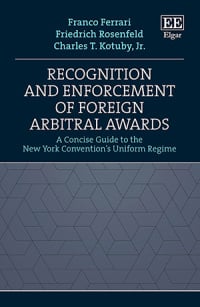
I was interested in reviewing this book as the first step towards familiarising myself with the recognition and enforcement of foreign arbitral awards. My previous knowledge of international commercial arbitration was derived from Nigerian case law, together with the much-cited West Tankers decision and its relationship with Brussels Ia. The book contains 10 chapters across 170 pages, wherein Ferrari et al. do an excellent job of introducing the uninitiated to ‘internationalist’ perspectives of the recognition and enforcement of foreign arbitral awards, greatly simplifying the topic to ensure the reader’s comprehension. However, experts in this area of law will equally enjoy the extensive comparative jurisprudence that is drawn upon in the book. Besides, it makes for a very interesting read: I finished it in just two days!
The New York Convention is one of the world’s most successful treaties. As of January 2023, there were 172 Contracting States. Thus, Ferrari et al. mainly rely on this Convention in the text, supported by extensive comparative case law and academic sources. From my reading of the book, its central themes are the promotion of a narrow approach to refusing the recognition and enforcement of foreign arbitral awards, and the promotion of uniformity in interpreting the New York Convention. Essentially, Ferrari et al. support a pro-arbitration stance throughout all the chapters of their book.
In particular, the above authors state that: “Recognition operates as a shield – at the outset of a dispute and after the arbitral process concludes” (p.1). Consequently, recognition could be used as a defence. Alternatively, they emphasise that an award in breach of an arbitration agreement should not be recognised. Recognition can similarly be used to avoid the re-litigation of a dispute. Furthermore, it is highlighted that: “Enforcement operates as a sword. It aims at giving effect to an arbitration agreement or arbitral award” (p.2). For example, this would involve compelling the parties to arbitrate, or applying coercive measures to execute an arbitral award under the law. Ferrari et al. claim that the enforceability of arbitral awards ranks highest amongst the perceived advantages of international arbitration
In Chapter One, the book advocates for a uniform and autonomous interpretation of the New York Convention – it is not simply a case of harmonisation. However, the authors admit that the lack of a court that can provide uniform interpretation (like the European Court of Justice for the EU Member State Courts, or the International Court of Justice for the global community) represents an obstacle to a uniform interpretation of the New York Convention. It is also noted in this Chapter that most Courts of Member States adopt a pro-enforcement approach under the New York Convention, with a narrow interpretation of the grounds for refusing recognition and enforcement.
In Chapter Two, the focus is on the New York Convention’s scope of application, wherein three main issues are identified. The first of these is the need for an autonomous definition of what constitutes an arbitral award, citing the following criteria: (a) The decision must be made by arbitrators or permanent arbitral tribunals in a private capacity, (b) The adjudicatory authority must be conferred with the consent of the parties, and (c) The decision must be a binding one, as in the case of a judicial decision.
The second issue explored in Chapter Two is internationality, likewise composed of three main pillars. The internationality requirement is fulfilled (a) Once the arbitral award is made in a State other than the contracting State in which recognition and enforcement are sought, irrespective of whether the award would be considered international under domestic law, (b) The awards are issued within the territory of an enforcing State but possess foreign elements that prevent them from being domestic, and (c) The arbitration agreements are not purely domestic – they contain foreign elements. Finally, the third issue, according to the authors, is that reservations have lost their importance, due to the success of the New York Convention.
In Chapter Three, however, the authors turn their attention towards the recognition and enforcement of arbitration agreements. They submit that the success of international arbitration is based on respect for arbitration agreements, which is subject to five main criteria, the first being the presumptive validity of an arbitration agreement (pro-arbitration bias).
The second criterion mentioned is arbitrability, or the subject matter being capable of arbitration. The extent to which a state limits the matters that may be arbitrated will determine whether that state is arbitration friendly. Moreover, the determination of issues as non-arbitrable should be based on narrow and justifiable public policy grounds. The protection of weaker parties, like employees, is an example that the book provides of issues that are not arbitrable in certain legal systems.
The third criterion is that the arbitration agreement should not be null and void, and should likewise not be inoperative or incapable of being performed. Chapter Three discusses this point in depth, with the inclusion of separability (which safeguards arbitral authority), and the law that applies to an arbitration agreement. Here, the issue of the applicable law is widely debated in the UK and globally. In the absence of an express choice of law, it is contested whether the law of the seat, law governing the main contract, or lex fori should apply to an arbitration agreement. Therefore, it is wise for the parties to include an express choice of law to govern their arbitration agreement, so that these complexities and uncertainties may be avoided. Finally, the scope and drafting of arbitration agreements are outlined in this Chapter.
Chapter Four then proceeds to discuss the duty to recognise and enforce arbitral awards, together with the limitations of this duty. Interestingly, the authors argue that ‘Enforcement shopping’ for the most favourable forum is permitted under the New York Convention, even in multiple jurisdictions simultaneously. Meanwhile, the refusal to recognise or enforce foreign arbitral awards must be based on an exhaustive list of grounds, burden of proof, waivers, the preclusive effects of prior determinations (deference to arbitral tribunals), and the discretion to deny recognition and enforcement. Finally, Chapter Four clarifies that the refusal to recognise or enforce a foreign arbitral award is not binding on another State.
Chapter Five continues by discussing the grounds for refusing to recognise or enforce a foreign arbitral award in relation to jurisdiction. Here, three main elements are identified. First, it should be impossible to resolve the subject matter through arbitration (due to, for example, matters of state interest). Second, the parties should lack capacity under the applicable law, or else the arbitration agreement must be invalid. Third, the arbitral decision must fall outside the scope of the arbitration agreement or submission of the parties.
Chapter Six subsequently discusses grounds for refusal in relation to proper notice and the ability to present one’s case, such as due process or natural justice. The authors hereby note that the courts in most of the signatory States of the New York Convention are reluctant to apply this ground for refusal, in order to protect international commercial arbitration.
Meanwhile, Chapter Seven focuses on further grounds for refusal, specifically with regard to procedure, such as the composition of the arbitral tribunal, the failure of the parties’ agreement (or deviation of the arbitration procedure from that agreement), or the procedure not being in accordance with the law of the country in which the arbitration took place.
Conversely, Chapter Eight looks at grounds for refusal in relation to the status of an award under the applicable law. This involves situations where a foreign arbitral award has not become binding on the parties, or else has been set aside by a competent authority in the country where the award was made, or under the law of that country.
Chapter Nine then discusses public policy requirements, which .the authors rightly note as being applied narrowly or on justifiable grounds to promote international commercial arbitration.
Finally, Chapter Ten focuses on the procedure and formal requirements for recognition and enforcement.
My verdict is that this book is certainly worth reading for anyone with an interest in international commercial arbitration. I highly commend its simplicity and the comparative approach embodied in the writing, specifically with reference to the recognition and enforcement of foreign arbitral awards.
More please.