


Views
ERA: Recent European Court of Human Rights Case Law in Family Matters (conference report)
Report written by Tine Van Hof, researcher at the University of Antwerp
On the 13th and 14th of February 2020, the Academy of European Law (ERA) organized a conference on ‘Recent ECtHR Case Law in Family Matters’. This conference was held in Strasbourg and brought together forty participants coming from twenty-one different countries. This report will set out some of the issues addressed at the conference.
The presentation, made by Ksenija Turkovi?, Judge at the European Court of Human Rights, focused on children on the move and more specifically on minors in the context of migration. On this topic the European Court of Human Rights (ECtHR) has developed a child-specific human rights approach. This approach implies taking into account three particular concepts: vulnerability, best interests and autonomy. Judge Turkovi? pointed to the interesting discussion on whether vulnerability could only apply to young migrant children. On this discussion, there is now agreement that the vulnerability applies to all children under the age of 18 and regardless whether they are accompanied by adults. The ECtHR made very clear in its case law that migrant children are especially vulnerable and that this vulnerability is a decisive factor that takes precedence over the children’s migrant status. This vulnerability also plays a role in the cases on the detention of children. The more vulnerable a person is, the lower the threshold for a situation of detention to fall within the scope of Article 3 of the European Convention on Human Rights (ECHR), encompassing the prohibition of torture.
Family unification and the free movement of family status was the second topic of the day. Michael Hellner, professor at Stockholm University, discussed several cases of the ECtHR (Ejimson v Germany) and the Court of Justice of the EU (CJEU) (K.A. v Belgium, Coman and S.M.). He concluded that family life does not automatically create a right of residence but it can create such a right in certain circumstances. In the Coman case for example, the CJEU decided that Romania had to recognize the marriage between the two men for the purpose of enabling such persons to exercise the rights they enjoy under EU law (i.e. free movement). Professor Hellner noted that it seems to be quite easy to circumvent national law in the future if one looks at the Coman case. He considered it positive if the consequence was that same-sex marriages and surrogacy arrangements created abroad were recognized. However, he made the interesting observation that it might be a very different story if one thinks about child marriages and the recognition thereof.
Maria-Andriani Kostopoulou, consultant in family law for the Council of Europe, thereafter shared her insights on parental rights, pre-adoption foster care and adoption. She discussed i.a. the evolution in the case law of the ECtHR on the representation of the child before the Court. In the Strand-Lobben case, the Court stated that the issue of representation does not require a restrictive or technical approach and thus made clear that a certain level of flexibility is necessary. In the Paradisio and Campanelli case, the ECtHR provided three criteria that should be taken into account for assessing the representation of the child: the link between the child and the representative, the subject-matter of the case and any potential conflict of interests between the interests of the child and those of the representative. The latest case, A. and B. against Croatia, introduced a security safeguard. In this case, the ECtHR asked the Croatian Bar Association to appoint a legal representative for the child for the procedure before the ECtHR since the Court was not sure that there were no conflict of interests between the child and the mother, who proposed to be the representative.
To end the first conference day, Dmytro Tretyakov, lawyer at the Registry of the ECtHR, enlightened us about the misconceptions and best practices of submitting a case to the Court. His most important tips for a submission to the Court are the following:
- Use the current application form and not an old one;
- Submit well in time and certainly within the six-month period;
- Summarize the facts of the case on the three pages provided. This summary has to be clear, readable (for those that do it in handwriting) and comprehensible;
- To state claims, refer to the relevant Article from the ECHR (do not cite it) and explain what the specific problem is with regard to that Article;
- Support each claim with documents; and
- Sign the form in the correct boxes and carefully look where the signature of the applicant and where the signature of the representative is required.
The second day of the conference started with the presentation of Nadia Rusinova, attorney-at-law and lecturer at the Hague University of Applied Science, on international child abduction. She discussed i.a. the issue of domestic violence in child abduction cases. Several questions can be raised in this regard, for example: what constitutes domestic violence? When should a court accept the domestic violence to be established? What is adequate protection in light of the Hague Convention on International Child Abduction (1980) and who decides on this? In the case O.C.I. and others v Romania, one of the questions was whether there is such a thing as light violence that does not amount to a grave risk in the sense of Article 13(1)(b) of the Hague Convention. The ECtHR approached this issue very critically and stated that no form of corporal punishment is acceptable. Regarding the adequate measures, the Court stated that domestic authorities have a discretion to decide what is adequate but the measures should be in place before ordering the return of the child. Another point raised by Ms. Rusinova is the time factor that is required. If one looks at Article 11(2) of the Hague Convention and at Article 11(3) of the Brussels IIbis Regulation together, six weeks is the required time period for the return proceedings. The Brussels IIbis Recast clarified that the procedure should take no more than six weeks per instance. However, according to Ms. Rusinova it is hardly possible to do the procedures in six weeks; it will only work when the proceeding is not turned into an adversarial proceeding in which all kinds of claims of both parents are dealt with.
Samuel Fulli-Lemaire, professor at the University of Strasbourg, addressed the interesting evolution of reproductive rights and surrogacy. In the case of C. and E. v France, the French Court of Cassation asked the ECtHR for an advisory opinion on the question whether the current state of the case law in France was compatible with the obligations under Article 8 ECHR (the right to respect for private and family life). The status of the French case law was that the genetic parent was fully accepted but the other intended parent was required to adopt the child if he or she wished to establish parentage links. The ECtHR replied that the obligation under Article 8 entailed that there must be a possibility of recognition of the parent-child relationship but that it is up to the States to decide how to do this. Adoption is a sufficient method of recognizing such relationship, provided that it is quick and effective enough. The Court also refers to the possibility of transcription of the birth certificate as an alternative to adoption. However, professor Fulli-Lemaire pointed out that there is a misconception on what transcription means under French law. The mere transcription of the birth certificate does not establish legal parentage in France. The fact that the ECtHR says that an intended parent can adopt or transcribe the birth certificate is therefore tricky because under French law the effects of the two methods are not at all the same.
The very last presentation of the conference was given by Gabriela Lünsmann, attorney-at-law and member of the Executive Board of the Lesbian and Gay Federation in Germany. She spoke about LGBTQI rights as human rights and hereby focused i.a. on transsexuals’ gender identity and the case of X. v North-Macedonia. The question raised in that case is whether the state must provide for a procedure to recognize a different gender. The applicant had tried to change their gender but North-Macedonia did not offer any possibility to undergo an operation or to have medical treatment in that regard. The applicant then went abroad for treatment. Back in North-Macedonia, he had his name changed but it was not possible to change his officially registered gender. The applicant claimed that this amounted to a violation of Article 8 ECHR and specially referred to the obligation of the state to respect a person’s physical and psychological integrity. The Court found that there was indeed a violation. What is as yet unclear, and is thus an interesting point for reflection, is whether states are under an obligation to provide for a procedure for the recognition of a change of gender without the person having had an operation.
The author would like to thank ERA for the excellent organization of the conference and for the interesting range of topics discussed.
Same-sex parentage and surrogacy and their practical implications in Poland
Written by Anna Wysocka-Bar, Senior Lecturer at Jagiellonian University (Poland)
On 2 December 2019 Supreme Administrative Court of Poland (Naczelny S?d Administracyjny) adopted a resolution of seven judges (signature: II OPS 1/19), in which it stated that it is not possible – due to public policy – to transcribe into the domestic register of civil status a foreign birth certificate indicating two persons of the same sex as parents. The Ombudsman joined arguing that the refusal of transcription infringes the child’s right to nationality and identity, and as a result may lead to infringement of the right to protection of health, the right to education, the right to personal security and the right to free movement and choice of place of residence. Interestingly, the Ombudsman for Children and public prosecutor suggested non-transcription. The background of the case concerns a child whose birth certificate indicated two women of Polish nationality as parents, a biological mother and her partner to a de facto union. Parents applied for such transcription in order to apply subsequently for the issuance of the passport for the child.
The Supreme Administrative Court stated that in accordance with the law on civil status register, the transcription must be refused if contrary to ordre public in Poland. The public policy clause protects the domestic legal order against its violation. Such violation would result from the “recognition” of a birth certificate irreconcilable with fundamental principles of public policy. It was underlined that in accordance with Article 18 of the Constitution of Poland marriage is understood as a union between a man and a woman; family, motherhood and parenthood are under protection and guardianship of the State. In accordance with those principles and the whole system of family law, only one mother and one father might be treated as parents of a child. Any other category of “parent” is unknown. The Court underlined, at the same time, that transcription of the birth certificate into the domestic register should not be indispensable for a child to obtain a passport, as the child has, by operation of law, already acquired Polish nationality as inherited from the mother. However, in practical terms this would require challenging administrative authorities’ approach (requesting domestic birth certificate) in another court procedure.
It should be explained here that the resolution was taken on the request of the panel of judges of the Supreme Administrative Court reviewing the cassation appeal brought by the parents, and therefore, in this particular case is binding. In other, similar cases panels of judges should, in general, follow the standpoint presented in such resolution. If the panel of judges is of a different view, it should request another resolution, instead of presenting a view contrary to the previous one. As a result, it might happen that there are two resolutions of seven judges presenting different views. Given the above, it can be said that the question of transcription is not as definitively answered as might seem at first glance.
A similar justification based on the public policy clause in conjunction with Article 18 of the Constitution has already been presented before in other cases, for example one concerning children born in the US out of surrogacy arrangements with a married woman, whose birth certificates indicated two men as parents, a (biological) father and his partner (identical judgments of 6 May 2015, signature: II OSK 2372/13 and II OSK 2419/13). The implications of these judgments were quite different as the Court refused to confirm that children acquired Polish nationality by birth from their father. In the eyes of the Court and according to fundamental principles of Polish family law, children born out of surrogacy (which is not regulated in Poland) by operation of law have filiation links only with the (biological, surrogate) mother and her husband. The paternity of the biological father (only) might be (at least theoretically) established, once the paternity of the surrogate mother’s husband is successfully disavowed in a court proceeding.
Here it should be added that opposite views were presented by the Supreme Administrative Court in other judgments. One of the cases concerned transcription of the birth certificate of a child born in India out of surrogacy arrangement. Such birth certificate indicates only the father (in this case a biological father) and do not contain any information about the (surrogate) mother. This was perceived as contrary to public policy by the administrative authorities, which underlined that in the Polish legal order establishing paternity is always dependent on the establishment of maternity. As a result, the lack of information about the mother raises doubts as to paternity of the man indicated on the birth certificate as father. Interestingly, based on the same birth certificate the acquisition of Polish nationality of the child was earlier confirmed by administrative authorities. In its judgment of 29 August 2018 (signature: II OSK 2129/16), Supreme Administrative Court criticized the way the public policy clause was so far understood. The Court (which hears the case after the refusal of administrative authorities of two instances and administrative court of the first instance – just as in all of the mentioned cases) underlined that this clause must be interpreted having regard to a broader context of the legal issue at hand, in particular it should take into account constitutional values (always prevailing best interest of a child) and international standards on protection of children’s rights and human rights. This allows for the transcription of the birth certificate into civil status records in Poland.
Another interesting case concerned again the question of confirmation that the children acquired Polish nationality by birth after their father (four identical judgments of 30 October 2018, signatures: II OSK 1868/16, II OSK 1869/16, II OSK 1870/16, II OSK 1871/16). Four girls were born in US through surrogacy. The US birth certificates indicated two men as parents, one of them being a Polish national. The Supreme Administrative Court underlined that for the legal status of a child, including the possibility of confirming acquisition of Polish nationality, it should not matter that the child was born to a surrogate mother. What should matter is that a human being with inherent and inalienable dignity was born and this human being has a right to Polish nationality, as long as one of the parents is a Polish national.
The above mentioned cases, where the Supreme Administrative Court presented a conservative approach and approved the refusal of the confirmation that children born out of surrogacy acquired Polish nationality by birth is now pending before European Court of Human Rights (Schlittner-Hay v. Poland). The applications raise violation by Poland of Article 8 (respect for private and family life) and Article 14 (discrimination on grounds of parents’ sexual orientation) of the European Convention on Human Rights.
This shows that practical implications for children to same-sex parents and from surrogacy arrangements are of growing interest and importance also in Poland. The approaches of domestic authorities and courts seems to be evolving, but are still quite divergent. The view on the issue from the European Court of Human Rights is awaited.
Common law recognition of foreign declarations of parentage
This note addresses the question whether there is a common law basis for the recognition of foreign declarations of parentage. It appears that this issue has not received much attention in common law jurisdictions, but it was the subject of a relatively recent Privy Council decision (C v C [2019] UKPC 40).
The issue arises where a foreign court or judicial authority has previously determined that a person is, or is not, a child’s parent, and the question of parentage then resurfaces in the forum (for example, in the context of parentage proceedings or maintenance proceedings). If there is no basis for recognition of the foreign declaration, the forum court will have to consider the issue de novo (usually by applying the law of the forum: see, eg, Status of Children Act 1969 (NZ)). This would increase the risk of “limping” parent-child relationships (that is, relationships that are recognised in some countries but not in others) – a risk that is especially problematic in the context of children born by way of surrogacy or assisted human reproduction technology.
The following example illustrates the problem. A baby is born in a surrogacy-friendly country to a surrogate mother domiciled and resident in that country, as the result of a surrogacy arrangement entered into with intending parents who are habitually resident in New Zealand. The courts of the foreign country declare that the intending parents are the legal parents of the child. Under New Zealand law, however, the surrogacy arrangement would have no legal effect, and the surrogate mother and her partner would be treated as the child’s legal parents upon the child’s birth. Unless the foreign judgment is capable of recognition in New Zealand, the only way for the intending parents to become the child’s legal parents in New Zealand is to apply for adoption (see, eg, Re Cobain [2015] NZFC 4072, Re Clifford [2016] NZFC 1666, Re Henwood [2015] NZFC 1541, Re Reynard [2014] NZFC 7652, Re Kennedy [2014] NZFLR 367, Re W [2019] NZFC 2482, Re C [2019] NZFC 1629).
So what is the relevance of a foreign declaration on parentage in common law courts? In C v C [2019] UKPC 40, [2019] WLR(D) 622, the Privy Council decided that there was a basis in the common law for recognising such declarations, pursuant to the so-called Travers v Holley principle. This principle, which has traditionally been applied in the context of divorce and adoption, calls for recognition of foreign judgments on the basis of “jurisdictional reciprocity” (at [44]). The Privy Council applied the principle to recognise a declaration of parentage made in Latvia, in relation to a child domiciled and habitually resident in Latvia, for the purposes of maintenance proceedings in the forum court of Jersey. Lord Wilson emphasised that, although foreign judgments may, in some cases, be refused on grounds of public policy, recognition will not be refused lightly: “a court’s recognition of a foreign order under private international law does not depend on any arrogant attempt on that court’s part to mark the foreign court’s homework” (at [58]).
As a matter of policy, my first impression is that the Privy Council’s decision is to be welcomed. Common law jurisdictions have traditionally taken a conservative, relatively “closed” approach to the recognition of foreign laws and judgments on parentage (see Hague Conference on Private International Law A Study of Legal Parentage and the Issues Arising from International Surrogacy Arrangements (Prelim Doc No 3C, 2014)). Such an approach has become increasingly indefensible in a world that is witnessing unprecedented levels of cross-border mobility and migration. The conflict of laws should, as a matter of priority, avoid limping parent-child relationships: for example, a child who was declared by the courts of their place of birth to be the child of the intending parents, but who is nevertheless treated as the surrogate mother’s child under New Zealand law. The ability to recognise foreign judgments on parentage may not amount to much progress, given that it can apply only where the foreign court has, in fact, made a declaration of parentage: it would have no application where the relevant parent-child relationship simply arises by operation of law or through an administrative act (such as entry of the intending parents in the birth register). There is no doubt that an international solution must be found to the problem as a whole. But it is surely better than nothing.
Another question is what to make of the Privy Council’s reliance on the Travers v Holley principle. Based on the decision in Travers v Holley [1953] P 246 (CA), the principle enables recognition of foreign judgments by virtue of reciprocity: the forum court will recognise a foreign judgment if the forum court itself would have had jurisdiction to grant the judgment had the facts been reversed (ie had the forum court been faced with the equivalent situation as the foreign court). In the context of divorce, the principle has since been subsumed within a wider principle of “real and substantial connection” (Indyka v Indyka [1969] 1 AC 33 (HL)). In the context of adoption, the principle has been applied to recognise “the status of adoption duly constituted … in another country in similar circumstances as we claim for ourselves” (Re Valentine’s Settlement [1965] Ch 831 (CA) at 842).
Perhaps it is not a big step from adoption to parentage more generally. The Privy Council recognised that the latter primarily represents “a conclusion of biological fact”, while adoption “stamps a person with a changed legal effect” (at [39]). But the Privy Council did not seem to consider that this distinction should warrant a different approach in principle. In C v C, the issue of parentage involved a relatively straightforward question of paternity. Had the case involved a question of surrogacy or human assisted reproduction, the answer might well have been different. There is an argument that a parent-child relationship created under foreign law can only be recognised in the forum if the foreign law is substantially similar to forum law. Thus, in the context of adoption, it has been asked whether the concept of adoption in the foreign country “substantially conform[s] to the English concept” (Re T & M (Adoption) [2010] EWHC 964, [2011] 1 FLR 1487 at [13]). This requirement might not be made out where, for example, the law of the forum does not recognise parentage by way of surrogacy (as is the case in New Zealand).
The Privy Council cautioned that the Board did not receive full argument on the issue and that the reader “must bear the lack of it in mind” (at [34]). It seems especially important, then, for conflict of laws scholars to give the issue further consideration. This note may serve as a careful first step – I would be interested to hear other views. Perhaps the most encouraging aspect of the Board’s reasoning, in my mind, is its openness to recognition. The Board’s starting point was that the declaration could be recognised. Arguably, this was because counsel seemed to have largely conceded the point. But to the extent that it cuts through an assumption that questions of parentage are generally left to the law of the forum, it nevertheless strikes me as significant – even more so since the UK Supreme Court’s previous refusal to extend the Travers v Holley principle beyond the sphere of family law (Rubin v Eurofinance SA [2012] UKSC 46, [2012] 3 WLR 1019 at [110], [127]).
News
The European Parliament’s last plenary session & Private International Law
This post was written by Begüm Kilimcio?lu (PhD researcher), Thalia Kruger (Professor) and Tine Van Hof (Guest professor and postdoctoral researcher), all of the University of Antwerp.
During the last plenary meeting of the current composition of the European Parliament (before the elections of June 2024), which took place from Monday 22 until Thursday 24 April, several proposals relevant to private international law were put to a vote (see the full agenda of votes and debates). All of the regulations discussed here still have to be formally approved by the Council of the European Union before they become binding law, in accordance with the ordinary legislative procedure.
It is interesting to note that, while many pieces of new legislation have a clear cross-border impact in civil matters, not all of them explicitly address private international law. While readers of this blog are probably used to the discrepancies this has led to in various fields of the law, it is still worth our consideration.
First, the European Parliament voted on and adopted the proposal for a Directive on Corporate Sustainability Due Diligence (CSDDD) with 374 votes in favour, 235 against and 19 abstentions (see also the European Parliament’s Press Release). The text adopted is the result of fierce battles between the Commission, Parliament and the Council and also other stakeholders such as civil society, academics and practitioners. This necessitated compromise and resulted in a watered-down version of the Commission’s initial proposal of 23 February 2022 and does not go as far as envisaged in the European Parliament’s Resolution of 10 March 2021 (see also earlier blog pieces by Jan von Hein, Chris Tomale, Giesela Rühl, Eduardo Álvarez-Armas and Geert van Calster).
The Directive is one of the few instruments worldwide that put legally-binding obligations on multinational enterprises. It lays down obligations for companies regarding their adverse actual and potential human rights and environmental impacts, with respect to their own operation, the operations of their subsidiaries, and the operations carried out by their business partners in the chains of activities. The Directive further stipulates specific measures that companies have to take to prevent, mitigate or bring an end to their actual or potential adverse human rights impacts. Besides national supervisory authorities for the oversight of the implementation of the obligations, the Directive enacts civil liability for victims of corporate harm.
The adopted Directive is more or less silent on private international law. The closest it gets to addressing our field of the law is Article 29(7), placing the duty on Member States to ensure the mandatory nature of civil remedies:
Member States shall ensure that the provisions of national law transposing this Article are of overriding mandatory application in cases where the law applicable to claims to that effect is not the national law of a Member State.
and Recital 90, which is more general:
In order to ensure that victims of human rights and environmental harm can bring an action for damages and claim compensation for damage caused when the company intentionally or negligently failed to comply with the due diligence obligations stemming from this Directive, this Directive should require Member States to ensure that the provisions of national law transposing the civil liability regime provided for in this Directive are of overriding mandatory application in cases where the law applicable to such claims is not the national law of a Member State, as could for instance be the case in accordance with international private law rules when the damage occurs in a third country. This means that the Member States should also ensure that the requirements in respect of which natural or legal persons can bring the claim, the statute of limitations and the disclosure of evidence are of overriding mandatory application. When transposing the civil liability regime provided for in this Directive and choosing the methods to achieve such results, Member States should also be able to take into account all related national rules to the extent they are necessary to ensure the protection of victims and crucial for safeguarding the Member States’ public interests, such as its political, social or economic organisation.
While the text contains references to numerous existing Regulations, Brussels I and Rome I are not among them; not even a precursory or confusing reference as in Recital 147 of the GDRP.
Second, the European Parliament voted on two other proposals that build on and implement the objectives of the European Green Deal and the EU Circular Economy Action Plan. The first is a proposal for a Regulation establishing a framework for setting eco-design requirements for sustainable products with 455 votes in favour, 99 against and 54 abstentions (see also the European Parliament’s Press Release). The Regulation aims to reduce the negative life cycle environmental impacts of products by improving the products’ durability, reusability, upgradability, reparability etc. It sets design requirements for products that will be placed on the market, and establishes a digital product certificate to inform consumers.
This Regulation does not contain a private-international-law type connecting factor for contracts or products. Neither does it expressly elevate its provisions to overriding rules of mandatory law (to at least give us some private international law clue). Its scope is determined by the EU’s internal market. All products that enter the European market have to be in conformity with the requirements of both regulations, also those that are produced in third countries and subsequently imported on the European market (Art. 3(1)). “Products that enter the market” is the connecting factor, or the basis for applying the Regulation as overriding mandatory law. The Regulation is silent on products that exit the market. Hopefully the result will not be that products that were still in the production cycle at the time of entry into force will simply be exported out of the EU.
The third adopted proposal is the Regulation on packaging and packaging waste with 476 votes in favour, 129 against and 24 abstentions (see also the European Parliament’s Press Release). This Regulation aims to reduce the amount of packaging placed on the Union market, ensuring the environmental sustainability of the packaging that is placed on the market, preventing the generation of packaging waste, and the collection and treatment of packaging waste that has been generated. To reach these aims, the regulation’s key measures include phasing out certain single-use plastics by 2030, minimizing so called “forever chemicals” chemicals in food packaging, promoting reuse and refill options, and implementing separate collection and recycling systems for beverage containers by 2029.
Like the Eco-design Regulation, no word on Private International Law, no references. The Regulation refers to packaging “placed on the market” in various provisions (most notably Art. 4(1)) and recitals (e.g. Recitals 10 and 14).
Lastly, the European Parliament approved the proposal for a regulation on prohibiting products made with forced labour on the Union market with an overwhelming majority of 555 votes in favour, 6 against and 45 abstentions (see also the European Parliament’s Press Release). The purpose of this Regulation is to improve the functioning of the internal market while also contributing to the fight against forced labour (including forced child labour). Economic operators are to eliminate forced labour from their operations through the pre-existing due diligence obligations under Union law. It introduces responsible authorities and a database of forced labour risk areas or products.
Just as is the case for the other Regulations, this Regulation does not contain references to private international law instruments, and no explicit reference to instruments in this field, even though the implementation of the Regulation requires vigilance throughout the value chain. It would be correct to assume that this provides overriding mandatory law, as the ban on forced labour is generally accepted to be jus cogens even though the extent of this ban is contentious (see Franklin).
Other proposals that are more clearly in the domain of private international law have not (yet?) reached the finish line. First, in the procedure on the dual proposals in the field of the protection of adults of 31 May 2023, the European Parliament could either adopt them or introduce amendments at first reading. However, these proposals have not reached the plenary level before the end of term and it will thus be for the Conference of Presidents to decide at the beginning of the new parliamentary term whether the consideration of this ‘unfinished business’ can be resumed or continued (Art. 240 Rules of Procedure of the European Parliament).
In the second file, the proposal for a Regulation in matters of parenthood and on the creation of a European Certificate of Parenthood of 7 December 2022 the European Parliament was already consulted and submitted its opinion in a Resolution of 14 December 2023. It is now up to the Council of the European Union to decide unanimously (according to the procedure in Art. 81(3) of the Treaty on the Functioning of the European Union). It can either adopt the amended proposal or amend the proposal once again. In the latter case the Council has to notify or consult (in case of substantial amendments) the European Parliament again.
Ficticious service still active outside Europe
With the EU Service Regulation being active for more than 20 years, and the Hague Service Convention being ratified by almost all European countries, there is little space for practicing fictitious service of proceedings in Europe. However, for service to third countries outside Europe, and especially to continents, such as Africa, Asia, and the Middle East, remise au parquet is still the ground rule for many European countries. A recent judgment issued by the Piraeus Court of Appeal provides a clear picture of how the mechanism operates in Greece [Piraeus Court of Appeal, judgment nr. 142/2024, available here].
I. THE FACTS:
The parties are two companies active in the international maritime sector. The claimant, a Greek company with its seat in Piraeus, filed an action before the Piraeus Court of First Instance, seeking the award of the total sum of $29,163,200. The defendant, an Iranian company with its seat in Tehran, did not appear in the hearing. The action was upheld as being well founded in substance by the Piraeus Court of 1st Instance. The defendant was ordered to pay the equivalent of $28. 663,200.
Both the action and the first instance judgment were duly served on the Piraeus District Attorney, in accordance with the provisions of Articles 134 §§ 1 and 2, and 136 § 1 Code of Greek Civil Procedure (henceforth CCP), due to the defendant’s domicile in a non-member state of the European Union, thus excluding the application of EU law, and because Iran has not acceded to the Hague Convention of 15 November 1965, which requires actual service of documents by one of the methods provided for therein. Finally, the court underlined the absence of a bilateral agreement between Iran and Greece, which would possibly regulate the issues of service in a different manner.
The defendant lodged an appeal. The appeal was however untimely filed, because it was brought after the expiry of the sixty [60] days period following service of the judgment, provided for in Article 518 § 1 CCP, which began with the fictitious service of the judgment on the Public Prosecutor, to be sent to the Minister of Foreign Affairs, in order to be transmitted through diplomatic channels to the addressee, as provided for by Article 134 §§ 1 and 3 CCP.
The Iranian company acknowledged that the time-limit had expired without effect. For this reason, it filed a request for restitutio in integrum in accordance with Article 152 CCP, requesting that the appeal be considered as timely lodged, claiming that the delay in lodging the appeal was due to force majeure. In particular, it is asserted that the Iranian company did not receive notification of both the claim, which resulted in a default judgment without its participation in the trial at first instance, and of the judgment given in default of appearance, due to the service method selected, i.e., ficticious service to the Public Prosecutor, which sets the time-limit for the appeal. Secondly, the appellant asserts that that it acted within the time-limit laid down in Article 153 CCP, that is to say, immediately after real service.
The appellant invokes the delay caused by the Piraeus Prosecutor’s Office and the diplomatic services of the Country, which did not take care to complete service within two months. In other words, it relies on the omission of third parties, which it could not prevent, and which prevented the appellant from being aware of the fictitious service and the commencement of the time-limit for lodging an appeal in Greece.
II.THE JUDGMENT OF THE PIRAEUS COURT OF APPEAL
The appellate court ruled as follows: The lawsuit was forwarded by the Piraeus Prosecutor’s Office to the Minister of Foreign Affairs, in order to be served at the defendant’s headquarters in Tehran. The diplomatic authorities of Greece did indeed send and their counterparts in Iran did receive and forward the statement of claim to its addressee. However, the Iranian company’s agents, namely the secretariat and the clerk in the Legal Affairs Department, refused to receive it. This is evident from the “Letter of confirmation for declaration of received documents from foreign countries” issued by the International Affairs Department of the Judiciary of the Islamic Republic of Iran. This document states that the defendant, through its aforementioned nominees, refused to receive the disputed “document”.
The reason for that refusal is not specified. However, from the document of the Consular Office of the Embassy of Greece in Iran, and the attached document of the Ministry of Foreign Affairs of the Islamic Republic of Iran, it can be inferred that the refusal was made because the document to be served was not accompanied by an official translation into Farsi. Iranian law does indeed appear to permit refusal to accept service of a foreigner’s statement of claim against an Iranian national on that ground (a legal opinion of Mr., a lawyer at the Central Iranian Bar Association was submitted to the CoA by the appellant). Still, domestic Greek law does not make the validity of service of an action dependent on the attachment of a translated copy of the action in the language of the State of destination. Therefore, service of the action, if it had been completed, would always be valid under Greek law.
In addition, the mere attempt to serve the action made it clear to the defendant in any event, irrespective of whether it had been aware of its content from the outset, that a claim has being brought against it in a Greek court and triggered its obligation under Article 116 CCP to monitor the progress of the proceedings from that time onwards, even if it chose not to participate in the proceedings, which the defendant was able to do, by behaving in a prudent and diligent manner, and by following the fate of the action brought in Greece.
To that end, it was sufficient simply to appoint a lawyer in Greece, who would arrange for the translation of the documents, and would attend the ongoing proceedings at first instance. Such an action was made by the appellant only after actual service of the judgment.
Similarly, the applicant does not explain the reason why it did not act by appointing a lawyer in Greece, after the refusal to receive the summons of the claimant, even though it was also sent to it accompanied by a translation of the summons in English. That omission gives the impression that the refusal to receive the summons was made in order to prolong the proceedings, and to prepare for the lodging of the appeal and the application for restitutio in integrum, which on the whole is considered to be abusive.
Consequently, the application for restitutio in integrum was dismissed as unfounded and the appeal, which was nevertheless brought out of time, was dismissed as inadmissible.
III. COMMENT
The judgment of the Piraeus CoA is interesting because it goes a step further in the examination of fictitious service: It did not simply reiterate the wording of the domestic rules; moreover, it scrutinized the facts, and avoided a stringent application of Article 134 CCP. Due process and right to be heard were included in the court’s analysis. Finally, the court dismissed the legal remedies of the appellant due to its reluctance to demonstrate proactivity, and its intention to bring the Greek proceedings to a stalemate.
[Out Now!] New Open Access Book on Corruption and Investment Arbitration: Nobumichi Teramura, Luke Nottage and Bruno Jetin (eds), Corruption and Illegality in Asian Investment Arbitration (Springer, 2024)
Nobumichi TERAMURA (Assistant Professor, Universiti Brunei Darussalam; Affiliate, Centre for Asian and Pacific Law in the University of Sydney), Luke Nottage (Professor of Comparative and Transnational Business Law, Sydney Law School) and Bruno Jetin (Associate Professor of Economics, Universiti Brunei Darussalam) published an edited volume entitled “Corruption and Illegality in Asian Investment Arbitration” from Springer on 20 April 2024. The book is an open access title, so it is freely available to any states and organisations, including less well-resourced institutions in transitioning economies. Corrupt behaviour by foreign investors, like bribery to local government officials, faces wide condemnation in any society. Nevertheless, there remains a paucity of research appraising the consequences of corruption and illegality affecting international investment in Asia, especially investment arbitration involving East and South Asian jurisdictions. This book intends to fill the gap from an interdisciplinary (legal-economic) perspective.
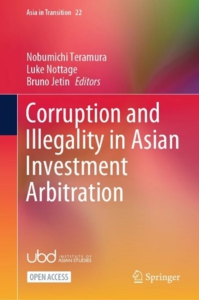 The volume’s description reads as follows:
This open access book explores Asian approaches towards investment arbitration—a transnational procedure to resolve disputes between a foreign investor and a host state—setting it in the wider political economy and within domestic law contexts. It considers the extent to which significant states in Asia are, or could become, “rule makers” rather than “rule takers” regarding corruption and serious illegality in investor-state arbitration. Corruption and illegality in international investment are widely condemned in any society, but there remains a lack of consensus on the consequences, especially in investment arbitration. A core issue addressed is whether a foreign investor violating a host state’s law should be awarded protection of its investment, as per its contract with the host state and/or the applicable investment or trade agreement between the home state and the host state. Some suggest such protection would be unnecessary as the investor committed a crime in the host state, while others attempt to establish an equilibrium between the investor and the host state. Others claim to protect investment, invoking the sanctity of promises made. The book starts with a deep dive into economic and legal issues in corruption and investment arbitration and then explores the situation and issues in major countries in the region in detail. It is a useful reference point for lawyers, economists, investors, and government officials who are seeking comprehensive and up-to-date information on anti-bribery rules in Asian investment treaties. It is of particular interest to students and researchers in economics, finance, and law, who are undertaking new research relating to the multifaceted impacts of corruption.
The book’s table of contents is as follows:
Chapter 1 – “Bribery and Other Serious Investor Misconduct in Asian International Arbitration” by Nobumichi Teramura, Luke Nottage and Bruno Jetin;
Chapter 2 – “Does Corruption Hinder Foreign Direct Investment and Growth in Asia and Beyond? The Grabbing Versus the Helping Hand Revisited” by Ahmed M Khalid (Professor of Economics, Universiti Brunei Darussalam);
Chapter 3 – “The Effect of Corruption on Foreign Direct Investment at the Regional Level: A Positive or Negative Relationship?” By Bruno Jetin, Jamel Saadaoui (Senior Lecturer of Economics, The University of Strasbourg), Haingo Ratiarison (The University of Strasbourg);
Chapter 4 – “Anti-Corruption Laws and Investment Treaty Arbitration: An Asian Perspective” by Anselmo Reyes (International Judge, Singapore International Commercial Court) and Till Haechler (Associate, Lenz & Staehelin);
Chapter 5 – “Multi-Tiered International Anti-Corruption Cooperation in Asia: A Review of Treaties and Prospects” by Yueming Yan (Assistant Professor, Chinese University of Hong Kong) and Tianyu Liu (ADR Case Manager, Hong Kong International Arbitration Centre);
Chapter 6 – “Corruption in International Investment Arbitration” by Michael Hwang SC (Arbitrator, Michael Hwang Chambers) and Aloysius Chang (Michael Hwang Chambers);
Chapter 7 – “Rebalancing Asymmetries Between Host States and Investors in Asian Investor–State Dispute Settlement: An Exception for Systemic Corruption” by Martin Jarrett (Senior Research Fellow, Max Planck Institute for Comparative Public Law and International Law);
Chapter 8 – “Foreign Investment, Investment Treaties and Corruption in China and Hong Kong” by Vivienne Bath (Professor of Chinese Law, Sydney Law School) and Tianqi Gu (Sydney Law School);
Chapter 9 – “Corruption and Investment Treaty Arbitration in India” by Prabhash Ranjan (Professor and Vice Dean, Jindal Global Law School);
Chapter 10 – “Corruption and Illegality in Asian Investment Disputes: Indonesia” by Simon Butt (Professor of Indonesian Law, Sydney Law School), Antony Crockett (Partner, Herbert Smith Freehills Hong Kong) and Tim Lindsey (Malcolm Smith Chair of Asian Law and Redmond Barry Distinguished Professor, Melbourne Law School);
Chapter 11 – “Foreign Investment, Treaties, Arbitration and Corruption: Comparing Japan” by Luke Nottage and Nobumichi Teramura;
Chapter 12 – “Corruption and Investment Arbitration in the Lao People’s Democratic Republic: Corruptio Incognito” by Romesh Weeramantry (Special Counsel, Clifford Chance Perth) and Uma Sharma (Associate, Jones Day Singapore);
Chapter 13 – “Corruption and Illegality in Asian Investment Arbitration: The Philippines” by Thomas Elliot A Mondez (Faculty Member, De La Salle University, Philippines) and Jocelyn P Cruz (Associate Professor, De La Salle University, Philippines);
Chapter 14 – “Investment Arbitration, Corruption and Illegality: South Korea” by Joongi Kim (Professor Yonsei Law School);
Chapter 15 – “Foreign Investment, Corruption, Investment Treaties and Arbitration in Thailand” by Sirilaksana Khoman (Professor, Thammasat University, Thailand), Luke Nottage and Sakda Thanitcul (Professor, Chulalongkorn University); and
Chapter 16 – “Towards a More Harmonised Asian Approach to Corruption and Illegality in Investment Arbitration” by Nobumichi Teramura, Luke Nottage and Bruno Jetin.