


Views
Plaintiff’s Application for Leave to Proceed when no Appearance by Defendant: Recent Developments in New South Wales Australia
| If a defendant is not present in Australia, Uniform Civil Procedure Rules (“UCPR”) of New South Wales provides that service outside of Australia is permitted if the plaintiff’s claim falls within UCPR Schedule 6 or if a leave is granted under UCPR rule 11.5. If a defendant does not respond within 42 days after being served successfully (rule 11.8), the plaintiff must apply for leave to proceed (rule 11.8AA). A defendant can challenge the jurisdiction of the court and apply to set aside service (rule 12.11). The court has discretion to decide whether to assume jurisdiction (rule 11.6).
AGC Capital Securities v Jaijaifu Modern Agriculture (HK) Limited [2019] NSWSC 62, a case decided by NSW Supreme Court in 2019 provides a test to determine a plaintiff’s application for leave to proceed when no appearance by defendant. The test includes four components: 1. Whether the defendant has been properly served; 2. Whether the claim in the originating process falls within UCPR Schedule 6; 3. Whether it be demonstrated that there is a real issue to be determined (this requirement as being that the plaintiff has an arguable case being one that would be sufficient to survive an application for summary judgment); and 4. Whether this Court is not a clearly inappropriate forum. The same test is adopted by Yoon v Lee [2017] NSWSC 1338 and Rossiter v. Core Mining [2015] NSWSC 360. The application for leave in AGC Capital Securities, Yoon, and Rossiter is not related to UCPR r 11.5. r 11.5 is to determine whether a leave to serve outside of Australia should be granted. However, these three cases are cases where service outside of Australia has been completed. They are concerned with leaves under r 11.8AA, which provides: UCPR 11.8AA Leave to proceed where no appearance by person (1) If an originating process is served on a person outside Australia and the person does not enter an appearance, the party serving the document may not proceed against the person served except by leave of the court. (2) An application for leave under subrule (1) may be made without serving notice of the application on the person served with the originating process. R11.8AA does not specify a test. In Australia, the leading case for leave to proceed where no appearance by defendant is Agar v Hyde [2000] HCA 41. In Agar, two rugby players at the NSW brought a personal injury claim against the International Rugby Football Board and several national representatives at the Board, alleging that the Board and its representatives own a duty of care for the plaintiffs. The defendants were served outside of Australia and applied to set aside the service. Agar holds that different tests should be adopted for the plaintiff’s application for leave to proceed where no appearance by defendant and for the defendant’s application to set aside the service. According to Agar, the test for the plaintiff’s application for leave to proceed when no appearance by defendant should focus on the jurisdictional nexus between the plaintiff’s pleading and the forum and should not consider the merits of the case. The High Court considers: “is the claim a claim in which the plaintiff alleges that he has a cause of action which, according to those allegations, is a cause of action arising in the State? The inquiry just described neither requires nor permits an assessment of the strength (in the sense of the likelihood of success) of the plaintiff’s claim.” (Agar, para 50) The Court of Appeal required the plaintiff to establish a good arguable case. However, the High Court held that “[t]he Court of Appeal was wrong to make such an assessment in deciding whether the Rules permitted service out.” (Agar, para 51) Instead, the High Court only requires the plaintiff to establish a prima facie case, saying “[t]he application of these paragraphs of r1A depends on the nature of the allegations which the plaintiff makes, not on whether those allegations will be made good at trial. Once a claim is seen to be of the requisite kind, the proceeding falls within the relevant paragraph or paragraphs of PT 10 r 1A, service outside Australia is permitted, and prima facie the plaintiff should have leave to proceed.” (Agar, para 51) PT 10 r 1A is functionally equivalent to the current UCPR Sch 6 although their contents differ to some extent. In contrast, the test of “real issue to be determined” held in AGC Capital Securities, Yoon, and Rossiter is on the merits of the case, which is excluded by Agar. Regarding the defendant’s application to set aside the service, Agar adopts three common grounds:
These grounds are not exhaustive. For example, the defendant can apply to set aside the service based on an exclusive jurisdiction clause favouring a foreign court. However, AGC Capital Securities, Yoon, and Rossiter do not concern the defendant’s application to set aside the service. Further, the test of “real issue to be determined” in AGC Capital Securities, Yoon, and Rossiter is not the same as the “insufficient prospects of the success” in Agar. The test of “insufficient prospects of the success” has been embedded in UCPR 11.6(2)(c), while AGC Capital Securities, Yoon, and Rossiter are not concerned with this provision. They are brought on r11.8AA. Comparing Agar on one hand and AGC Capital Securities, Yoon, and Rossiter on the other, the latter cases consider forum non conveniens when determining the plaintiff’s application to proceed where no appearance by defendant. Is this consistent with Agar? This issue should be discussed from two aspects. First, Agar did not consider forum non conveniens under a clearly inappropriate forum doctrine because parties did not raise this issue. Therefore, it may argue that this issue was not considered by High Court in Agar. Second, Agar limits courts’ consideration to jurisdictional nexus with the forum when determining the plaintiff’s application to proceed where no appearance by defendant. Jurisdictional nexus refers to whether the service is authorized by the UCPR. However, broadly, jurisdictional nexus may cover forum non conveniens considerations. Further, AGC Capital Securities, Yoon, and Rossiter seem to confuse the test for the plaintiff’s application for leave to proceed where no appearance by defendant with the test for the defendant’s application to set aside the service. The test of “real issue to be determined” requires the court to examine the merits of the plaintiff’s claim. This is permitted when determining the defendant’s application to set aside the service. However, when determining the plaintiff’s application for leave to proceed where no appearance by defendant, Agar says the court should not assess the strength of the plaintiff’s claim. Further, the test of “real issue to be determined” is not equivalent to the test of “insufficient prospects of the success” decided by Agar and embedded in UCPR r 11.6. Could AGC Capital Securities, Yoon, and Rossiter be justified on policy grounds? A proposed argument is that leave to proceed involves leave, which requires an exercise of discretion; and providing leave to proceed in circumstances where there is “no real issue” would be a waste of limited court resources. However, the difficulty of this argument is that it conflates the leave to proceed with the motion for a summary judgment. If the plaintiff only asks a leave to proceed without applying for a summary judgment, there is no ground for the court to consider the test of “no real issue” sua sponte. Could AGC Capital Securities, Yoon, and Rossiter be distinguished from Agar? In both Yoon and Rossiter, the court issued a summary judgment for the plaintiff. In AGC Capital Securities, the court directed the plaintiff to apply for a default judgment. AGC Capital Securities, Yoon, and Rossiter are proceedings where the defendants make no appearance. However, Agar is a proceeding where the defendant applied to set aside the service. Although Agar considered the test for the plaintiff’s application to proceed where no appearance by defendant, it did so for the purpose of distinguishing this test from the test for the defendant’s application to set aside the service. Therefore, in this aspect, it may argue that AGC Capital Securities, Yoon, and Rossiter are distinguishable from Agar, because they are the cases where the plaintiff applied for both a leave and a summary judgment. Therefore, the real issue for AGC Capital Securities, Yoon, and Rossiter is that the court conflated the test for the plaintiff’s application to proceed where no appearance by defendant and the test for summary judgment. AGC Capital Securities, Yoon, Rossiter, and Agar also bring up another question: why is the test for a plaintiff’s application for leave when no appearance by defendant and the test for a defendant’s application to set aside the service are different? Or should the tests be the same? In the plaintiff’s application for leave to proceed, is the court supposed to take care of the non-responding defendant? The answer is negative partly because the common-law court is not an inquisitorial court in civil-law countries. More important, if the plaintiff only asks a leave to proceed without applying for a summary judgment, there is no ground for the court to consider whether there is real issue to be determined in the plaintiff’s claim. |
State immunity in global COVID-19 pandemic:
State immunity in global COVID-19 pandemic: Alters, et. al. v People’s Republic of China, et. al.
By Zheng Sophia Tang and Zhengxin Huo
- Background
Four American citizens and a company filed the class-action against Chinese government for damages suffered as the result of the COVID-19 pandemic. None of the named plaintiffs were infected by the COVID-19 but they suffered financial loss due to the outbreak. The defendants include the People’s Republic of China, National Health Commission of PRC, Ministry of Emergency Management of PRC, Ministry of Civil Affairs of PRC, Government of Hubei Province and Government of the City of Wuhan. The plaintiff argued that Chinese government knew COVID-19 was dangerous and capable of causing a pandemic yet covered it up for their economic self-interest and caused injury and incalculable harm to the plaintiffs. (here)
- State Immunity and US Courts’ Jurisdiction
The Defendant is a sovereign state and enjoys immunity from jurisdiction of other countries. Most countries, like the U.S., adopt the restrictive immunity approach, and apply exception to the immunity of a state when the disputed state’s act, for example, relates to commercial activities or commercial assets, or constitutes tort. The Foreign Sovereign Immunities Act (FSIA) of 1976 provides the sole basis for obtaining jurisdiction on an action against a foreign state. (Argentine Republic v Amerada Hess Shipping Corp, 488 US 428) Plaintiffs relied on the Foreign Sovereign Immunities Act (FSIA) of 1976, 28 U.S.C. §§1602 et seq. §1605 states:
“(a) A foreign state shall not be immune from the jurisdiction of courts of the United States or of the States in any case—
…
(5) …money damages are sought against a foreign state for personal injury or death, or damage to or loss of property, occurring in the United States and caused by the tortious act or omission of that foreign state or of any official or employee of that foreign state while acting within the scope of his office or employment; except this paragraph shall not apply to—
(A) any claim based upon the exercise or performance or the failure to exercise or perform a discretionary function regardless of whether the discretion be abused, or
(B)any claim arising out of malicious prosecution, abuse of process, libel, slander, misrepresentation, deceit, or interference with contract rights;”
This is not the first time for China to be sued in the US court under §1605(a)(5) of the FSIA (for example, see Youming Jin et al., v Ministry of State Security et al., 475 F.Supp. 2d 54 (2007); Jin v Ministry of State Security, 557 F.Supp. 2d 131 (2008); Walters v Industrial and Commercial Bank of China, 651 F.2d 280 (2011)), but given the impact of COVID-19 this case probably is the most influential one. The purpose of this provision is to provide the victim the right to claim damages against a foreign state for tortious activities that may be legalised by the foreign law. The U.S. court thus will apply the local law to interpret this provision. Some crucial concepts, such as “tortious act” and “discretionary function”, are interpreted by the relevant US law. (Doe v Federal Democratic Republic of Ethiopia, 189 F.Supp. 3d 6 (2016)) However, since the FSIA is a unilateral domestic statute with clear impact in the foreign sovereign and international comity, it is inappropriate to apply the U.S. law, as the national law of a state of equal status, to determine if the foreign state has committed tort. This approach impliedly grants the U.S. and U.S. law the superior position over foreign states and foreign law. If the FSIA aims to protect humanity and basic rights of individuals that are universally recognised and protected, an international law standard instead of U.S. one should be more appropriate.
Anyway, although the U.S. has adopted the restrictive immunity approach and the U.S. standard to protect the tort victim against foreign government, this exception is applied with a high threshold, making the jurisdiction hurdle difficult to cross. Firstly, the alleged tort or omission must occur in the U.S. The Supreme Court in Argentine Republic v Amerada Hess Shipping, 488 US 428 (1989) articulated the “entire tort” rule, holding that the non-commercial tort exception “covers only torts occurring within the territorial jurisdiction of the United States” (Argentine v Amerada, 441) “Entire tort” means only when both tort action and damage occur in the US, jurisdiction may be asserted. (Cabiri v Government of Ghana, 165 F.3d 193 (2d Cir. 1999) Even if the damage caused by COVID-19 occurred in the U.S., the alleged tort conduct of Chinese government were conducted exclusively out of the territory of the U.S. Arguably, the Supreme Court did not consider the situation where tort actions abroad may causing damages in the US in its 1989 judgment. However, there is no authority support extension of jurisdiction to cross-border tort.
Secondly, pursuant to the common law on tort, the plaintiffs should prove the defendants had a duty of care, breached this duty, and the breach caused the foreseeable harm. Chinese government undoubtedly owes the duty of care to Chinese citizens and residents. Does Chinese government owe any duty to non-residents? Such a duty cannot be found in Chinese domestic law. Relevant duties may be found in international conventions. Art 12 of the International Covenant on Economic, Social and Cultural Rights states a state member should recognise the right of everyone to enjoy the highest standard of health and should take steps necessary for “(t)he prevention, treatment and control of epidemic, endemic, occupational and other diseases”. (Art 12(2)(c)) This duty applies to nationals and non-nationals alike. (Art 2(2)) However, none of the named plaintiffs in this suit were infected by COVID-19. The damage is sought for the damage to their commercial and business activities instead of physical or mental health. Furthermore, the International Health Regulation 2005 provides the state parties international obligations to prevent spreading of disease, such as thee duty to notify WHO of all events which may constitute a public health emergency of international concern within its territory within 24 hours of assessment of public health information (Art 6(1)) and sharing information (Art 8), but these obligations are not directly owed to individuals and cannot be directly enforced by individuals in ordinary courts. It is thus hard to argue Chinese government owes the plaintiff a duty of care.
Even if the plaintiffs seek damages for personal injury. It is difficult to prove China has breached the duty and the breach “caused” the COVID-19 outbreak in the US or other part of the world. Since COVID-19 is a new virus with many details remaining unknown, it takes time to truly understand the virus and be able to contain the spread of the disease. Therefore, when the first case of “a mysterious pneumonia” was discovered in Wuhan in December 2019, there was no enough knowledge and information to piece together an accurate picture of a yet-to-be-identified new virus, let alone to predict its risk of quick spreading and the later global pandemic. After the first case was identified on 31 December 2019, Wuhan airport started to screen passengers from 3 Jan 2020, WHO issued travel restriction instruction on 5 Jan, and COVID-19 was only identified on 7 Jan. On 8 Jan, the first suspected case was reported in Thailand. It shows that the Chinese government responded quickly and the virus spread out of China before enough information was collected to understand it. After the seriousness of COVID-19 was confirmed, China has adopted the most restrictive measures, including lockdown the City of Wuhan and put the whole country under full or partial quarantine to contain the disease, which was a critical move to slow the spread of the virus to the rest of the world by two or three weeks. It is hard to argue that Chinese government has breached the duty. It is even harder to claim that the conduct of Chinese government caused the outbreak in the US. US confirmed the first case on 21 Jan, evacuated citizens out of Wuhan on 26 Jan and started visa travel ban on Chinese travellers on 8 Feb. Only 10 cases were confirmed in the US by 10 Feb. It suggests that the later outbreak in the US was not caused by the Chinese government. As of now, China is the only country in the whole world which has brought the COVID-19 pandemic back under control.
Finally, a foreign state does no loss immunity under §1605(a)(5) of the FSIA for discretionary conducts. The discretion shield aims to “prevent judicial ‘second-guessing’ of legislative and administrative decisions grounded in social, economic, and political policy through the medium of an action in tort. The exception … protects only governmental actions and decisions based on considerations of public policy.” (Berkovitz v US, 486 U.S. 531, 546-37) Discretion is assessed by a two-limb test. Firstly, if the defendant followed any statute, regulation, or policy specifically prescribing a course of action, the conduct was non-discretionary. Secondly, if, in the absence of regulatory guide, the defendant’s decision was grounded in social, economic, or political goals, such an action is deemed the exercise of discretion. (Berkovitz, 531) An exercise of power contrary to regulatory guidance is not shielded by the discretion exemption. (Doe v Ethiopia, 26) Measures adopted to prevent epidemic are largely discretion-based, which closely related to the local economy and culture.
- Likely Response from China
As mentioned above, it is not the first case that China was sued before an American court; therefore, the likely response from China can be predicted. A general judgment is that the Chinese government will reiterate its position in case of need that it will accept no suit against it at a domestic American court, and China will not enter into appearance before the American court.
Unlike the U.S., China is one of the few countries that insist on absolute immunity approach. This has been clearly affirmed by the continuous assertion of absolute immunity by its central government in various occasions. (Russell Jackson et al. v People’s Republic of China, 794 F.2d 1490, 1494 (11th Cir. 1986); Memorandum sent by the Chinese Embassy in Washington, DC, in Morris v. People’s Republic of China, 478 F. Supp. 2d 561 (S.D.N.Y. 2007). It is worth mentioning that on 14 September2005, the then Chinese Foreign Minister signed the 2004 United Nations Convention on Jurisdictional Immunities of States and Their Property (not yet in force), which is understood by some observers to be a signal that China is switching to endorse the restrictive approach in relation to the application of the principle of state immunity. Nonetheless, it is still too early to conclude that China has abandoned the absolute doctrine, and has chosen to embrace the restrictive doctrine, insofar as the Standing Committee of the NPC has not ratified the United Nations Convention on Jurisdictional Immunities of States and Their Property so far, and there is no signal to suggest the NPC should do so in the foreseeable future.
In this light, it can be predicted that China will argue that it enjoys immunity from jurisdiction of domestic American court. To be more specific, if the U.S. District Court for the District of Southern Florida authorized the summons directed to the Defendant, China’s possible response may be analysed as follows, depending on specific means of the service of process.
Firstly, if counsel to the Plaintiffs submitted the summons to the Chinese government by mail, a common practice of American lawyers, the Chinese government may choose to ignore it. Service in United States federal and state courts on foreign sovereigns and their agencies and instrumentalities is governed primarily by the FSIA. Since there is no special agreement for service of process between China and the U.S., pursuant to the FSIA, the Hague Service Convention to which both countries are party is the applicable instrument in this case. It is worth noticing that upon accession and ratification of the Hague Service Convention, China notified the Hague Conference on Private International Law of its objection, in accordance with Article 10, sub-paragraph (a) of the Convention, to service of process via postal channels; therefore, service by counsel to the Plaintiffs of a summons on the Defendant via mail will not be effective. Hence, ignoring the request advanced by counsel to the Plaintiffs is the most reasonable option for China.
Second, if the summons is served on the Chinese government through diplomatic channels, China will choose to turn it down by resorting to the Hague Service Convention. Pursuant to Article 13 of the Hague Service Convention, where a request for service complies with the terms of the present Convention, the State addressed may refuse to comply therewith only if it deems that compliance would infringe its sovereignty or security. As China insists on absolute immunity approach, it is logic that China will refuse the request advanced by counsel to the Plaintiffs and returned the documents by Article 13 of the Hague Service Convention.
Last, but not least, as the present development suggests that the U.S. government is blaming China for the spread ofthe COVID-19, accusing China of delaying America’s response, China would probably deem the lawsuit as a part of the American smear campaign to blame it. The possibility that China responds to this case via legal measures is further reduced. Therefore, we submit that there is a big chance that China may not enter into appearance before the court in Florida and would raise diplomatic protest.
Italian Self-Proclaimed Overriding Mandatory Provisions to Fight Coronavirus
By Ennio Piovesani. The author is a PhD Student at the Università degli Studi di Torino and at the Universität zu Köln.
- Summary
The Italian Government has adopted a series of Decree-Laws [1] introducing measures to fight the emergency caused by the “new” Coronavirus.
These measures include “self-proclaimed” overriding mandatory provisions on the reimbursement of prices paid under transport, package travel and accommodation contracts by specified persons affected by the Coronavirus.
- Arts. 28 of Decree-Law No. 9/2020 and 88 of Decree-Law No. 18/2020
In particular, on 2.4.3020, the Italian Government adopted Decree-Law No. 9, titled “Urgent measures to support families, workers and businesses, in connection with the epidemiological emergency by COVID-19” [2].
Article 28 of Decree-Law No. 9/2020 provides for “Reimbursement of Travel Tickets and Travel Packages”.
The first paragraph of Article 28 stipulates that, obligations arising from transport and package travel contracts, concluded by specified persons affected by the Coronavirus [3], are to be considered as impossible under Article 1463 of the Italian Civil Code [4].
Paragraphs 2 to 7 of Article 28 establish a specific procedure for obtaining and making the reimbursement of the price paid under the transport or package travel contract covered by the same Article.
The following paragraph 8 “proclaims”:
“The provisions of the present article constitute overriding mandatory provisions within the meaning of Article 17 of Law of 31 May 1995, No. 218 [“Italian PIL Act”] [5, 6] and of Article 9 of Regulation (EU) No. 593/2008 of the European Parliament and of the Council, of 17 June 2008 [“Rome 1 Regulation”]”.
On 17.3.2020, the Italian Government has adopted a new Decree-Law (dubbed “Heal Italy”), introducing new measures to fight the emergency caused by the Coronavirus [7].
Art. 88(1) of new Decree-Law No. 18/2020 extends the provisions of Art. 28 of Decree-Law No. 9/2020 to accommodation contracts.
- Short Comment
As a short comment to the above, I note that it is not the first time that the Italian legislator enacts “self-proclaimed” overriding mandatory provisions [8].
However, as known, it is questionable whether, EU Member States can freely enact similar provisions when they fall within the material scope of Union private international law instruments, such as the Rome 1 Regulation.
In fact, this practice appears to be particularly questionable in cases such as that at issue, where the self-proclaimed overriding mandatory provisions do not appear to be “crucial” for safeguarding public interests within the meaning of Article 9(1) of the Rome 1 Regulation, but rather appear to be exclusively purported to protect private interests (for however widespread they may be).
Notes
[1] In the Italian legal order, a Decree-Law is a provisional act having force of law, adopted in extraordinary cases of necessity and urgency by the Government. A Decree-Law must be “converted” into a Law within a period of 60 days from its publication, or otherwise it loses its effects. See, in particular, Art. 77 of the Costituzione della Repubblica Italiana, Gazzetta Ufficiale No. 298 of 27.12.1947, www.gazzettaufficiale.it/eli/id/1947/12/27/047U0001/sg.
[2] Decree-Law of 2.3.2020, No. 9, Misure urgenti di sostegno per famiglie, lavoratori e imprese connesse all’emergenza epidemiologica da COVID-19, Gazzetta Ufficiale, Serie Generale No. 53 of 2.3.2020, www.gazzettaufficiale.it/eli/id/2020/03/02/20G00026/sg.
[3] See Art. 28(1)(a) to (f) of Decree-Law No. 9/2020.
[4] Article 1463 of the Italian Civil Code, headed “Total Impossibility”, can be translated as follows: “In [case of] contracts with reciprocal performances, the party that is freed due to supervening impossibility of the performance owed cannot demand counter-performance, and must return that which he has already received, in accordance with the rules on undue payment”. See, Royal Decree of 16.3.1942, No. 262, Approvazione del testo del Codice civile, Gazzetta Ufficiale, Serie Generale No. 79 of 4.4.1942, www.gazzettaufficiale.it/eli/id/1942/04/04/042U0262/sg.
[5] Law of 31.5.1995, No. 218, Riforma del sistema italiano di diritto internazionale privato, Gazzetta Ufficiale, Serie Generale No. 128 of 3.6.1995, Supplemento Ordinario No. 68, https://www.gazzettaufficiale.it/eli/id/1995/06/03/095G0256/sg.
[6] Article 17 of the Italian PIL Act, is the Italian (autonomous) private international law provision governing overriding mandatory provisions. Article 17, headed “Norms of necessary application”, can be translated as follows: “Norms of necessary application. 1. Italian norms which, considering their object and their objective, must be applied notwithstanding reference to foreign law, prevail over the following provisions”.
[7] Decree-Law of 17.3.2020, No. 18, Misure di potenziamento del Servizio sanitario nazionale e di sostegno economico per famiglie, lavoratori e imprese connesse all’emergenza epidemiologica da COVID-19, Gazzetta Ufficiale, Serie Generale No. 70 del 17.3.2020, https://www.gazzettaufficiale.it/eli/id/2020/03/17/20G00034/sg.
[8] See, e.g., Article 32-ter of the Italian PIL Act.
—
Comment by Pietro Franzina
States occasionally declare in their legislation that a particular provision ought to be treated as an overriding mandatory provision. The author of this post submits that this practice is ‘questionable’. The post is short, and few hints are provided as to what would make this practice questionable, and in which way this should matter. The question raised by the practice described is, in my view, whether States are permitted to make this kind of statements, and what the legal effects of such statements are. I would be interested in knowing the author’s views on this. There is little doubt that domestic legislators are entirely free to label a given provision in their legislation as ‘overriding’ insofar as this characterisation affects the operation of domestic conflict-of-laws rules. The provision so characterised will then trump the operation of the latter rules as lex specialis. Truly enough, as the author of the post observes, the picture is different when it comest to conflict-of-laws provisions enacted by the EU, because Member States are not permitted to derogate from such provisions. Treating a domestic provision of substantive private law as an overriding mandatory provision amounts, in fact, to derogating from the applicable conflict-of-laws rules (or altering their effects). Article 9 of the Rome I Regulation sets forth the conditions subject to which such a derogation (or alteration) is permitted: no mandatory provision may override the conflict-of-laws rules in that Regulation, unless it fits in the definition in Article 9(1). Things being so, I guess the only real issue is whether a given provision, no matter how labelled by the enacting legislator, fits in the said definition. If it does, then it will lawfully interfere with the relevant EU provisions on conflicts of laws in the way provided for under Article 9 of the Rome I Regulation (or under the pertinent provisions in other EU texts, depending on the circumstances). I don’t see how this would be questionable. Instead, if the substantive provision concerned does not fit in the Article 9(1) definition, then the non-application (or the altered application) of the applicable EU conflict-of-laws rules will simply amount to an infringement of EU law, and would bring about the consequences that such an infringement entails (the opening of an infringement procedure, the award of damages etc.). Here, too, I wouldn’t speak of a ‘questionable’ practice: it’d be a violation of EU law. Domestic courts have authority to assess whether a given provision fits in the Article 9(1) definition. If they consider that it does not, they have the power to disregard any legislative statements to the contrary and enforce the relevant EU rules instead. Domestic courts may even ask the Court of Justice to take a stance on the matter by a request for a preliminary ruling. The rulings in Dieter Krombach (Case C-7/98) and Unamar (C?184/12) indicate that a similar course of action is indeed possible. The preceding remarks are of a general nature. It is not the purpose of this comment to discuss whether the particular measures that have been recently adopted in Italy to tackle the coronavirus crisis represent genuine overriding mandatory provisions within the meaning of Article 9(1), or not. On this point, too, however, I have strong reservations about the author’s approach and findings.
Comment by Caterina Benini (PhD Student at the Università Cattolica del Sacro Cuore di Milano)
March 27, 2020, 3:47 pm
Ennio Piovesani contends that neither Article 28 of the Italian Decree-Law 9/2020 nor Article 88 of the Decree-Law 18/2020 are genuine overriding mandatory provisions for the purposes of the Rome I Regulation. He argues that the two provisions do not appear to be crucial for safeguarding public interests, since they exclusively protect private interests. I do not share his view.
Pursuant to Article 9(1) of the Rome I Regulation, overriding mandatory provisions are provisions that are regarded by the enacting State as crucial for the protection of public interests.
The test appears to have two prongs. One is subjective in nature, in the sense that it rests on a finding by the enacting State that the provision concerned is crucial. The other is objective, and requires assessing whether the provision pursues a public interest.
As to the first prong, one must arguably content itself with determining whether the provision ranks among those that the enacting State considers to be particularly important for the community it governs. By labelling the provision as an overriding mandatory rule, the enacting State shows precisely that it considers that provision to be crucial for its interests. Where this occurs, the first prong of the test is satisfied. Otherwise stated, self-characterisation by the enacting State, while not being enough for a provision to be regarded as an overriding mandatory provision for the purposes of Article 9(1), simplifies the task of courts and interpreters which consists in assessing whether the enacting State considers the provision to be crucial.
As to the second prong, one should assess whether, irrespective of any self-characterisation, the provision objectively pursues the protection of a public interest. This prong of the test is essential to preserve the effectiveness of the normally applicable EU conflict-of-laws rules. It is at this stage of the test that the nature of the interests protected by the provision comes into play. In this connection, contrary to Ennio Piovesani, I do not consider that the above Italian provisions are merely concerned with private interests, that is, the interests of the parties to the contracts concerned. By declaring that the spread of the epidemic makes the performance of obligations impossible within the meaning of Article 1463 of the Italian Civil Code, the legislator aimed at fostering the compliance with the governmental measures adopted to fight the coronavirus. It did so by exempting the parties from their obligations under transport and accommodation contracts, arguably on the assumption that this would reduce the risk that the concern for the unfettered performance of those obligations could undermine the strict compliance of the measures taken by the government to restrict the movement of people. Seen from this angle, the above provisions, while affecting as such the individual rights and obligations of the parties, are meant to safeguard the public health by reducing the movement of people and lowering the risk of any further spread of the virus.
Based on the foregoing, my view is that the above provisions should be labelled as overriding mandatory rules within the meaning of Article 9(1) of the Rome I Regulation.
Comment by Margherita Salvadori
March 27, 2020, 7:46 pm
I would first like to thank Mr Piovesani for having signalled the newly adopted Italian provisions and for having raised this very interesting point.
A huge number of emergency rules have been enacted by the Italian government (v., a collection of this rules: https://www.gazzettaufficiale.it/dettaglioArea/12).
From a non-Italian perspective, it should be underlined, as already noted, that all the rules found in the Decree-Laws will need to be “converted” into Law by the Parliament. This is an aspect of particular importance, since in that moment the Italian Parliament will have the chance to consider all the emergency rules with perhaps greater attention.
However, it is necessary to immediately consider whether these rules are compatible within the EU framework.
This is particularly important for all the provisions that have an impact on fundamental freedoms of the European Union, including freedom of services and goods, and an impact on the intra-EU instruments. Furthermore, uniform EU law exists in the fields covered by the emergency rules and even if each Member State may be allowed to take emergency rules, the following provisions should be consistent with EU law
Some of the matters covered by the emergency rules are already governed by EU law protecting companies and families. In my view, what should be truly “overriding mandatory” is that, in the current emergency, EU Member States take shared solutions in said matters of EU law, including transport, travel package and accommodation contracts.
Comment by Ennio Piovesani
March 27, 2020, 8:36 pm
My comment was perhaps too short and I would like to: 1. provide some more information on the refund procedure introduced by the self-proclaimed overriding mandatory provisions; 2. clarify the reasons why I consider the practice of self-proclaiming questionable; 3. add some remarks as to the compatibility of the provisions at issue with Union law; 4. share my views on the possible interests underlying the same provisions.
- As mentioned, the self-proclaimed overriding mandatory provisions introduce a procedure for the refund of prices paid under transport (namely, carriage of persons), package travel and accommodation contracts. This newly introduced procedure is more favourable to the carrier, travel organiser or innkeeper, for the reasons that follow: Arts. 28(2) and 88(1) introduce a time-limit within which the passenger/guest must notify his request of refund to the carrier/innkeeper; Arts. 28(3) and 88(1) leave to the carrier/innkeeper the choice of refunding either by returning the price paid or by issuing a credit note (referred to as “voucher”) to be used within one year; Art. 28(4) introduces the possibility for the travel organiser to refund the traveller through a voucher to be used within one year. Incidentally, “Corona-vouchers” (as dubbed by certain companies) have been implemented also in the legislation of other EU Member States to support tour operators who are suffering “strains on liquidity […] because of missing new bookings coupled with reimbursement claims” (EU Commission, Information on the Package Travel Directive in Connection With the Covid-19, 19.3.2020, revised version, replaces the version of 5.3.2020 – see further on the point below).
- I question the practice of self-proclaiming for the following reasons. In the first place, as noted, self-proclaiming provisions which do not fit within the definition of Art. 9(1) may lead to an infringement of Union law . In particular, in the case of the Rome 1 Regulation, the infringement would concern the conflict rules contained in the Regulation discarded by the alleged overriding mandatory provision. The risk of infringing Union law which the national legislator takes when self-proclaiming seems to me sufficient to consider the practice questionable. That said, it is understood that Art. 9(1) also covers provisions that protect individual/private interests, as far as the main objective is to promote a collective/public interest. Therefore, in the second place, I share Mankowski’s fear that self-proclaiming entails the “theoretical-dogmatic danger” that individual/private interests be “par ordre du mufti” transformed into super-individual/public interests (Bar/Mankowski, IPR, Vol. I,2nd edn. 2003, mn. 99). Thirdly, still from a broader perspective, I might beover-pessimistic, but I also fear that self-proclaiming may trigger a race to the bottom and a proliferation of overriding mandatory provisions, which should instead remain a limited number. In my eyes these are the reasons why this practice may be referred to as questionable, or, at best as risky.
- Apart from the compatibility with Art. 9 Rome 1 Regulation, the self-proclaimed provisions could be incompatible with other provisions of Union law, namely those contained in the Regulations on passengers’ rights and inthe Package Travel Directive. In particular, as concerns transport contracts, I note what follows. If I understand correctly, Art. 28(1) provides that the carrier’s obligation is impossible under Art. 1463 Italian Civil Code, when the passenger cannot travel because self-isolated, quarantined, hospitalized, or otherwise confined due to the coronavirus (and the containment measures taken by the Italian authorities to fight the pandemic). Termination of contract under Art. 1463 Italian Civil Code occurs ex lege, without the need for any activity by the parties or the judge. Accordingly, the judge merely ascertains that total impossibility occurred, with a decision having ex tunc (retroactive) effects. Take for instance the case where a passenger was quarantined and later the flight company, for independent reasons, cancelled the flight. Considering that, following Art. 28(1), the carrier’s obligation became impossible under Art. 1463 before the flight’s cancellation, I wonder whether the passenger will be able to rely on Regulation (EC) No. 261/2004.Therefore, I fear that the self-proclaimed overriding mandatory provisions may by incompatible with the Regulations on passengers’ rights, in particular to the extent that they seem to prevent passengers from resorting to the more-favourable refund procedures provided for in the same Regulations. Moreover, as concerns package travel contracts, I note what follows. The Package Travel Directive is a full harmonization directive (see Art. 4 thereof). Following AG Wahl’s opinion delivered in the cited Unamar case (see, particularly, points 40-43 thereof), I doubt as to the validity of self-proclaiming overriding mandatory provisions in matters governed by full harmonisation directives such as the Package Travel Directive. That said, by allowing refund through a voucher in cases referred to in Art. 12(2) Package Travel Directive, Art. 28(4) appears to be less favourable to the traveller. In fact, with reference to the Corona-vouchers implemented in Belgium in the field of package travel contracts, Mr. Didier Reynders (European Commissioner for Justice) has recently underlined the measure’s incompatibility with Union law (Un voucherplutôt qu’un remboursement? Didier Reynders recadre la Belgique sur lesvoyages organisés annulés, http://www.rtbf.be, 25.3.20120). For the record, Belgium has not felt the need of self-proclaiming the provisions in question overriding mandatory (see 19 MARS 2020. – Arrêté ministériel relatif auremboursement des voyages à forfait annulés, Publié le 2020-03-20, Numac2020040676, http://www.ejustice.just.fgov.be/eli/arrete/2020/03/19/2020040676/moniteur).
- Finally, some thoughts on the public interests which the self-proclaimed overriding mandatory provisions allegedly promote. I’m not convinced that the provisions are aimed at promoting the containment measures adopted by the Italian Government. If this were the case, then I would doubt that said provisions could be considered as “crucial” for the purpose of safeguarding the relevant public interest (here: limiting the circulation of persons). In fact, that public interest appears to be sufficiently and well-protected by the containment measures alone. Incidentally, infringing the containment measures leads to a criminal (now administrative) sanction. Rather, considering that the self-proclaimed overriding mandatory provisions allow for refund with Corona-vouchers (rather than in money), in my view, the interest underlying the provisions may be that of supporting companies belonging to the tourism sector, which — as noted above — are suffering strains on liquidity due to the coronavirus emergency. Perhaps I might have been once more too concise. In any case, given the large number of issues involved, I refer any other consideration to a separate article.
News
Australasian Association of Private International Law
(Posted on behalf of Professor Reid Mortensen)
We are pleased to let you know about the establishment of the Australasian Association of Private International Law (‘AAPrIL’).
AAPrIL is being established to promote understanding of private international law in Australia, Aotearoa New Zealand, and the nations of the Pacific Islands. By ‘private international law’ (or ‘conflict of laws’), we mean the body of law that deals with cross-border elements in civil litigation and practice, whether arising internationally or, in the case of Australia, intra-nationally.
To make AAPrIL a reality, we need your help. If you have an interest in Australasian private international law, please join us by attending the first general meeting of members of AAPrIL, which will be held online on Thursday 11 July 2024. The meeting is necessary to establish AAPrIL, approve a Constitution, and elect AAPrIL’s first officers.
The beginnings of our Association
The proposal to establish AAPrIL comes from an organising group* of Australian and New Zealand scholars and practitioners who have been working together in private international law for a long period.
We believe that there is a need for a permanent regional organisation to provide support for regular events and conferences on private international law, and to help coordinate, manage and publicise them. Our vision for AAPrIL is that it will:
- Regularly distribute a newsletter on recent decisions, legislative developments and publications, and on hot topics and upcoming events on private international law in Australasia.
- Organise proposals and submissions for law reform in private international law.
- Promote the study of private international law in universities.
- Provide a forum for the exchange of information and opinions, debate and scholarship on private international law in Australasia.
- Connect with other private international law associations worldwide.
The proposed Association already has a website and a LinkedIn page.
To our delight, the Honourable Dr Andrew Bell, Chief Justice of New South Wales, has agreed to serve as patron of the Association. His Honour is well-known as co-author of Nygh’s Conflict of Laws in Australia, and the author of many other publications on private international law. Before being appointed to judicial office, he had a significant Australia-wide practice in cross-border litigation and international arbitration.
How do you join?
You can join the Australasian Association of Private International Law by signing up on the Membership page of AAPrIL’s website.
There is initially no membership fee to join. At the meeting to establish AAPrIL, there will be a proposal to set membership fees for 2024-2025 at:
Individual members: AUD 100
Corporate members: AUD 300
Student members: AUD 20
However, membership fees for 2024-2025 will not be requested until after the first general meeting.
What will happen at the general meeting on Thursday 11 July?
Those who join as members by 18 June 2024 will be sent a notice of meeting for the general meeting on 11 July 2024. The agenda will include proposed resolutions:
- To establish the Australasian Association of Private International Law.
- To adopt the Constitution of the Association. If members have any questions about the proposed Constitution before the meeting, could you please direct them to me: mortensen@unisq.edu.au.†
- To appoint the President, Treasurer and Secretary of the Association, and potentially an Australian Vice-President, a New Zealand Vice-President and Pacific Islands Vice-President. If any member wishes to propose another member for one of these offices, please email your nomination to me: mortensen@unisq.edu.au.†
- To set membership fees for the financial year 2024-2025.
The organising group will also present plans for the activities of the Association.
We are looking forward to this exciting development for those of us who are rightly fascinated by private international law. We hope you will join us!
Best wishes
Professor Reid Mortensen
On behalf of the AAPrIL interim executive
*******
* The organising group comprises Dr Michael Douglas (Bennett, Perth), Professor Richard Garnett (University of Melbourne), Associate Professor Maria Hook (University of Otago), Professor Mary Keyes (Griffith University), Professor Reid Mortensen (University of Southern Queensland), Ms Cara North (Corrs Chambers Westgarth, Melbourne) and Mr Jack Wass (Stout Street Chambers, Wellington).
† I will be on leave from 3-14 June 2024, but will answer any enquiries that are made in that period as soon as possible afterwards.
European Legal Forum 1/2024: Comments on the Proposal for a Council Regulation on Parenthood
The latest issue (1/2024) of The European Legal Forum features a series of comments on the Proposal for a Council Regulation on Parenthood by Ilaria Queirolo on The Proposed EU Regulation on Parenthood: A critical Overview of the Rules on Jurisdiction; Francesco Pesce on, The Law Applicable to Parenthood in the European Commission’s Regulation Proposal; Stefano Dominelli on Recognition of Decisions and Acceptance of Authentic Instruments in Matters of Parenthood under the Commission’s 2022 Proposal; Francesca Maoli on The European Certificate of Parenthood in the European Commission’s Regulation Proposal: on the ‘Legacy’ of the European Certificate of Succession and Open Issues, and Laura Carpaneto on The Hague Conference of Private International Law’s “parentage/surrogacy” project.

The commentary is a deliverable of the Project Fluidity in family structures. International and EU law challenges on parentage matters, financed by the Ministry of University and Research of the Italian Republic and by the European Union – Next Generation EU (prot. n. 2022FR5NNJ – PRIN 2022). The Consortium includes: the University of Pavia as coordinator and the universities of Milano, Genova, and Cagliari.
All publications of the project are available in Open Access here.
ZEuP – Zeitschrift für Europäisches Privatrecht 2/2024
Issue 2/2024 of ZEuP – Zeitschrift für Europäisches Privatrecht has just been published. It includes contributions on EU private law, comparative law, legal history, uniform law, and private international law. The full table of content can be accessed here.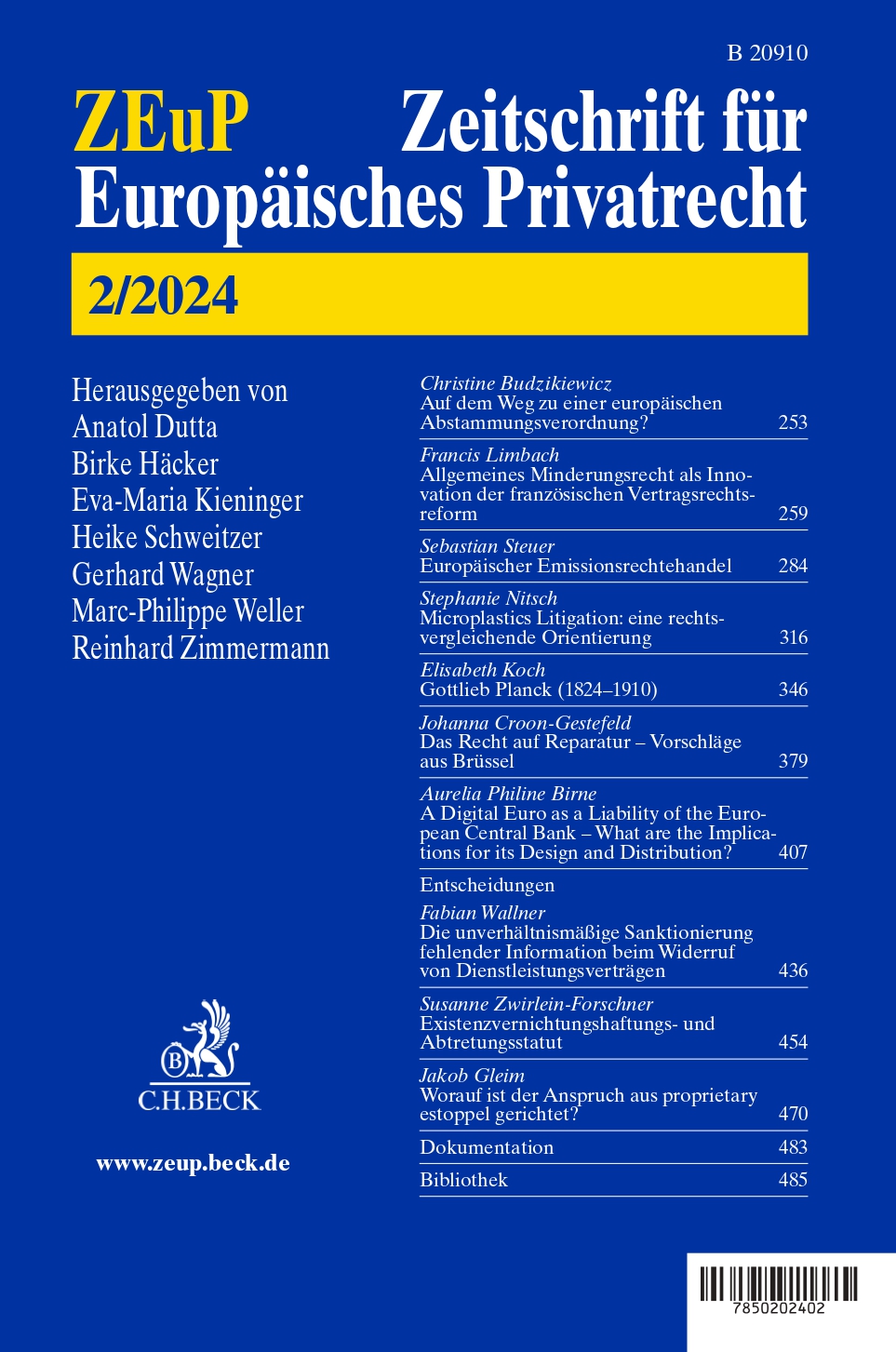
The following contributions might be of particular interest for the readers of this blog:
- Auf dem Weg zu einer europäischen Abstammungsverordnung? – Licht und Schatten im Vorschlag der Europäischen Kommission
Editorial by Christine Budzikiewicz on the Commission Proposal for a EU Regulation on Parenthood and the Creation of a European Certificate of Parenthood - Europäischer Emissionsrechtehandel – Eine Momentaufnahme nach der Reform durch das „Fit for 55“-Paket
Sebastian Steuer on European emissions trading: Carbon pricing according to the “cap and trade” principle plays a key role in European climate policy. As part of the “Fit for 55” package, the Emissions Trading Directive has, once again, undergone comprehensive revisions and has been substantially toughened in certain respects. This article gives a basic overview of the current state of European emissions trading after the recent changes. It explores the chief components of the Emissions Trading Directive, highlights the economic differences between quantity- and price-based regulation, and discusses the interplay of the EU emissions trading system with international and German climate policy. - Microplastics Litigation: eine rechtsvergleichende Orientierung
Stephanie Nitsch on Microplastics Litigation: The present paper provides a comparative law analysis of liability for microplastics pollution with a special focus on product liability as well as liability due to deliberate or negligent breaches of statutory duties or duties of care. - Bundesgerichtshof, 18 April 2023, II ZR 184/21
Susanne Zwirlein-Forschner discusses a decision of the German Federal Court of Justice on the law applicable to liability due to economically destructive actions and to the assignment of claims.