


Views
Mbatha v. Cutting: Implications for Litigants of Indian Origin
Guest Post by Chytanya S. Agarwal*
I. Introduction
Rising cross-border migration of people and concomitant increase in lawsuits relating to matrimonial disputes between couples brings to the forefront the issue of conflict of jurisdictional laws (219th Law Commission Report, ¶1.1-¶1.2). Mbatha v. Cutting is one such recent case that grapples with conflict of laws pertaining to divorce and division of matrimonial property when the spouses are domiciled in separate jurisdictions. In this case, the Georgian Court of Appeal dealt with competing claims from a couple who married in New York and had their matrimonial domicile in South Africa. The wife, domiciled in Georgia, USA, argued for the application of the matrimonial property regime of South Africa – their only (though temporary) common matrimonial domicile. In determining the applicable law, the Court upheld the traditional approach, which favours lex situs for real property and lex domicilii for personal property.
Views and News from the 9th Journal of Private International Law Conference 2023 in Singapore
Four years after the 8th JPIL conference in Munich, the global community of PIL scholars finally got another opportunity to exchange thoughts and ideas, this time at Singapore Management University on the kind invitation of our co-editor Adeline Chong.
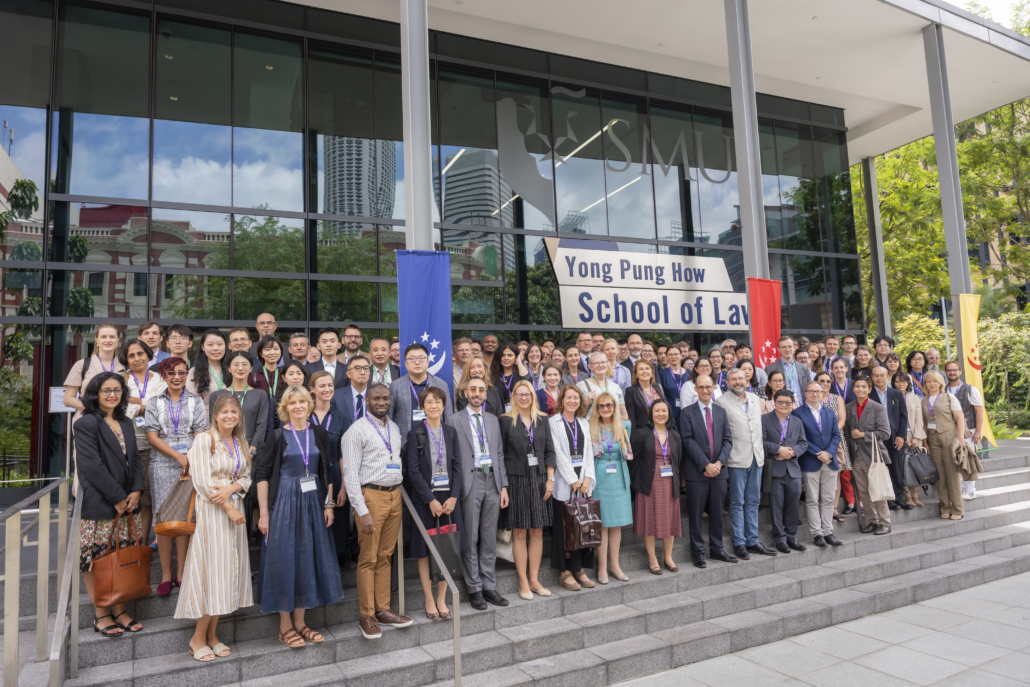
The conference was kicked off by a keynote speech by Justice Philip Jeyaretnam (Singapore International Commercial Court), providing an in-depth analysis of the Court of Appeal’s decision in Anupam Mittal v Westbridge Ventures II [2023] SGCA 1 (discussed in more detail here).
The keynote was followed by a total of 23 panels and four plenary sessions, a selection of which is summarised below by our editors.
The EU Sustainability Directive and Jurisdiction
The Draft for a Corporate Sustainable Due Diligence Directive currently contains no rules on jurisdiction. This creates inconsistencies between the scope of application of the Draft Directive and existing jurisdictional law, both on the EU level and on the domestic level, and can lead to an enforcement gap: EU companies may be able to escape the existing EU jurisdiction; non-EU companies may even not be subject to such jurisdiction. Effectivity requires closing that gap, and we propose ways in which this could be achieved.
(authored by Ralf Michaels and Antonia. Sommerfeld and crossposted at https://eapil.org/)
- The Proposal for a Directive on Corporate Sustainability Due Diligence
The process towards an EU Corporate Sustainability Due Diligence Directive is gaining momentum. The EU Commission published a long awaited Proposal for a Directive on Corporate Sustainability Due Diligence (CSDDD), COM(2022) 71 final, on 23 February 2022; the EU Council adopted its negotiation position on 1 December 2022; and now, the EU Parliament has suggested amendments to this Draft Directive on 1 June 2023. The EU Parliament has thereby backed the compromise textreached by its legal affairs committee on 25 April 2023. This sets off the trilogue between representatives of the Parliament, the Council and the Commission.
News
Private International Law and Sustainable Development in Africa
Editors:
Dr Chukwuma Okoli, Dr Eghosa O. Ekhator, Professor Veronica Ruiz Abou-Nigm, Professor Ralf Michaels, Hans van Loon
Originally sourced from Max Planck Institute for Comparative and International Private Law post on 22 July 2025, with slight amedments.

Recall, on 14 October 2024, we invited submissions to The Journal of Sustainable Development and Policy for a special issue focusing on “Private International Law and Sustainable Development in Africa.”
Make today matter! Under this motto, legal scholars from all over the world gathered at the University of Pretoria on July 8, 2025 to take part in the conference “Sustainable Development and Transnational Law in Africa”. The event was jointly organized by the Law Schools Global League and Max Planck Institute for Comparative and International Private Law with a view to fostering academic exchange across continents on today’s most pressing challenges.
“It was fantastic to see the breadth and depth of work done in and on Africa within the new field of sustainable development and private international law. Thanks are due also to our co-organizers at the Law Schools Global League ant the University of Pretoria; it is so important to hold conferences like this one outside of Europe,” says Max Planck Institute’s Director Ralf Michaels.
The conference program consisted of four panel discussions (for a report, see ? here). The last two panels brought together five of the participants in a current project titled “Private International Law and Sustainable Development in Africa”**:
Solomon Okorley (University of Johannesburg) spoke about International Child Abduction Jurisprudence in South Africa; Grihobou Roland Nombré (Thomas SANKARA University School of Law) discussed the implications of the rise of Nuclear Energy in Africa for Private International Law; Michael K. Quartey (University of Johannesburg) and Theophilus Edwin Coleman (University at Buffalo School of Law & University of Johannesburg) addressed Product Liability Disputes in Ghana from the perspective of sustainable development, and Panji Chirwa (University of Pretoria) looked at the Impact of the EU Directive 2024/1760 on African Sustainability Frameworks.
** The project “Private International Law and Sustainable Development in Africa” forms the African component of the broader initiative “The Private Side of Transforming our World – UN Sustainable Development Goals 2030 and the Role of Private International Law” (see ? here), led globally by Ralf Michaels (Max Planck Institute), Hans Van Loon (previously Secretary General of the Hague Conference on Private International), and Veronica Ruiz Abou-Nigm (University of Edinburgh). The African initiative is spearheaded by Chukwuma Samuel Adesina Okoli (University of Birmingham), in partnership with Eghosa Ekhator (University of Derby) and the Journal of Sustainable Development Law and Policy (Afe Babalola University, Nigeria), and works closely with the global project leaders.
Publication of the fifth editions of the Practical Handbooks on the Operation of the 1965 Service and 1970 Evidence Conventions


The Permanent Bureau of the HCCH is pleased to announce that the fifth editions of the Practical Handbooks on the Operation of the 1965 Service and 1970 Evidence Conventions are now available for purchase in both paper and e-book format.
The 1965 Service and 1970 Evidence Conventions establish uniform frameworks of cooperation mechanisms to streamline, respectively, the transmission of documents for service abroad and the taking of evidence abroad. The Service and Evidence Handbooks are intended to assist users of the Conventions, including Central Authorities, government officials, courts, counsel and legal practitioners, by providing practical guidance on their implementation and operation.
The Practical Handbook on the 1965 Service Convention is designed first and foremost to assist users with the operation of the main and alternative channels of transmission and the provisions regarding adequate protection of the defendant. As for the Practical Handbook on the 1970 Evidence Convention, it is designed to assist users with the operation of the two systems of taking evidence that are provided by the Convention, namely (1) Letters of Request and (2) Consuls and Commissioners. The Practical Handbooks also explain how information technology is and may be used to further enhance the operation of the Conventions, including by incorporating, for the 1970 Evidence Convention, relevant information from the HCCH Guide to Good Practice on the Use of Video-Link.
Incorporating recent developments, court decisions, and practical examples provided by experts from around the world, as well as updates from the meeting of the Special Commission held in July 2024, the fifth editions of the Handbooks are essential resources for anyone involved in the implementation and operation of the 1965 Service and 1970 Evidence Conventions.
More information on how to purchase hard copies and/or e-book copies is available on the Publications section of the HCCH website (for the general public). Specific instructions for HCCH National and Contact Organs and Member Central Authorities designated under the Service and Evidence Conventions are also provided on the Publications section of the HCCH website.
This post is published by the Permanent Bureau of the Hague Conference of Private International Law (HCCH).
Extended Deadline – Call for Papers: “Tariffs: Emerging challenges in global trade” by the Journal of Law, Market & Innovation (JMLI)
We have recently shared the call for papers by the Journal of Law, Market & Innovation (JLMI) for its first issue of 2026. The deadline has now been moved to 20 July 2025.
For further information, we are again referring to the editors who can be reached at editors.jlmi@iuse.it.