


Views
Review of: PP Penasthika, Unravelling Choice of Law in International Commercial Contracts: Indonesia as an Illustrative Case Study (The Hague: Eleven Publishers 2022)

Very recently, Indonesian private international law has attracted significant scholarship in the English language.[1] Dr Penasthika’s monograph (‘the monograph’)[2] is one such work that deserves attention for its compelling and comprehensive account of choice of law in international commercial contracts in Indonesia. My review attempts to capture the methodology, summarise the contents, and give a verdict on the quality of this monograph.
Mbatha v. Cutting: Implications for Litigants of Indian Origin
Guest Post by Chytanya S. Agarwal*
I. Introduction
Rising cross-border migration of people and concomitant increase in lawsuits relating to matrimonial disputes between couples brings to the forefront the issue of conflict of jurisdictional laws (219th Law Commission Report, ¶1.1-¶1.2). Mbatha v. Cutting is one such recent case that grapples with conflict of laws pertaining to divorce and division of matrimonial property when the spouses are domiciled in separate jurisdictions. In this case, the Georgian Court of Appeal dealt with competing claims from a couple who married in New York and had their matrimonial domicile in South Africa. The wife, domiciled in Georgia, USA, argued for the application of the matrimonial property regime of South Africa – their only (though temporary) common matrimonial domicile. In determining the applicable law, the Court upheld the traditional approach, which favours lex situs for real property and lex domicilii for personal property.
Views and News from the 9th Journal of Private International Law Conference 2023 in Singapore
Four years after the 8th JPIL conference in Munich, the global community of PIL scholars finally got another opportunity to exchange thoughts and ideas, this time at Singapore Management University on the kind invitation of our co-editor Adeline Chong.
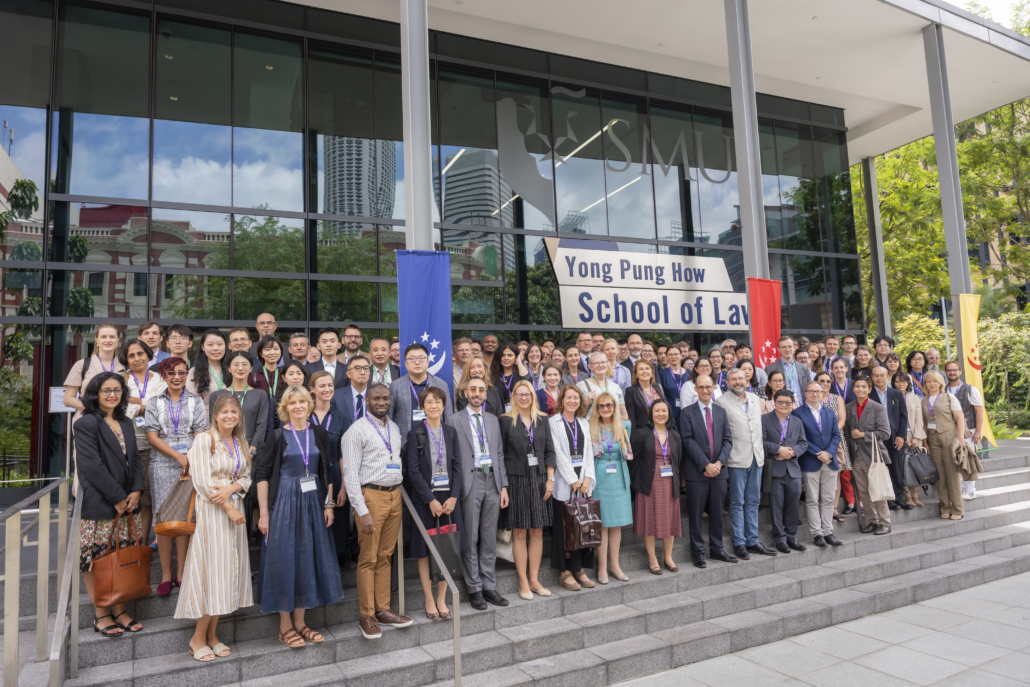
The conference was kicked off by a keynote speech by Justice Philip Jeyaretnam (Singapore International Commercial Court), providing an in-depth analysis of the Court of Appeal’s decision in Anupam Mittal v Westbridge Ventures II [2023] SGCA 1 (discussed in more detail here).
The keynote was followed by a total of 23 panels and four plenary sessions, a selection of which is summarised below by our editors.
News
Extended Deadline – Call for Papers: “Tariffs: Emerging challenges in global trade” by the Journal of Law, Market & Innovation (JMLI)
We have recently shared the call for papers by the Journal of Law, Market & Innovation (JLMI) for its first issue of 2026. The deadline has now been moved to 20 July 2025.
For further information, we are again referring to the editors who can be reached at editors.jlmi@iuse.it.
Call for Papers: Special Issue of the Akdeniz University Faculty of Law Journal in Honor of Peter Hay
Necla Ozturk (Editor of the Akdeniz University Faculty of Law Journal) has kindly shared the following call for papers with us:
On the occasion of the 90th birthday of distinguished legal scholar Professor Dr. Peter Hay, Akdeniz University Faculty of Law Journal is preparing a special issue to be published in 2025, dedicated to his outstanding contributions to Private International Law and Comparative Law.
Throughout his illustrious academic career, Professor Hay has profoundly influenced the field through his pioneering work on the relationships between American, German, and European Private Law systems. His publications, teaching, and international engagements have left a lasting mark on the legal world.
We would be honored to receive a contribution from you for this commemorative issue. We especially welcome articles that address topics aligned with Professor Hay’s areas of expertise or offer critical reflections inspired by his scholarly legacy.
Suggested Topics Include:
• Private International Law
• Comparative Law
• Convergence/Divergence of Legal Systems
• American And European Private Law
• Critical Assessments of Professor Hay’s WorkSubmission Deadline: November 15, 2025
Languages Accepted: Turkish, English, German, French.
Submission Guidelines: https://dergipark.org.tr/en/pub/akdhfd/writing-rulesPlease submit your article via https://dergipark.org.tr/en/pub/akdhfd or hukukdergi@akdeniz.edu.tr by the deadline indicated above.
We look forward to your valuable contribution to this special issue that pays tribute to Professor Peter Hay’s scholarly achievements and influence.
Out Now: Elgar Concise Encyclopedia of International Commercial Arbitration

Despite all recent efforts from the HCCH 2019 Judgments Convention to the founding of International Commercial Courts (ICC) promoting the attractiveness of court litigation, the most favoured method for resolving international disputes in civil and commercial matters, without a single doubt, remains arbitration. According to the 2025 QMUL International Arbitration Survey an overwhelming majority of respondents (87%) would choose international arbitration either as a standalone mechanism (39%) or in combination with other mechanisms of alternative dispute resolution (48%). Read more