


Views
This week begins the Special Commission on the 1980 Child Abduction Convention and the 1996 Child Protection Convention
Written by Mayela Celis
The eighth meeting of the Special Commission on the Practical Operation of the 1980 Child Abduction Convention and the 1996 Child Protection Convention will be held from 10 to 17 October 2023 in The Hague, the Netherlands. For more information, click here.
One of the key documents prepared for the meeting is the Global Report – Statistical study of applications made in 2021 under the 1980 Child Abduction Convention, where crucial information has been gathered about the application of this Convention during the year 2021. However, these figures were perhaps affected by the Covid-19 pandemic as indicated in the Addendum of the document (see paragraphs 157-167, pp. 33-34). Because it refers to a time period in the midst of lockdowns and travel restrictions, it is not unrealistic to say that the figures of the year 2021 should be taken with a grain of salt. For example, the overall return rate was the lowest ever recorded at 39% (it was 45% in 2015). The percentage of the combined sole and multiple reasons for judicial refusals in 2021 was 46% as regards the grave risk exception (it was 25% in 2015). The overall average time taken to reach a final outcome from the receipt of the application by the Central Authority in 2021 was 207 days (it was 164 days in 2015). While statistics are always useful to understand a social phenomenon, one may only wonder why a statistical study was conducted with regard to applications during such an unusual year – apart from the fact that a Special Commission meeting is taking place and needs recent statistics -, as it will unlikely reflect realistic trends (but it can certainly satisfy a curious mind).
Judicial Application of the 1980 HCCH Convention in Morocco
The question of the accession (or reluctance to accede) of Muslim countries to the 1980 HCCH Convention has attracted the interest of scholars from Muslim countries and abroad. Scholars who have addressed this issue have come to different (sometimes contradictory) conclusions, especially when it comes to the influence of classical Islamic rules and principles on the attitudes and policies of Muslim states. Unfortunately, it is not uncommon that the available studies on this subject do not take into account the actual judicial practice of Muslim jurisdictions and focus more on the (theoretical) compatibility (or not) of Islamic rules and principles underlying the 1980 HCCH Convention. This post briefly presents some decisions dealing with the issue of cross-border child abduction under the 1980 HCCH Convention in a Muslim state, Morocco, but without going into too much into details or assessment, as this deserves to be done properly in a dedicated article.
Overview of the 2023 Amendments to Chinese Civil Procedure Law
Written by NIE Yuxin, Wuhan University Institute of International Law
1. Background
China’s Civil Procedure Law was enacted in April 1991 by the Fourth Session of the Seventh National People’s Congress. Since then, it had undergone four revisions in 2007, 2012, 2017, and 2021. However, no substantial revisions were made to the provisions concerning foreign-related civil litigation. The latest amendments to the Civil Procedure Law in 2023, referred to as the new CPL, involve 26 amendments, including 14 modified articles and 15 new additions. Notably, 19 changes deal with the special provisions on cross-border procedures.
News
Chair for Comparative and Private International Law, University of Vienna
The following information was kindly shared with us by Matthias Lehmann (University of Vienna).
At the University of Vienna, a Chair for Comparative Law and Private International Law will become vacant in 2026 (current holder: Professor Helmut Ofner).
The role will be to teach and research private international law and comparative law. Knowledge of the German language and the Austrian legal system is not a prerequisite; however, applicants should be willing to learn German and familiarise themselves with Austrian law. Familiarity with several legal systems is highly desirable. A specialisation in a particular area, such as international family law or international commercial law, is welcome; publications in the field of uniform law and European law are an advantage.
The successful candidate is expected to relocate to Vienna, which is consistently ranked as the most or second-most liveable city in the world (see Global Liveability Index). Initial appointments to a first professorship may be limited to six years, with the possibility of extending it to a permanent position.
More information on the position is available here. The application deadline is 17 September 2025.
[Out Now] Lopez on Choice of Forum Clauses in Asia
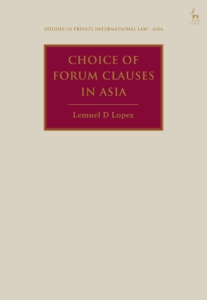
The Hart Series “Studies in Private International Law – Asia” continues to deliver outstanding volumes, the latest being authored by Lemuel D. Lopez (lecturer of Law at the Royal Melbourne Institute of Technology University), and titled “Choice of Forum Clauses in Asia”.
This marks the 13th volume in the series, which was launched only a few years ago in 2019, with many more volumes expected to follow.
The topic is of great significance, and this book provides a much-needed Asian perspective, shedding light on how forum selection clauses function within the region’s unique legal environment.
The book’s description reads as follows:
This book compares and explains the approaches taken by Asian courts when choice of forum clauses in international commercial contracts are challenged in litigation.
It examines key common law jurisdictions (Singapore, Hong Kong and Malaysia), civil law jurisdictions (China, Japan, and Indonesia), and hybrid jurisdictions (the Philippines).
With Asia’s ascent in cross-border trade and investment, alongside a corresponding increase in cross-border litigation, understanding how Asian courts address choice of forum clauses in international commercial contracts has never been more critical. Employing a comparative law method, the book identifies and explains the relief and remedies used by Asian courts in enforcing choice of forum clauses, analysing how their classification as either contractual or procedural in nature shapes judicial approaches. It further distinguishes choice of forum clauses from arbitration agreements and explores their interaction with other contractual provisions. Party autonomy – as the parties’ freedom to determine the contents of the choice of forum clause and the freedom to control the flow of litigation – is also critically scrutinised.Furthermore, the book investigates the factors courts consider in resolving key choice of forum clause issues (ie, enforceability; specific relief to be granted; existence, validity, interpretation of choice of forum clauses; role of mandatory rules, public policy, and international interests) and explores the prospects for future development of this area of law in Asia.
Crucially, the book highlights the unique approaches of Asian courts, while underscoring the differences and similarities among common law, civil law, and hybrid jurisdictions.
Table of Contents
1. Introduction
2. The Nature of Choice-of-Forum Clauses
3. Party Autonomy and Choice-of-Forum Clauses
4. The Enforcement of Choice-of-Forum Clauses: Singapore, Hong Kong, Malaysia, Philippines
5. The Factors Considered in Granting Relief: Singapore, Hong Kong, Malaysia, Philippines
6. Existence, Validity and Interpretation: Singapore, Hong Kong, Malaysia, Philippines
7. Mandatory Rules, Public Policy and International Interests: Singapore, Hong Kong, Malaysia, Philippines
8. Choice of Forum Clauses in Asian Civil Law Countries: China, Indonesia and Japan
9. Conclusions
2026 applications for a 6-month internship in The Hague, Netherlands
The Australian Institute of International Affairs and the Australian Branch of the International Law Association call for applications for the 2026 Peter Nygh Hague Conference Internship.