


Views
International high-tech surrogacy and legal developments in the Netherlands
This blogpost is an edited version of this blogpost written in Dutch by Stichting IJI (The Hague Institute for private international law and foreign law). We thought it was interesting to also bring it to the attention of the international readership of this blog.
Introduction
In the Netherlands, international high-tech surrogacy is a hot topic, resulting in interesting legal developments. Recently, a Dutch District Court dealt with a case on the recognition of US court decisions on legal parenthood over children born from a high-tech surrogacy trajectory in the US, providing many private international law insights on how to assess such request for recognition. Furthermore, on July 4 a bill was proposed that encloses several private international law provisions. This blogpost briefly highlights both developments.
Same-sex relationships concluded abroad in Namibia – Between (Limited) Judicial Recognition and Legislative Rejection
There is no doubt that the issue of same-sex marriage is highly controversial. This is true for both liberal and conservative societies, especially when the same-sex union to be formed involves parties from different countries. Liberal societies may be tempted to open up access to same-sex marriage to all, especially when their citizens are involved and regardless of whether the same-sex marriage is permitted under the personal law of the other foreign party. For conservative societies, the challenge is even greater, as local authorities may have to decide whether or not to recognise same-sex marriages contracted abroad (in particular when their nationals are involved). The issue becomes even more complicated in countries where domestic law is hostile to, or even criminalises, same-sex relationships.
Cassirer on Remand: Considering the Laws of Other Interested States
This post is by Carlos Manuel Vázquez, a professor of law at Georgetown Law School. It is cross-posted at Transnational Litigation Blog.
Claude Cassirer brought suit in federal court in California eighteen years ago against the Thyssen Bornemisza Museum of Madrid, Spain, to recover a painting by Camille Pissarro that was stolen from his grandmother by the Nazis during World War II. After a reversal and remand from the U.S. Supreme Court last summer, the case is now before the Ninth Circuit for decision of the legal question that is likely to be decisive: which law governs?
The district court and the court of appeals have so far framed the issue as a binary choice: the governing law on the merits is either that of Spain or that of California. I suggest here that the issue is better framed as a choice between the law of Spain, on the one hand, and the laws of all the other states or countries with connections to the dispute, on the other. (Disclosure: I submitted expert declarations in support of the plaintiffs on issues of public international law during earlier phases of this case.)
The U.S. Court of Appeals for the Ninth Circuit has affirmed the district court’s holding that, under the law of Spain, the plaintiff loses because the museum acquired title to the painting through adverse possession (otherwise known as acquisitive prescription). It is equally clear that, under the law of California, the plaintiff would prevail because California does not recognize the acquisition of title to moveable property through adverse possession. What has so far not featured prominently in the courts’ analyses of the choice-of-law issue is that the plaintiff would also prevail under the laws of all the other jurisdictions that have relevant connections to the dispute. Under governmental interest analysis, this should be central to the analysis. Read more
News
[Out Now] Lopez on Choice of Forum Clauses in Asia
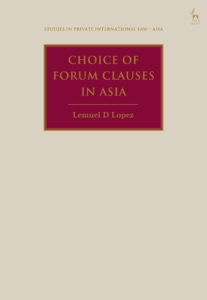
The Hart Series “Studies in Private International Law – Asia” continues to deliver outstanding volumes, the latest being authored by Lemuel D. Lopez (lecturer of Law at the Royal Melbourne Institute of Technology University), and titled “Choice of Forum Clauses in Asia”.
This marks the 13th volume in the series, which was launched only a few years ago in 2019, with many more volumes expected to follow.
The topic is of great significance, and this book provides a much-needed Asian perspective, shedding light on how forum selection clauses function within the region’s unique legal environment.
The book’s description reads as follows:
This book compares and explains the approaches taken by Asian courts when choice of forum clauses in international commercial contracts are challenged in litigation.
It examines key common law jurisdictions (Singapore, Hong Kong and Malaysia), civil law jurisdictions (China, Japan, and Indonesia), and hybrid jurisdictions (the Philippines).
With Asia’s ascent in cross-border trade and investment, alongside a corresponding increase in cross-border litigation, understanding how Asian courts address choice of forum clauses in international commercial contracts has never been more critical. Employing a comparative law method, the book identifies and explains the relief and remedies used by Asian courts in enforcing choice of forum clauses, analysing how their classification as either contractual or procedural in nature shapes judicial approaches. It further distinguishes choice of forum clauses from arbitration agreements and explores their interaction with other contractual provisions. Party autonomy – as the parties’ freedom to determine the contents of the choice of forum clause and the freedom to control the flow of litigation – is also critically scrutinised.Furthermore, the book investigates the factors courts consider in resolving key choice of forum clause issues (ie, enforceability; specific relief to be granted; existence, validity, interpretation of choice of forum clauses; role of mandatory rules, public policy, and international interests) and explores the prospects for future development of this area of law in Asia.
Crucially, the book highlights the unique approaches of Asian courts, while underscoring the differences and similarities among common law, civil law, and hybrid jurisdictions.
Table of Contents
1. Introduction
2. The Nature of Choice-of-Forum Clauses
3. Party Autonomy and Choice-of-Forum Clauses
4. The Enforcement of Choice-of-Forum Clauses: Singapore, Hong Kong, Malaysia, Philippines
5. The Factors Considered in Granting Relief: Singapore, Hong Kong, Malaysia, Philippines
6. Existence, Validity and Interpretation: Singapore, Hong Kong, Malaysia, Philippines
7. Mandatory Rules, Public Policy and International Interests: Singapore, Hong Kong, Malaysia, Philippines
8. Choice of Forum Clauses in Asian Civil Law Countries: China, Indonesia and Japan
9. Conclusions
2026 applications for a 6-month internship in The Hague, Netherlands
The Australian Institute of International Affairs and the Australian Branch of the International Law Association call for applications for the 2026 Peter Nygh Hague Conference Internship.
New Journal: Perspectives contentieuses internationales (PCI)
The following announcement was kindly shared with us by Fabienne Jault-Seseke
Created with the support of LexisNexis, the Review Perspectives contentieuses internationales (PCI) is a biannual academic journal dedicated to the globalization of international litigation in both its public and private aspects. Each issue features a thematic dossier, complemented by several articles outside the main topic (Varia), as well as brief focus pieces addressing current events relevant to political or regulatory developments impacting international disputes (Focus).
The editorial committee, which ensures the scientific and operational direction of the Review, is composed of Sandrine Clavel, Patrick Jacob, and Fabienne Jault-Seseke (professors at Université Paris-Saclay, UVSQ).
Three issues have already been published and are available open access.