


Views
The EU Sustainability Directive and Jurisdiction
The Draft for a Corporate Sustainable Due Diligence Directive currently contains no rules on jurisdiction. This creates inconsistencies between the scope of application of the Draft Directive and existing jurisdictional law, both on the EU level and on the domestic level, and can lead to an enforcement gap: EU companies may be able to escape the existing EU jurisdiction; non-EU companies may even not be subject to such jurisdiction. Effectivity requires closing that gap, and we propose ways in which this could be achieved.
(authored by Ralf Michaels and Antonia. Sommerfeld and crossposted at https://eapil.org/)
- The Proposal for a Directive on Corporate Sustainability Due Diligence
The process towards an EU Corporate Sustainability Due Diligence Directive is gaining momentum. The EU Commission published a long awaited Proposal for a Directive on Corporate Sustainability Due Diligence (CSDDD), COM(2022) 71 final, on 23 February 2022; the EU Council adopted its negotiation position on 1 December 2022; and now, the EU Parliament has suggested amendments to this Draft Directive on 1 June 2023. The EU Parliament has thereby backed the compromise textreached by its legal affairs committee on 25 April 2023. This sets off the trilogue between representatives of the Parliament, the Council and the Commission.
No Sunset of Retained EU Conflict of Laws in the UK, but Increased Risk of Sunburn
By Dr Johannes Ungerer, University of Oxford
The sunset of retained EU law in the UK has begun: the Retained EU Law (Revocation and Reform) Act 2023 received Royal Assent at the end of June. The Act will revoke many EU laws that have so far been retained in the UK by the end of 2023.
The good news for the conflict of laws is that the retained Rome I and II Regulations are not included in the long list of EU legal instruments which are affected by the mass-revocation. Both Regulations have been retained in the UK post-Brexit by section 3 of the European Union (Withdrawal) Act 2018 and were modified by the Law Applicable to Contractual Obligations and Non-Contractual Obligations (Amendment etc.) (EU Exit) Regulations 2019 (as amended in 2020). The retained (modified) Rome I and II Regulations will thus be part of domestic law beyond the end of 2023. Yet this retained EU law must not be called by name anymore: it will be called “assimilated law” according to section 5 of the Retained EU Law (Revocation and Reform) Act 2023 (although the title of this enactment, like others, will strangely continue to contain the phrase “Retained EU Law” and will not be changed to “Assimilated Law”, see section 5(5)).
The CJEU on Procedural Rules in Child Abduction Cases: private international law and children’s rights law
Comment on CJEU case Rzecznik Praw Dziecka e.a., C-638/22 PPU, 16 February 2023)
Written by Tine Van Hof, post-doc researcher in Private International Law and Children’s Rights Law at the University of Antwerp, previously published on EU live
The Court of Justice of the EU has been criticised after some previous cases concerning international child abduction such as Povse and Aguirre Zarraga for prioritising the effectiveness of the EU private international law framework (i.e. the Brussels IIa Regulation, since replaced by Brussels IIb, and the principle of mutual trust) and using the children’s rights law framework (i.e. Article 24 of the EU Charter of Fundamental Rights and the principle of the child’s best interests) in a functional manner (see e.g. Silvia Bartolini and Ruth Lamont). In Rzecznik Praw Dziecka the Court takes both frameworks into account but does not prioritise one or the other, since the frameworks concur.
News
Judgment of the Hellenic Supreme Court Part 2: Relatives’ rights to compensation for emotional distress in fatal car accidents under the Rome II Regulation
Following a judgment by the Supreme Court of Greece in 2023, the issue of direct damages was once again brought before Areios Pagos. In a decision that diverged from the ruling of the Court of Justice of the European Union (CJEU) in the Lazar case, the Supreme Court reaffirmed its position. However, one member of the court expressed a dissenting opinion, emphasizing the obligation of national courts to submit a preliminary reference. This judge provided rationale for the Supreme Court’s departure from established case law, highlighting the importance of adhering to the CJEU’s precedents in the context of European legal integration.
Out Now: The 50th anniversary of the first Inter-American specialized conference on private international law. The future of private international law in the Americas by Dante Mauricio Negro Alvarado
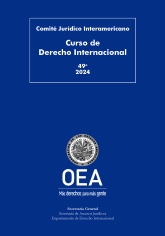
The Department of International Law (Secretariat for Legal Affairs) of the Organization of American States (OAS) has just published in essay form the lectures delivered during the 49th Course on International Law, which was held on 5 -16 August 2024. For more information, click here.
The book features the following piece: The 50th anniversary of the first Inter-American specialized conference on private international law. The future of private international law in the Americas by Dante Mauricio Negro Alvarado (in English, p. 295-335). This is a must-read for Private International Law academics and lawyers from the region and beyond. Read more
Call for Abstracts – Emerging Voices in Private International Law (Asser Institute)
Post prepared by Eduardo Silva de Freitas, PhD researcher Erasmus University Rotterdam and junior researcher at the Asser Institute
As part of its 60th anniversary celebrations, the T.M.C. Asser Institute invites abstracts for the panel “Emerging Voices in Private International Law”, to be held on 24 October 2025 in The Hague, at the conference Adapting Private International Law in an Era of Uncertainty.
The panel will feature two early-career scholars (PhD candidates or postdoctoral researchers) presenting original work in the field. Selected participants will also contribute to a forthcoming volume in the Short Studies in Private International Law series.
To apply, please submit a 400-word abstract and brief personal details by 15 August 2025 (24:00 CET) to: e.silva.de.freitas@asser.nl
Full call for abstracts: https://www.asser.nl/media/797989/call-for-abstracts_pil_asser.pdf