


Views
Review of: PP Penasthika, Unravelling Choice of Law in International Commercial Contracts: Indonesia as an Illustrative Case Study (The Hague: Eleven Publishers 2022)

Very recently, Indonesian private international law has attracted significant scholarship in the English language.[1] Dr Penasthika’s monograph (‘the monograph’)[2] is one such work that deserves attention for its compelling and comprehensive account of choice of law in international commercial contracts in Indonesia. My review attempts to capture the methodology, summarise the contents, and give a verdict on the quality of this monograph.
Mbatha v. Cutting: Implications for Litigants of Indian Origin
Guest Post by Chytanya S. Agarwal*
I. Introduction
Rising cross-border migration of people and concomitant increase in lawsuits relating to matrimonial disputes between couples brings to the forefront the issue of conflict of jurisdictional laws (219th Law Commission Report, ¶1.1-¶1.2). Mbatha v. Cutting is one such recent case that grapples with conflict of laws pertaining to divorce and division of matrimonial property when the spouses are domiciled in separate jurisdictions. In this case, the Georgian Court of Appeal dealt with competing claims from a couple who married in New York and had their matrimonial domicile in South Africa. The wife, domiciled in Georgia, USA, argued for the application of the matrimonial property regime of South Africa – their only (though temporary) common matrimonial domicile. In determining the applicable law, the Court upheld the traditional approach, which favours lex situs for real property and lex domicilii for personal property.
Views and News from the 9th Journal of Private International Law Conference 2023 in Singapore
Four years after the 8th JPIL conference in Munich, the global community of PIL scholars finally got another opportunity to exchange thoughts and ideas, this time at Singapore Management University on the kind invitation of our co-editor Adeline Chong.
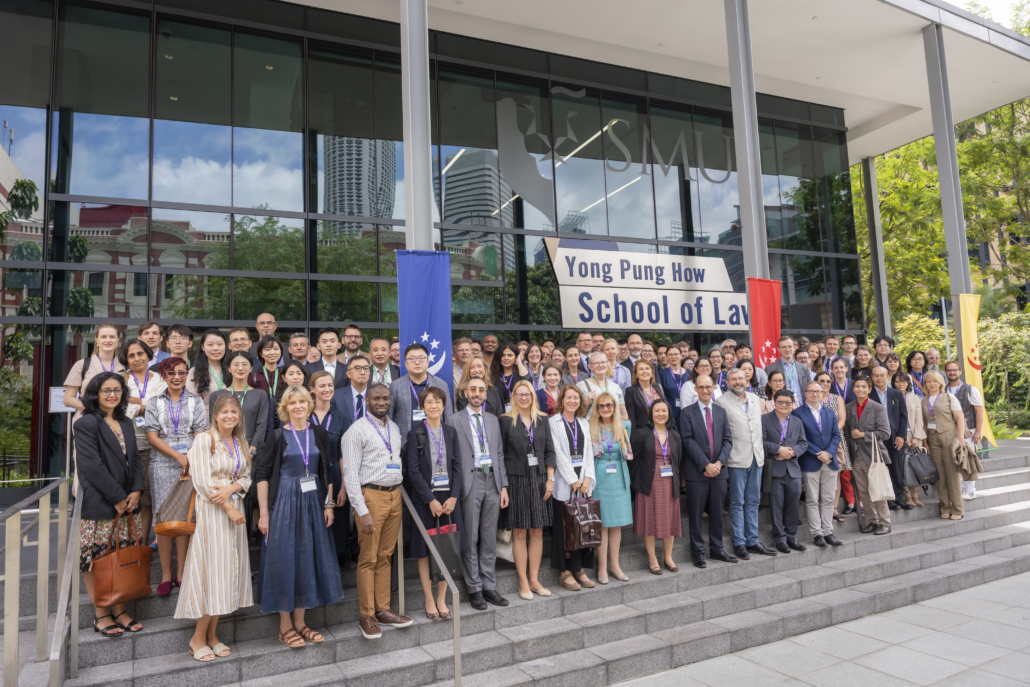
The conference was kicked off by a keynote speech by Justice Philip Jeyaretnam (Singapore International Commercial Court), providing an in-depth analysis of the Court of Appeal’s decision in Anupam Mittal v Westbridge Ventures II [2023] SGCA 1 (discussed in more detail here).
The keynote was followed by a total of 23 panels and four plenary sessions, a selection of which is summarised below by our editors.
News
The Establishment of the International Organization for Mediation (IOMed)
On 30 May 2025, the signing of the Convention on the Establishment of the International Organization for Mediation (IOMed) in Hong Kong marked an advancement in the field of international dispute resolution. Attended by representatives from over 85 countries and 20 international organisations – including the United Nations – the event introduced a treaty-based institutional framework dedicated specifically to mediation.
The IOMed Convention – with equally authentic texts in Arabic, Chinese, English, French, Russian, and Spanish – outlines a structured, treaty-based model of mediation whose scope is deliberately broad, encompassing disputes between States, between a State and nationals of other States, as well as disputes between private parties involved in international commercial relationships (Article 24).
A defining feature of the IOMed Convention is its treatment of the legal effect and enforceability of mediated outcomes. Articles 40 and 41 affirm both the binding nature of settlement agreements resulting from IOMed-facilitated mediation and their enforceability within the domestic legal systems of contracting States. This model of consensual yet normatively binding dispute resolution finds a compelling parallel in – and complements – the United Nations Convention on International Settlement Agreements Resulting from Mediation (the Singapore Convention). The Singapore Convention – which, as of 3 July 2025, counts 58 signatories and 18 parties – reinforces party autonomy while requiring the good faith implementation of mediated settlements. Particularly significant is Article 3 of the Convention, which obliges courts in contracting States to recognise international commercial settlement agreements and to enforce them in accordance with domestic procedures, provided the agreement satisfies the Convention’s requirements. While the Singapore Convention offers a uniform and efficient framework for the enforcement and “invocation” (see Art. 3(2)) of international settlement agreements resulting from mediation, the IOMed Convention contributes by establishing the institutional and procedural framework necessary for the conduct of mediation itself. Together, these instruments enhance both the normative foundation and the practical viability of cross-border mediation, thereby reinforcing its legitimacy in complex international commercial contexts.
Beyond its dispute resolution functions, IOMed also assumes a broader mandate to promote mediation (Art. 5). This includes fostering best practices (Art. 5(b)), organising conferences and training initiatives (Art. 5(c)), and implementing targeted capacity-building programmes (Art. 5(d)). A dedicated Mediation Fund (Art. 44), financed through voluntary contributions, is intended to promote equitable access to services, while a Capacity Building Committee (Art. 43) provides strategic oversight in this domain.
Ultimately, the IOMed Convention does not seek to alter the fundamental character of mediation. Rather, it aims to provide a coherent legal and institutional foundation at the international level. By anchoring mediation within a treaty-based framework, the IOMed Convention offers States and other actors a structured yet flexible environment in which to pursue dialogue-based resolution, with greater predictability, neutrality, and institutional support – while preserving the essential consensual nature that distinguishes mediation from adjudication. While its practical impact will depend on how States and other actors engage with its mechanisms over time, the Convention offers a new platform for exploring the potential of mediation in a variety of international contexts.
The HCCH 2019 Judgments Convention enters into force for the United Kingdom

Today the HCCH 2019 Judgments Convention entered into force for the United Kingdom. The UK signed this Convention on 12 January 2024 and filed its instrument of ratification on 27 June 2024.
On 26 March 2025, the UK extended the 2019 Judgments Convention to Scotland and Northern Ireland. Initially, the UK had extended this Convention to England and Wales only. These declarations will take effect on the day the Convention enters into force for the UK in accordance with Articles 25 & 30(3)(4) of the said Convention. For more information, click here. Read more
Praxis des Internationalen Privat- und Verfahrensrechts (IPRax) 4/2025: Abstracts
The latest issue of the „Praxis des Internationalen Privat- und Verfahrensrechts“ (IPRax) features the following articles: