


Views
Choice of law in commercial contracts and regulatory competition: new steps to be made by the EU?
The recently published study titled ‘European Commercial Contract Law’, authored by Andrea Bertolini, addresses the theme of regulatory competition. It offers new policy recommendations to improve EU legal systems’ chances of being chosen as the law governing commercial contracts.
The Study’s main question
The European Parliament’s Committee on Legal Affairs has published a new study authored by Andrea Bertolini, titled ‘European Commercial Contract Law’ (the ‘Study’). The Study formulates the main question as follows: ‘why the law chosen in commercial contracts is largely non-European and non-member state law’. The expression ‘non-European and non-member state’ law is specified as denoting the legal systems of England and Wales, the United States, and Singapore, and more generally, common law legal systems. The Study states:
It is easily observed how most often international contracts are governed by non-European law. The reasons why this occurs are up to debate and could be quite varied both in nature and relevance. Indeed, a recent study by Singapore Academy of Law (SAL) found that 43 per cent of commercial practitioners and in-house counsel preferred English law as the governing law of the contracts. Read more
Financial Hardship and Forum Selection Clauses
The U.S. Supreme Court has long held that a forum selection clause should not be enforced when “trial in the contractual forum will be so gravely difficult and inconvenient” that the plaintiff “will for all practical purposes be deprived of his day in court.” The financial status of the plaintiff is obviously a factor that should be considered as part of this inquiry. Large corporations can usually afford to litigate cases in distant courts. Individual plaintiffs frequently lack the resources to do so. Nevertheless, the lower federal courts in the United States have repeatedly held that financial hardship on the part of the plaintiff is not enough to make an otherwise valid forum selection clause unenforceable. Read more
Revised Canadian Statute on Judgment Enforcement
Two years ago, the Uniform Law Conference of Canada (ULCC) released a revised version of the Court Jurisdiction and Proceedings Transfer Act (CJPTA), model legislation putting the taking of jurisdiction and staying of proceedings on a statutory footing. The statute is available here.
The ULCC has now released a revised version of another model statute, the Enforcement of Canadian Judgments Act (ECJA). The original version of this statute was prepared in 1998 and had been amended four times. It has now been consolidated and substantially revised. It is available here and background information is available here and here.
News
Rivista di diritto internazionale privato e processuale (RDIPP) No 2/2025: Abstracts
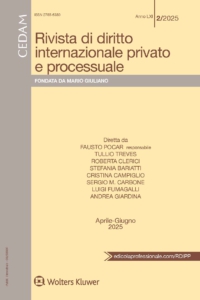 With a slight delay – entirely due to myself – I am pleased to announce the release of the second 2025 issue of the Rivista di diritto internazionale privato e processuale (RDIPP, published by CEDAM). This issue features:
Francesco Pesce, Associate Professor at the University of Genoa, Il riconoscimento delle decisioni straniere in materia civile tra previsioni sulla competenza funzionale del giudice interno e comunicazioni alla Commissione europea (Recognition of Foreign Decisions in Civil Matters between Provisions on the Functional Jurisdiction of National Courts and Communications to the European Commission; in Italian) Read more
Virtual Workshop (in English) on September 2, 2025: Eva Lein on “PIL and dispute resolution in times of crisis”

On Tuesday, September 2, 2025, the Hamburg Max Planck Institute will host its monthly virtual workshop Current Research in Private International Law at 11:00 a.m. – 12:30 p.m. (CEST). Professor Eva Lein (Lausanne University) will speak, in English, about the topic
“PIL and dispute resolution in times of crisis”
In times of polycrisis, the law is put to the challenge. In international commercial transactions the question is how law can safeguard commercial activity, avoid a plethora of disputes, and encourage a pragmatic legal environment conducive to global economic recovery. This contribution discusses how dispute settlement mechanisms and private international law can be used to responsibly manage disputes in this context and to appropriately respond to future crises.
The presentation will be followed by open discussion. All are welcome. More information and sign-up here.
If you want to be invited to these events in the future, please write to veranstaltungen@mpipriv.de.
UEMATSU on Cross-border Patent Litigation and Lis Alibi Pendens: A Korean–Japanese Case Study for Future Asian Principles of Private International Law
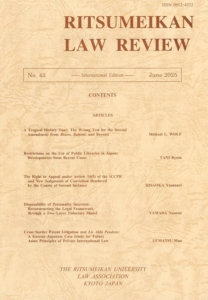
The latest issue of the Ritsumeikan Law Review (No. 43, 2025), a law review in English published by the Ritsumeikan University Law Association since 1986, features a study by Professor Mao UEMATSU (School of Law, Ritsumeikan University) entitled Cross-border Patent Litigation and Lis Alibi Pendens: A Korean–Japanese Case Study for Future Asian Principles of Private International Law.
The article examines a series of patent litigation cases in Korea and Japan, analyzing them to “illustrate the complexity of cross-border patent litigation.” It further argues that, even after reforms to procedural laws in both Korea and Japan, structurally similar cross-border conflicts remain unresolved. The paper concludes with preliminary reflections on possible improvements in legal coordination within Asia.
By introducing case law from both jurisdictions and sharing information on recent legal developments in the region, the study provides valuable material for comparative research and contributes to a better understanding of the dynamics of Asian private international law.
The paper is freely available at the Ritsumeikan Law Review online version here.