
Rivista di diritto internazionale privato e processuale (RDIPP) No 2/2025: Abstracts


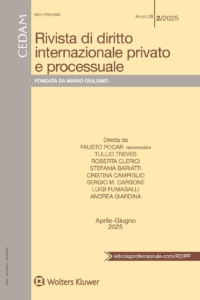 With a slight delay – entirely due to myself – I am pleased to announce the release of the second 2025 issue of the Rivista di diritto internazionale privato e processuale (RDIPP, published by CEDAM). This issue features:
Francesco Pesce, Associate Professor at the University of Genoa, Il riconoscimento delle decisioni straniere in materia civile tra previsioni sulla competenza funzionale del giudice interno e comunicazioni alla Commissione europea (Recognition of Foreign Decisions in Civil Matters between Provisions on the Functional Jurisdiction of National Courts and Communications to the European Commission; in Italian)
The implementation of the Regulations adopted by the EU in the context of so-called civil judicial cooperation has assumed an increasing importance over the last twenty years, due to the progressive expansion of the areas of intervention of the legislator of the European Union. Nonetheless, some of the repercussions of such uniform legislation do not seem to have been appropriately reversed, by the Italian national legislator, into the code of civil procedure and into the other special provisions aimed at ruling civil proceedings. With regard to the recognition and enforcement of foreign decisions, it appears that notwithstanding the ever more pressing need to address the matter in a complete and organic manner, a situation of inertia has prevailed in the Italian legal system, moving from the idea that, where compatible with the new EU Regulations, the domestic procedural rules could also be adapted to the intra-European circulation of judgments. This has resulted in a rather fragmentary and incomplete internal regulatory framework of civil procedure, so affecting the principle of legal certainty due to the lack of specific provisions aimed at implementing the EU discipline dedicated to the free movement of decisions. Moreover, the EU Regulations here considered require that each country informs the Commission, by means of a formal communication, of the internal procedures that may be relevant in the application of the uniform discipline (with particular reference to the competent national authorities and to the specific applicable procedures): in this regard – even after the 2022 ‘Cartabia’ reform of civil procedure – it seems that the content of the Italian communications is, in some cases, not only devoid of an adequate legislative basis of reference from the point of view of the national system, but even unreasonable and incoherent if observed in a systemic perspective.
This issue also comprises the following comments:
Curzio Fossati, Postdoctoral research fellow at the University of Cagliari, L’incidenza dell’obbligo di riconoscimento dello status filiationis nell’Unione europea sugli ordinamenti nazionali (The Impact on National Legal Systems of the Obligation to Recognise Filiation Status within the European Union; in Italian)
This article examines whether each Member State of the European Union is obliged to recognise the filiation established in another Member State. Noting the current lack of uniform private international law rules on filiation, the paper considers some examples of conflict-of-laws rules in force in the Member States and highlights the main differences between them. It then analyses the case-law of the Court of Justice on the circulation of personal and family status between Member States in order to examine the scope and basis of the Court’s obligation for Member States to recognise such status. The aim of this work is to show that the solution adopted by the Court of Justice is only partially able to resolve the problematic aspects of the current private international law regulation of filiation, highlighting persistent uncertainties and critical issues.
Kevin Silvestri, Doctor in law, La legge regolatrice degli effetti dell’apertura di procedure di insolvenza sui processi su crediti pendenti all’estero (The Law Governing the Effects of the Opening of Insolvency Proceedings on Proceedings Concerning Claims Pending Abroad; in Italian)
This paper examines a specific facet of the broader challenge of cross-border insolvency proceedings: identifying the law that governs the effect of opening insolvency proceedings in one State on lawsuits concerning creditors’ claims that are already pending in another. The issue is particularly delicate for several reasons. On the one hand, the impact of insolvency proceedings on ongoing creditor litigation is a key element in determining the liabilities of the estate under the lex fori concursus. This includes, in particular, how the proof of claims process interacts with pending lawsuits involving the debtor. On the other hand, under the principle lex fori regit processum, the rules applicable to those lawsuits may differ from those governing the insolvency proceedings themselves, especially when the litigation is pending abroad. This work highlights the tension between these competing principles and explores the difficulties that arise when the legal systems involved adopt different methods of coordinating the proof of claims process with creditor litigation. It then turns to the divergent interpretations of Article 18 of Regulation (EU) 2015/848, which seeks to determine the applicable law in such cases. Scholars have advanced a range of interpretations, reflecting the complexity created by the divergences among European leges concursus concerning the treatment of creditor lawsuits pending at the commencement of insolvency proceedings.
Finally, the issue features the following book review by Lenka Válková, Research fellow at the University of Milan: GEERT VAN CALSTER, European Private International Law: Commercial Litigation in the EU, Cambridge, Hart Publishing, 2024, 4th ed., p. 1-468.
