


Views
Reappreciating the Composite Approach with Anupam Mittal v Westbridge II
Written by: Aditya Singh, BA.LL.B. (Hons) student at the National Law School of India University(NLSIU), Bengaluru and line editor at the National Law School Business Law Review (NLSBLR)
I. INTRODUCTION
The debate surrounding the composite approach i.e., the approach of accommodating the application of both the law applicable to the substantive contract and the Lex Fori to the arbitration clause has recently resurfaced with Anupam Mittal v Westbridge Ventures II (“Westbridge”). In this case, the Singapore Court of Appeal paved way for application of both the law governing substantive contract and the Lex Fori to determine the arbitrability of the concerned oppression and mismanagement dispute. The same was based on principle of comity, past precedents and s 11 of the International Arbitration Act. The text of s 11 (governing arbitrability) does not specify and hence limit the law determining public policy to Lex Fori. In any event, the composite approach regardless of any provision, majorly stems from basic contractual interpretation that extends the law governing substantive contract to the arbitration clause unless the presumption is rebuttable. For instance, in the instant case, the dispute would have been rendered in-arbitrable with the application of Indian law (law governing substantive contract) and hence the Singapore law was inferred to be the implied choice.[1] Read more
Measure twice, cut once: Dutch case Presta v VLEP on choice of law in employment contracts
Presta v VLEP (23 june 2023) illustrates the application of the CEJU’s Gruber Logistics (Case C-152/20, 15 July 2021) by the Dutch Supreme Court. In order to determine the law applicable to an individual employment contract under article 8 Rome I, one must compare the level of protection that would have existed in the absence of a choice of law (in this case, Dutch law) with the level of protection offered by the law chosen by the parties in the contract (in this case, the laws of Luxembourg), thereafter, the law of the country offering the highest level of employee protection should be applied.
U.S. Supreme Court Renders Personal Jurisdiction Decision
This post is by Maggie Gardner, a professor of law at Cornell Law School. It is cross-posted at Transnational Litigation Blog.
The U.S. Supreme Court yesterday upheld the constitutionality of Pennsylvania’s corporate registration statute, even though it requires out-of-state corporations registering to do business within the state to consent to all-purpose (general) personal jurisdiction. The result in Mallory v. Norfolk Southern Railway Co. re-opens the door to suing foreign companies in U.S. courts over disputes that arise in other countries. It may also have significant repercussions for personal jurisdiction doctrine more broadly. Read more
News
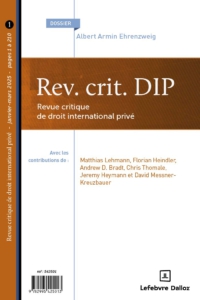
Revue Critique de droit international privé – issue 2025/1
 Written by Hadrien Pauchard (assistant researcher and doctoral student at Sciences Po Law School)
The first issue of the Revue Critique de droit international privé of 2025 has just been released. It gathers six contributions honouring Albert Armin Ehrenzweig and his legacy, as well as seven case notes and numerous book reviews.
The doctrinal part of the volume is devoted to the proceedings of the Albert Armin Ehrenzweig Conference organized in June 2024 at the University of Vienna, fifty years after the passing away of the great author. The contributions commemorate both the man and the scientist, testifying to the relevance of Albert A. Ehrenzweig’s scholarship to contemporary private international law. They are published in French in the printed version of the Revue (also available online here), and will be available shortly in English (here).
Out Now: Dickinson, Natural Justice in Recognition and Enforcement of Foreign Judgments, Recueil des cours, Tome 446
Last summer, Andrew Dickinson (Professor of the Conflict of Laws, University of Oxford, and former editor of ConflictofLaws.net) delivered a special course at the summer course of the Hague Academy of International Law entitled ‘Natural Justice in Recognition and Enforcement of Foreign Judgments’. It has now been published as Volume 446 of the Recueil des cours / Collected Courses.
The blurb reads as follows:
This special course assesses the utility of ideas of ‘natural law’ and ‘natural justice’ as tools to explain, rationalise and develop the rules governing the recognition and enforcement of foreign judgments currently applied by the world’s legal orders.
After introducing the topic, the first part of the course consider how influential 17th and 18th century accounts of the law of nature sought to account for the relations existing between all human beings, as well as the creation of political societies with law-making powers, the global ordering of those societies and the role of adjudication as a means of resolving disputes within and among them. This provides the historical and intellectual background for what follows.
The principal part of the course considers how writers on the conflict of laws in this period drew upon and utilised these ideas, as the rules that we apply today to regulate foreign judgments began to take shape. This leads to a study of the further evolution of the legal landscape in the 19th century, highlighting the use of natural law reasoning by judges and commentators to explain and justify the effectiveness of individual exercises of adjudicatory authority beyond their original domains, as well as the later rejection of natural law thinking in favour of models centred on ideas of sovereignty and territoriality, which continue to dominate today.
Having completed this historical survey, the course examines the specific legacy of natural law reasoning in the common law world, involving the use of principles of ‘natural justice’ to deny recognition of unjust foreign judgments, as well as the counterparts of these principles in other legal systems and international treaties.
Drawing on the preceding material, the concluding chapter considers the case for renaturalising the law in this area, and the implications of following this path.
More information on the book can be found here.
It is available to subscribers to the Recueil des cours here.
AMEDIP: Annual seminar to take place from 22 to 24 October 2025 (in Spanish)

The Mexican Academy of Private International and Comparative Law (AMEDIP) will be holding its XLVIII Seminar entitled “Reflections regarding the Inter-American system in the 50th Anniversary of the CIDIP-I and the latest developments of Private International Law in Mexico” (Reflexiones en torno al sistema interamericano en el 50 Aniversario de la CIDIP-I y la actualidad del Derecho Internacional Privado en México) from 22 to 24 October 2025. The venue of the seminar will be the Universidad Autónoma de Querétaro (Querétaro, Mexico). Read more