


Views
Same-sex relationships concluded abroad in Namibia – Between (Limited) Judicial Recognition and Legislative Rejection
There is no doubt that the issue of same-sex marriage is highly controversial. This is true for both liberal and conservative societies, especially when the same-sex union to be formed involves parties from different countries. Liberal societies may be tempted to open up access to same-sex marriage to all, especially when their citizens are involved and regardless of whether the same-sex marriage is permitted under the personal law of the other foreign party. For conservative societies, the challenge is even greater, as local authorities may have to decide whether or not to recognise same-sex marriages contracted abroad (in particular when their nationals are involved). The issue becomes even more complicated in countries where domestic law is hostile to, or even criminalises, same-sex relationships.
Cassirer on Remand: Considering the Laws of Other Interested States
This post is by Carlos Manuel Vázquez, a professor of law at Georgetown Law School. It is cross-posted at Transnational Litigation Blog.
Claude Cassirer brought suit in federal court in California eighteen years ago against the Thyssen Bornemisza Museum of Madrid, Spain, to recover a painting by Camille Pissarro that was stolen from his grandmother by the Nazis during World War II. After a reversal and remand from the U.S. Supreme Court last summer, the case is now before the Ninth Circuit for decision of the legal question that is likely to be decisive: which law governs?
The district court and the court of appeals have so far framed the issue as a binary choice: the governing law on the merits is either that of Spain or that of California. I suggest here that the issue is better framed as a choice between the law of Spain, on the one hand, and the laws of all the other states or countries with connections to the dispute, on the other. (Disclosure: I submitted expert declarations in support of the plaintiffs on issues of public international law during earlier phases of this case.)
The U.S. Court of Appeals for the Ninth Circuit has affirmed the district court’s holding that, under the law of Spain, the plaintiff loses because the museum acquired title to the painting through adverse possession (otherwise known as acquisitive prescription). It is equally clear that, under the law of California, the plaintiff would prevail because California does not recognize the acquisition of title to moveable property through adverse possession. What has so far not featured prominently in the courts’ analyses of the choice-of-law issue is that the plaintiff would also prevail under the laws of all the other jurisdictions that have relevant connections to the dispute. Under governmental interest analysis, this should be central to the analysis. Read more
Review of: PP Penasthika, Unravelling Choice of Law in International Commercial Contracts: Indonesia as an Illustrative Case Study (The Hague: Eleven Publishers 2022)

Very recently, Indonesian private international law has attracted significant scholarship in the English language.[1] Dr Penasthika’s monograph (‘the monograph’)[2] is one such work that deserves attention for its compelling and comprehensive account of choice of law in international commercial contracts in Indonesia. My review attempts to capture the methodology, summarise the contents, and give a verdict on the quality of this monograph.
News
5th German Conference for Young Researchers in Private International Law in Heidelberg – Conference Report
Written by Victoria Hélène Dintelmann (Heidelberg University)
 On February 14th and 15th, 2025, more than one hundred young academics gathered at Heidelberg University for the 5th German Conference for Young Researchers in Private International Law to discuss the topic “Digital Transformation and Private International Law – Local Connections in Boundless Spaces”. The conference was organized by Andreas Engel, Sophia Schwemmer, Felix Berner, Aron Johanson, Markus Lieberknecht, Ann-Kathrin Voß, Charlotte Wendland and Anton Zimmermann.

PIL conference in Ljubljana, 18 September 2025
University of Ljubljana is organising Private International Law Conference with sessions in Slovenian and English. The conference, which will take place in Ljubljana (Slovenia) on 18 September 2025, will gather reknown academics and practitioners who will address current topics in European and international PIL.
The programme is available by clicking here: PIL-Ljubljana2025 and for more infromation you are welcome to contact the organisers at: ipp.pf@pf.uni-lj.si.
Registration Open Soon: The Hague Academy of International Law’s Winter Courses 2026
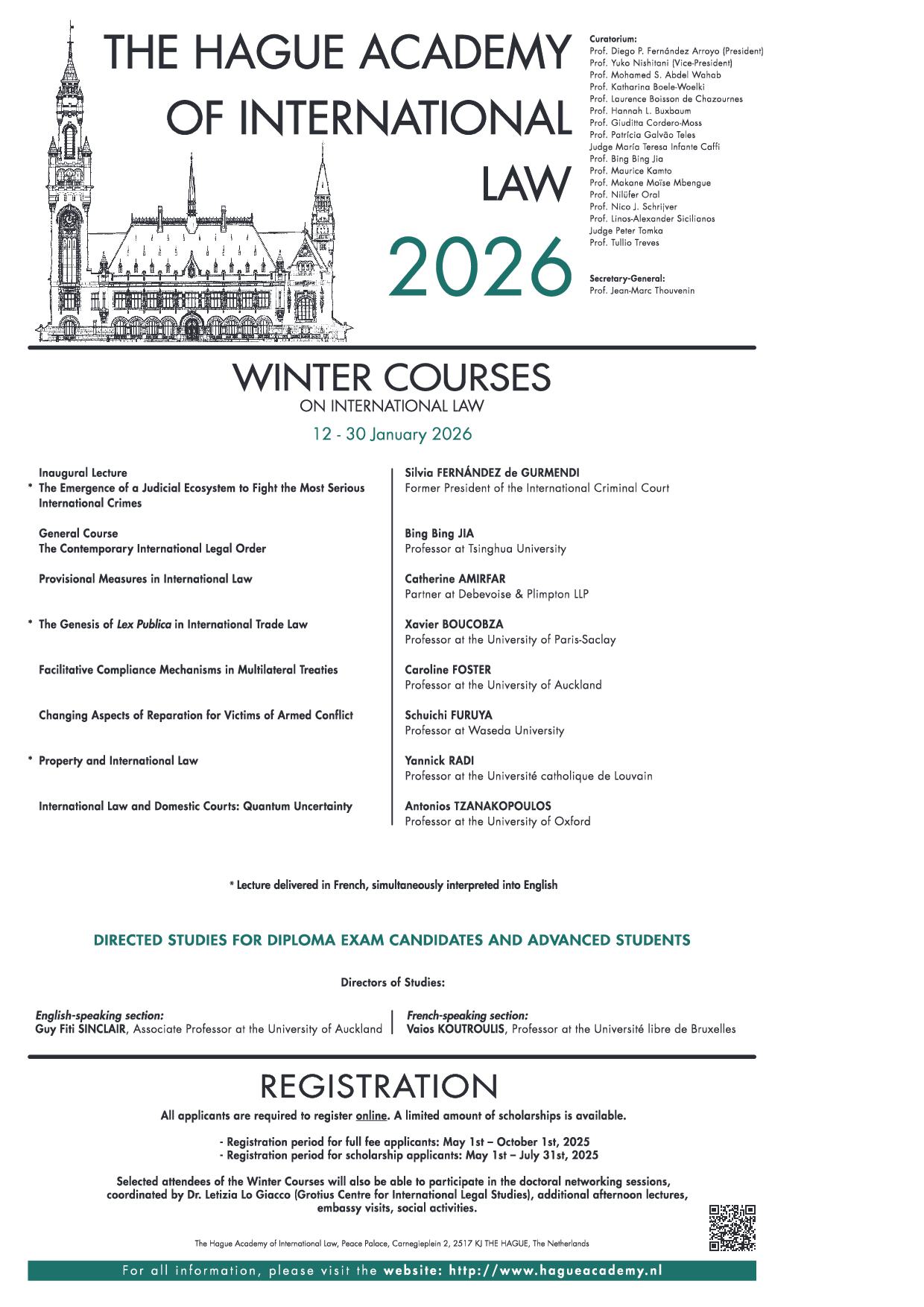
Recently, the Hague Academy of International Law published the 2026 programme of its renowned Winter Courses in International Law (12-30 January 2026). Unlike the Summer Courses, this program presents lectures on both Public and Private International Law and therefore provides for a particularly holistic academic experience. Once again, the Academy has spared no effort in inviting legal scholars from around the world to The Hague, including speakers from countries as diverse as Argentina, Belgium, China, France, Japan, the United Kingdom, and the United States, offering its audience a truly global perspective on the topic. Read more