


Views
The Public Law-Private Law Divide and Access to Frozen Russian Assets
By Csongor István Nagy, Professor of Law at the University of Galway, Ireland, and at the University of Szeged, Hungary, and research professor at the HUN-REN Center for Social Sciences, Hungary.
The overwhelming majority of the international community condemned Russia’s war against Ukraine as a gross violation of international law and several countries introduced unilateral measures freezing Russian assets. It has been argued that countries should go beyond that and use these assets for the indemnification of Ukrainian war damages. Confiscation would, however, be unprecedented and raise serious international law concerns. While states have, with good reason, been reluctant to react to one wrongful act with another, this question has given rise to intensive debate. Recently, the EU authorized the use of net profits from the frozen assets but not the assets themselves to support Ukraine.
Tesseract: Don’t Over-React! The High Court of Australia, Proportionate Liability, Arbitration, and Private International Law
By Dr Benjamin Hayward
Associate Professor, Department of Business Law and Taxation, Monash Business School
X: @LawGuyPI, @MonashITICL
On 7 August 2024, the High Court of Australia handed down its long-awaited decision in Tesseract International Pty Ltd v Pascale Construction Pty Ltd [2024] HCA 24. The dispute arose out of a domestic commercial arbitration seated in South Australia, where the Commercial Arbitration Act 2011 (SA) is the relevant lex arbitri. That Act is a domestically focused adaptation of the UNCITRAL Model Law on International Commercial Arbitration (with its 2006 amendments).
The respondent to the arbitration sought to rely upon proportionate liability legislation found in the Law Reform (Contributory Negligence and Apportionment of Liability) Act 2001 (SA) and in the Competition and Consumer Act 2010 (Cth). The High Court was asked to determine whether those proportionate liability regimes could be applied in the arbitration. A very practical difficulty arose here, reflected in Steward J noting (in dissent) that the High Court was ‘faced with an invidious choice’: see [228]. Were the proportionate liability laws not to apply in the arbitration, the respondent might find themselves liable for 100% of the applicant’s loss, when they would not be liable to that same extent in court proceedings applying the same body of South Australian law. But were the proportionate liability laws to apply, the applicant might find themselves able to recover only a portion of their loss in the arbitration, and might then have to then pursue court proceedings against another third party wrongdoer to recover the rest: given that joinder is not possible in arbitration without consent. Read more
News
HCCH Monthly Update: November 2025
HCCH Monthly Update: November 2025
Conventions & Instruments
On 5 November 2025, Algeria deposited its instrument of accession to the 1961 Apostille Convention. With the ratification of Argentina, the Convention now has 58 Contracting Parties. With the accession of Algeria, the 1961 Apostille Convention now has 128 Contracting Parties. It will enter into force for Algeria on 9 July 2026. More information is available here.
On 27 November 2025, Monaco deposited its instrument of accession to the 2005 Choice of Court Convention. With the accession of Monaco, 38 States and the European Union are bound by the 2005 Choice of Court Convention. The Convention will enter into force for Monaco on 1 March 2026. More information is available here.
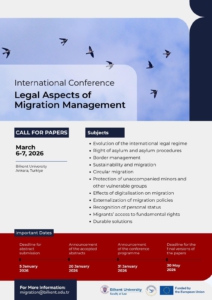
Call for Papers- International Conference on Legal Aspects of Migration Management
Bilkent University Faculty of Law and Jean Monnet Chair in Legal Aspects of Migration Management in the EU and in Türkiye cordially invite you to submit abstracts for the International Conference on Legal Aspects of Migration Management to be held at Bilkent University on 6-7 March 2026.
The Conference aims to give the opportunity to researchers who would like to present their theoretical or empirical research on the development of policy, legislative and administrative responses to key migration issues.
We particularly encourage submissions on the questions of evolution of the international legal regime relating to migration; the right of asylum and asylum procedures; border management; sustainability and migration; circular migration; protection of unaccompanied minors and other vulnerable groups; effects of digitalisation on migration; externalization of migration policies, recognition of personal status; migrants’ access to fundamental rights and durable solutions. Proposals involving comparative perspectives of international, European and national approaches are most welcome.
Abstracts (max. 500 words) (in English or in Turkish) should be sent to migration@bilkent.edu.tr by 5 January 2026.
Detailed information shall be provided upon request: migration@bilkent.edu.tr
Chronology of Practice: Chinese Practice in Private International Law in 2024 Published
Written by Dr. Zihao Fan (Peking University Law School)
On 14 November 2025, the annual survey Chronology of Practice: Chinese Practice in Private International Law in 2024 (“the 2024 Survey”) was published in the Chinese Journal of International Law (Oxford University Press, Vol. 24(4)). This survey continues the long-running series of yearly reports, now in its twelfth year since 2013, and it remains an indispensable resource documenting China’s development in private international law for an international audience. The Survey is available at:
https://academic.oup.com/chinesejil/article/24/4/jmaf031/8321298?login=true
- Content and Focus of the 2024 Survey
The 2024 Survey covers six areas: an overview, civil subjects, jurisdiction, choice of law, international judicial assistance, and international arbitration and judicial review. Its characteristics are as follows:
First, the Survey follows the structure of previous years, summarising original materials without providing commentary.
Second, it further streamlines case facts and extracts core viewpoints. It covers two revised laws, one treaty approved by the Chinese government, three new and three revised administrative regulations, three judicial interpretations, seven batches of Supreme People’s Court (SPC) case reports, forty-three directly relevant typical cases, one SPC Work Report, and other official information and media sources.
Third, it focuses on several key issues:
- Ascertainment of extraterritorial law. In recent years, China has not only established multiple ascertainment centres, but the SPC has also issued specialised judicial interpretations and typical cases. Local courts have introduced rules relating to the ascertainment of foreign law, and many local courts and foreign-law ascertainment centres have published dedicated reports. These achievements have placed China’s judicial practice in foreign-law ascertainment genuinely “at the forefront” internationally.
- Jurisdiction in anti-monopoly cases and the application of the appropriate-connection principle became focal points of Chinese private international law practice during the year.
- Choice of law in contracts. SPC Reply Regarding the Validity of an Agreement Entered into by a Hong Kong or Macao-Funded Enterprise Registered in the Mainland Part of the Guangdong-Hong Kong-Macao Greater Bay Area to Choose the Law of Hong Kong or Macao as the Applicable Law for Contracts or to Designate Hong Kong or Macao as the Place of Arbitration represents a significant breakthrough: two Mainland parties may choose Hong Kong or Macau law and may designate Hong Kong or Macau as the place of arbitration.
- Judicial review of arbitration. The SPC selected fifteen typical cases concerning judicial review of arbitration, including cases supporting the further development of Hong Kong arbitration, which is of positive significance.
Fourth, the 2024 Survey also covers other matters, including representative offices of foreign enterprises and foreign law firms in China. Notably, provisions allowing for the extraterritorial application of Chinese law are becoming increasingly common, and the securities-law field witnessed the first case in which a court exercised jurisdiction based on such a provision.
- Abstract of the 2024 Survey
The Survey provides the following abstract:
The 2024 survey of the Chinese practices in private international law highlights five aspects: First, in terms of legislative developments, two revised laws, three new and three revised administrative regulations, three judicial interpretations, were adopted. The Supreme People’s Court (“SPC”) also issued seven groups of 43 typical cases. Additionally, China ratified the Agreement on Judicial Assistance and Cooperation in Civil or Commercial Matters with Saudi Arabia. Second, Chinese courts concluded substantial numbers of international cases: 26,000 foreign-related civil and commercial cases, 34,000 maritime cases and 18,000 commercial arbitration judicial review cases. Third, regarding jurisdiction, Chinese courts for the first time applied the appropriate connection approach under Article 276(2) of the Civil Procedure Law. In civil monopoly cases, both the SPC’s new judicial interpretation and selected cases confirmed that jurisdiction follows tort and contract rules. Fourth, regarding choice of law, foreign law ascertainment remains prominent, with Chinese courts demonstrating increased efforts to research and apply foreign laws through numerous reports, cases and rules. Finally, regarding arbitration, the SPC released six typical cases supporting the arbitration in Hong Kong and a Report on Judicial Review of Commercial Arbitration. In the Report, the SPC identified three cases involving public policy to illustrate the application scope while maintaining strict application standards.
III. Core Rationale of the Survey Series
Since 2013, the English-language annual Survey of Chinese private international law practice has centred on developments in Chinese private international law, reviewing both institutional developments and judicial practice. It covers conflict of laws, uniform substantive law, international civil procedure, international commercial arbitration, and international commercial mediation. This structure is common to all editions, though specific emphases vary each year.
Between 2013 and 2024, the series has addressed twelve SPC Work Reports, twenty-nine laws, thirteen administrative regulations, seventy-six judicial-interpretation-type documents, and 307 cases.
It is noteworthy that Chinese courts adjudicate more than 45,000 foreign-related civil, commercial and maritime cases each year. Most cases included in the Survey are selected by the team after extensive review of large numbers of judgments available on China Judgments Online and Peking University’s legal database, with the intention of identifying representative examples.
By providing original materials—including legislative and regulatory developments and case law—the series traces the evolution of China’s foreign-related civil and commercial legal system and judicial practice. The author aims to “tell the story of China’s foreign-related rule of law in an international language”, using a documentary style that enables domestic and international readers to appreciate China’s progress in this field.