


Views
Abu Dhabi Court of Cassation on Civil Family Law and Muslim Foreigners: Has the Tide Turned?
Written by Lena-Maria Möller,
College of Law, Qatar University
The recent introduction of a civil family law regime in the United Arab Emirates – the first of its kind in the region – has attracted considerable attention, both on this blog and beyond.[1] A key unresolved issue has been the law’s applicability in Abu Dhabi, particularly regarding access for Muslim foreigners to the emirate’s newly established Civil Family Court. Scholars and legal practitioners navigating this new framework have long observed a surprising discrepancy, if not an ideological tension, between the law’s drafters and those interpreting it, especially at the higher court level. Central to this divergence has been whether Abu Dhabi’s Law on Civil Marriage and Its Effects (Law No. 14/2021 of 7 November 2021, as subsequently amended) and its Procedural Regulation (Chairman Resolution No. 8/2022 of 1 February 2022) apply exclusively to non-Muslims or extend also to Muslim foreigners who are citizens of non-Muslim jurisdictions. A recent judgment by the Abu Dhabi Court of Cassation in late October affirmed jurisdiction over Muslim foreigners with dual French-Moroccan nationality, marking a potential shift in personal jurisdiction. This ruling may expand access to a legal framework devoid of religious underpinnings for many Muslim expatriates in the UAE.
Book review: H. Muir Watt’s The Law’s Ultimate Frontier: Towards an Ecological Jurisprudence – A Global Horizon in Private International Law (Hart)
(Written by E. Farnoux and S. Fulli-Lemaire, Professors at the University of Strasbourg)
 Horatia Muir Watt (Sciences Po) hardly needs an introduction to the readers of this blog. The book published last year and reviewed here constitutes the latest installment in her critical epistemological exploration of the field of private international law. More specifically, the book builds upon previously published fundamental reflections on the methods of private international law already initiated (or developed) in her previous general course (in French) at the Hague Academy of International Law (Discours sur les méthodes du droit international privé (des formes juridiques de l’inter-altérité)), as well as on the contemporary relevance of private international law (“Private International Law Beyond the Schism”). Numerous other works, naturally, also come to mind when reading this book (see among many others, ed. with L. Bíziková, A. Brandão de Oliveira, D. Fernandez Arroyo, Global Private International Law : adjudication without frontiers; Private International Law and Public law).
The publication of a book on the field that this blog deals with would be enough to justify it being flagged for the readers’ attention. We feel, however, that its relevance to our academic pursuits warrants more than a mere heads-up and, while it would be unreasonable (and risky) to try to summarize the content of this engrossing and complex book in a blog friendly format, we would like to make a few remarks intended to encourage the readers of this blog to engage with this innovative and surprising work.
Transforming legal borders: international judicial cooperation and technology in private international law – Part II
Written by Yasmín Aguada** [1]– Laura Martina Jeifetz ***[2]. Part I is available here
Abstract: Part II aims to delve deeper into the aspects addressed in the previously published Part I. International Judicial Cooperation (IJC) and advanced technologies redefine Private International Law (PIL) in a globalized world. The convergences between legal collaboration among countries and technological innovations have revolutionized how cross-border legal issues are approached and resolved. These tools streamline international legal processes, overcoming old obstacles and generating new challenges. This paper explores how this intersection reshapes the global legal landscape, analyzing its advantages, challenges, and prospects.
Keywords: private international law, international judicial cooperation, new technologies, videoconferencing, direct judicial communications, Smart contracts, and Blockchain.
News
PAX Moot – Deadline for registration is Friday 16 January 2026 at 23:59 CET
The PAX Moot 2026 Vladimir Koutikov Round is well underway. The case was published on 13 October 2025 and is available here. The deadline for registration is 16 January 2026 at 23:59 CET.
Save the date: The oral rounds will take place from 15 to 17 April 2026 in Sofia, Bulgaria.
27th Volume of the Japanese Yearbook of Private International Law (2025)

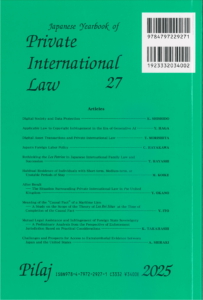
The 27th Volume (2025) of the Japanese Yearbook of Private International Law (JYPIL) (Kokusai Shiho Nenpo [Japanese]) published by the Private International Law Association of Japan (Kokusai Shiho Gakkai [Japanese]) (“PILAJ”) has recently been released.
This new volume features the following table of content.
The papers are published in Japanese; all links below direct to the papers’ English summaries.
Jiménez and Martínez on A Private International Law for Colombia
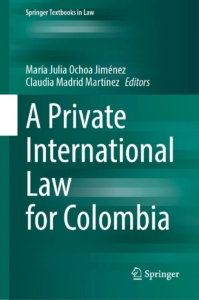
Colombian private international law research has been witnessing a notable period of renewed scholarly activity. Following a previous announcement on this blog of the publication of a volume dedicated to the Colombian Draft Project on Private International Law, a further significant contribution has now been published, this time offering a broader and more systematic perspective on the field. This new contribution takes the form of a book edited by María Julia Ochoa Jiménez (Loyola University) and Claudia Madrid Martínez (University of Antioquia), entitled “A Private International Law for Colombia”, published in the Springer Textbooks in Law series (Springer, 2025).
According to the publisher’s website, the book offers a “[c]omprehensive study of issues underlying PIL, particularly in Latin America and Colombia”, provides “[s]ystematical analysis of PIL rules in Colombia, allowing readers to understand how they deal with global issues”, and “[a]ddresses rules in force, critically examines them and, accordantly, presents and discusses a legislative proposal”. Read more