


Views
The $24 Billion Judgment Against China in Missouri’s COVID Suit
This article was written by Prof. William S. Dodge (George Washington University Law School) and first published on Transnational Litigation Blog. The original version can be found at Transnational Litigation Blog. Reposted with permission.
On March 7, 2025, Judge Stephen N. Limbaugh, Jr. (Eastern District of Missouri) entered a default judgment for more than $24 billion against the People’s Republic of China and eight other Chinese defendants for hoarding personal protective equipment (PPE) during the early days of the COVID pandemic in violation of federal and state antitrust laws. The Eighth Circuit had previously held that the Foreign Sovereign Immunities Act (FSIA) barred most of Missouri’s claims but that the hoarding claim fell within the act’s commercial activity exception.
Missouri now has the judgment against China that it wanted. But Missouri may find that judgment hard to enforce. As discussed below, there appear to be significant procedural problems with the judgment that at least some defendants might raise. More broadly, the properties of foreign states and their agencies or instrumentalities are entitled to immunity from execution under the FSIA. Immunity from execution is broader than immunity from suit, and it is not clear that any of the defendants have property in the United States that can be used to satisfy the judgment. Read more
Trending Topics in German PIL 2024 (Part 1 – Illegal Gambling and “Volkswagen”)
At the end of each year I publish an article (in German) about the Conflict of Laws developments in Germany of the last twelve months, covering more or less the year 2024 and the last months of 2023. I thought it would be interesting for the readers of this blog to get an overview over those topics that seem to be most trending.
The article focuses on the following topics:
- Restitution of Money lost in Illegal Gambling
- Applicable Law in the Dieselgate litigation
- The (Non-)Valitidy of Online Marriages
- New German conflict-of-law rules regarding gender afiliation / identity
- Reforms in international name law
I will start in this post with the two first areas that are mainly dealing with questions of Rome I and Rome II while in my follow-up post I will focus on the three areas that are not harmonized by EU law (yet) and are mainly questions of family law.
Chinese Judicial Practice on Asymmetric Choice of Court Agreements in International Civil & Commercial Disputes
By Yuchen Li, a PhD student at Wuhan University.
A. Introduction
An asymmetric choice of court agreement is commonly used in international commercial transactions, especially in financial agreements, which usually allows one party (option holder) an optional choice about the forum in which proceedings may be brought but the other (non-option holder) an exclusive choice to sue in a designated court.[1] A typical example is as follows:
‘(A) The courts of England have exclusive jurisdiction to settle any disputes ….
(B) The Parties agree that the courts of England are the most appropriate and convenient courts … to settle Disputes and accordingly no Party will argue to the contrary.
(C) This Clause is for the benefit of the Finance Parties only. As a result, no Finance Party shall be prevented from taking proceedings relating to a Dispute in any other courts with jurisdiction. To the extent allowed by law, the Finance Parties may take concurrent proceedings in any number of jurisdictions.’ [2]
In recent years, issues concerning asymmetric choice of court agreements have been controversial in cases within some jurisdictions.[3] Despite the significant amount of research on asymmetric choice of court agreements, little attention has been paid to Chinese stance on this topic. With Chinese private parties actively engaging in international transactions, Chinese attitude towards such clauses is important for commercial parties and academic researchers. This article gives a glimpse of how Chinese courts handle asymmetric choice of court agreements in international and commercial civil litigations.[4] Read more
News
EAPIL Conference in Geneva from 18-20 June 2026: Registration open!
 From 18 to 20 June 2026 the European Association of Private International Law (EAPIL) will host its third biannual conference. Following the Association’s conferences in Aarhus (Denmark) and Wroclaw (Poland) the conference promises to be a key event for scholars and practitioners interested in the present and future of European private international law.
Programme and Audience
Under the title “Shaping the Future of Private International Law in Europe – Putting Together the Pieces & Filling Gaps”, the conference will address structural developments, unresolved issues, and emerging challenges in European private international law. Special emphasis will be placed on 1) the consolidation of European private international law in a single instrument (EuPIL Act), 2) the unification of international property law (including the protection of cultural objects), and 3) the relationship of European Private International Law with third States.
All topics will be addressed from an analytical and a forward-looking perspective, combining doctrinal reflection with policy-oriented debate. Contributions will come from an internationally diverse group of speakers, reflecting EAPIL’s commitment to comparative and transnational perspectives.
The conference is open to academics, judges, practitioners, policymakers, and early-career researchers with an interest in (European) private international law.
Venue and Organisation
Hosted by the Faculty of Law of the University of Geneva, the conference will take place exclusively in person in Geneva. The choice of venue underscores the international outlook of the event and provides an ideal setting for scholarly exchange and networking.
Registration
Registration is available here. An early-bird rate applies until 15 March 2026, with standard registration available until 17 May 2026. Participation fees vary depending on registration date and include the option to attend the conference dinner. Further details on fees and registration can be found on the conference website.
Why Attend?
The EAPIL Conference 2026 offers a unique opportunity to:
- engage with cutting-edge research in private international law,
- discuss current reform projects and unresolved doctrinal questions,
- connect with leading scholars and practitioners from across jurisdictions, and
- contribute to shaping the future development of the field.
Further Information
More information on the programme, registration, and practical details is available on the conference website.
About EAPIL
The European Association of Private International Law was founded in 2019 to promote the study and development of Private International Law. It has today more than 600 members from more than 70 countries. For more information visit the EAPIL website and follow the EAPIL blog.
Crossroads in Private International Law Webinar with Tobias Lutzi on “Crossroads in Private International Law Seminar on the Reform of EU Private International Law” at the University of Aberdeen
The Centre for Private International Law & Transnational Governance of the University of Aberdeen is continuing its Crossroads in Private International Law webinar series with a talk by Tobias Lutzi (University of Augsburg) titled ‘Between Ambition and Realism – What to Expect from the Upcoming Reforms to the Rome II and Brussels Ia Regulation?’: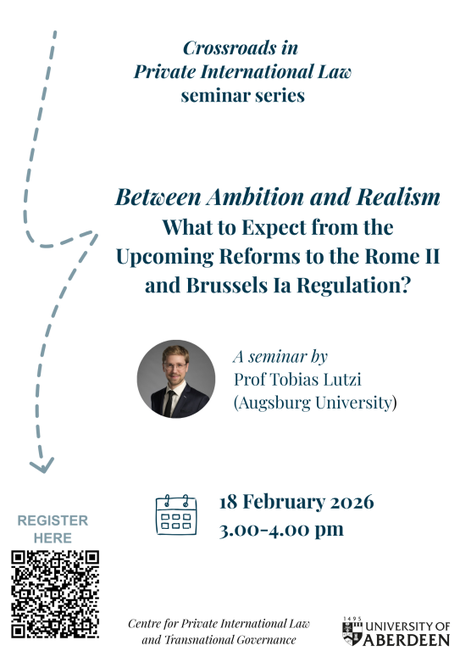
The Centre for Private International Law & Transnational Governance invites you to attend the next seminar in our Crossroads in Private International Law seminar series. You can find the link to register at the bottom of this page.
Prof Tobias Lutzi (Junior Professor for Private Law at Augsburg University) will give a seminar on the reforms to the Rome II and Brussels Ia Regulation. Prof Lutzi has kindly provided the following abstract:
Last year, the EU Commission formally kicked off the process of reforming two key instruments of EU Private International Law, identifying potential areas for reform and setting out some overarching policy goals. In 2026, the Commission will face the more difficult decision of which of those areas to actually focus on. This talk will discuss the respective merits of those areas of reform, highlighting the tension between ambition and realism that will shape the Commission’s work.
We are looking forward to welcoming you online or on campus!
Additional information and the link to register can be found here.
Revue critique de droit international privé – Issue 2025/4
Written by Hadrien Pauchard (assistant researcher and doctoral student at Sciences Po Law School)
The fourth and last issue of the Revue Critique de droit international privé of 2025 has just been released. It contains four articles, eight case notes, and six book reviews. In line with the Revue Critique’s policy, the doctrinal part will soon be made available in English on the editor’s website (for registered users and institutions). Read more