


Views
Trending Topics in German PIL 2024 (Part 2 – Online Marriages, Gender Afiliation and Name Law)
As already mentioned in my previous post, at the end of each year I publish an article (in German) about the Conflict of Laws developments in Germany of the last twelve months, covering more or less the year 2024 and the last months of 2023. This post is the second with an overview over those topics that seem to be most trending.
The two parts focus on the following topics (part 1 contained 1. and 2.):
- Restitution of Money lost in Illegal Gambling
- Applicable Law in the Dieselgate litigation
- The (Non-)Valitidy of Online Marriages
- New German conflict-of-law rules regarding gender afiliation / identity
- Reforms in international name law
I will now give attention to the last three topics that focus on the three areas that are not harmonized by EU law (yet) and are mainly questions of family law.
The FSIA’s Direct Effects Problem
Post authored by Lance Huckabee, JD candidate and Global Legal Scholar at the University of Pittsburgh School of Law
When a foreign sovereign breaches a commercial contract with a private entity, what recourse does the wronged party have? In the United States, the Foreign Sovereign Immunities Act (FSIA) governs such disputes, providing an exception for commercial activity that causes a “direct effect” in the U.S. Yet, the definition of “direct effect” has remained elusive, leading to decades of judicial inconsistency and a deepening circuit split.
At the heart of this legal uncertainty is the Supreme Court’s decision in Republic of Argentina v. Weltover (1992), which sought to clarify the issue but instead left room for widely divergent interpretations. Some circuits have adopted a flexible, causation-based approach, analyzing whether a foreign state’s breach had an immediate consequence in the U.S. Others, like the recent D.C. Circuit decision in Wye Oak Tech., Inc. v. Republic of Iraq, have imposed rigid bright-line rules—specifically requiring that the contract contemplate the U.S. as a place of performance. This formalistic approach creates a dangerous loophole, allowing foreign states to structure agreements in a way that insulates them from jurisdiction. As a result, a U.S. business may suffer substantial financial harm from a foreign sovereign’s breach but find itself without legal recourse simply because the contract was silent on where payments were to be made.
This restrictive interpretation undermines the FSIA’s core purpose: to hold foreign sovereigns accountable when their commercial activities impact U.S. businesses. By prioritizing contractual language over economic reality, decisions like Wye Oak erode the ability of American companies to seek redress, making sovereign breaches effectively consequence-free. A proper interpretation of the FSIA should align with Weltover’s focus on causation, ensuring that foreign states cannot exploit technicalities to evade liability. If left uncorrected, the current trend risks turning the FSIA into little more than a paper shield—one that protects sovereigns rather than those they harm.
The Wye Oak decision exacerbates both intra- and inter-circuit inconsistencies, further complicating the FSIA’s application and weakening the commercial activity exception in breach-of-contract cases. By imposing a rigid bright-line rule, it unduly narrows the scope of what qualifies as a “direct effect,” creating uncertainty for U.S. businesses engaged in international commerce. With Wye Oak’s attorneys petitioning for certiorari in January 2025, the case presents a critical opportunity for the Supreme Court to resolve the longstanding circuit split on the FSIA’s direct effects clause.
The Explosion of Private International Law in Asian Scholarship
The 21st century has witnessed a remarkable surge in academic scholarship on private international law in Asia. This is not to say that significant studies on the subject were absent before this period. However, in recent decades, Asian scholars have brought renewed vigour and depth to the field, establishing private international law as a critical area of legal inquiry on the continent.
A testament to this intellectual flourishing is Hart Publishing’s extensive series on private international law in Asia, featuring no fewer than 16 volumes with Professors Anselmo Reyes and Paul Beaumont as Series Editors. These works serve as a rich repository of comparative legal thought, offering valuable insights that extend far beyond Asia’s borders. Scholars and practitioners seeking inspiration from diverse jurisdictions will find these books to be an essential resource. Moreover, other publishers have also contributed to this growing body of literature, further amplifying Asia’s voice in the global discourse on private international law.
Having read and reviewed many of these works on the blog, I am continually struck by the depth of scholarship they offer. Each new book reveals fresh perspectives, reinforcing the notion that private international law is not merely a regional concern but a truly global conversation.
As someone deeply engaged with African private international law, I have found immense value in these Asian publications. The parallels between Asia and Africa—particularly in terms of legal pluralism and cultural diversity—make these studies both relevant and instructive. The cross-pollination of ideas between these regions has the potential to strengthen the development of private international law in both continents.
What is most striking about this surge in Asian scholarship is its outward-looking nature. No longer confined to internal discussions, private international law in Asia is now exporting ideas, influencing legal developments worldwide. This is a phenomenon that deserves both recognition and emulation. The rise of Asian scholarship in private international law is not just an academic trend—it is a pivotal force shaping the future of global legal thought.
News
Jurisdiction in the Middle Ages

Since not all readers of the blog can be presumed to be avid consumers of the Journal of Legal History, it may be worth pointing out that issue 46/1 (2025) (table of contents here) was dedicated to jurisdiction in the European Central Middle Ages. In their (open access) introduction, historians Danica Summerlin and Alice Taylor suggest explaining medieval law neither through the (rediscovered) Codex Justinianus as the basis of a ius commune, nor through the concept of legal pluralism, but instead through the emerging law of jurisdiction. Indeed, their approach deviates from earlier state-focused analyses on struggles between state and church and instead “foregrounds actors and performances as the means by which jurisdictions were asserted, defined and formalized – or, to put it another way, as the means by which jurisdiction came into being.” The issue emerges from a British Academy funded multi-year research project on Jurisdictions, political discourse, and legal community, 1050–1250 that brought together (legal) historians from Europe and North America – but not, it seems, conflict of laws scholars. The contributions are fascinating and relevant for those of us who want to understand conflict of laws through its history – and may perhaps even provide a basis for future collaborations across disciplines?
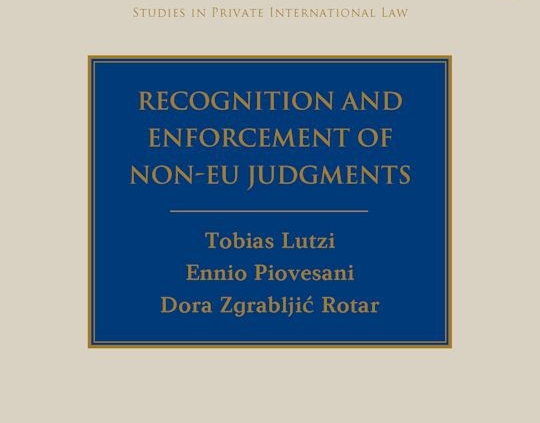
New Book Alert: Recognition and Enforcement of Non-EU Judgments
An upcoming milestone in private international law — Recognition and Enforcement of Non-EU Judgments (Bloomsbury / Hart Publishing, Feb. 19 2026), edited by Tobias Lutzi, Ennio Piovesani, and Dora Zgrabljic Rotar.
This is not just another doctrinal text, but the first comprehensive comparative deep dive into how EU Member States handle judgments from outside the EU, an area of law that has been notoriously fragmented and under-theorized.
The book contains country reports from 21 EU Member States on their national rules on recognition and enforcement of non-EU judgments in a unified framework, giving the reader both breadth and comparative depth. The editors pull these strands together in a detailed comparative report that highlights patterns of convergence and divergence across EU jurisdictions. Additionally, the book situates the Member State approaches in relation to the Brussels I regime and the 2019 HCCH Judgments Convention, which is itself reshaping global judicial cooperation. It had practical and scholarly appeal
The release date is 19 February 2026 and it is available for pre-order already at here.