
ZEuP – Zeitschrift für Europäisches Privatrecht 4/2025


A new issue of ZEuP – Zeitschrift für Europäisches Privatrecht is now available and includes contributions on EU private law, comparative law and legal history, legal unification, private international law, and individual European private law regimes. The full table of content can be accessed here: https://rsw.beck.de/zeitschriften/zeup. 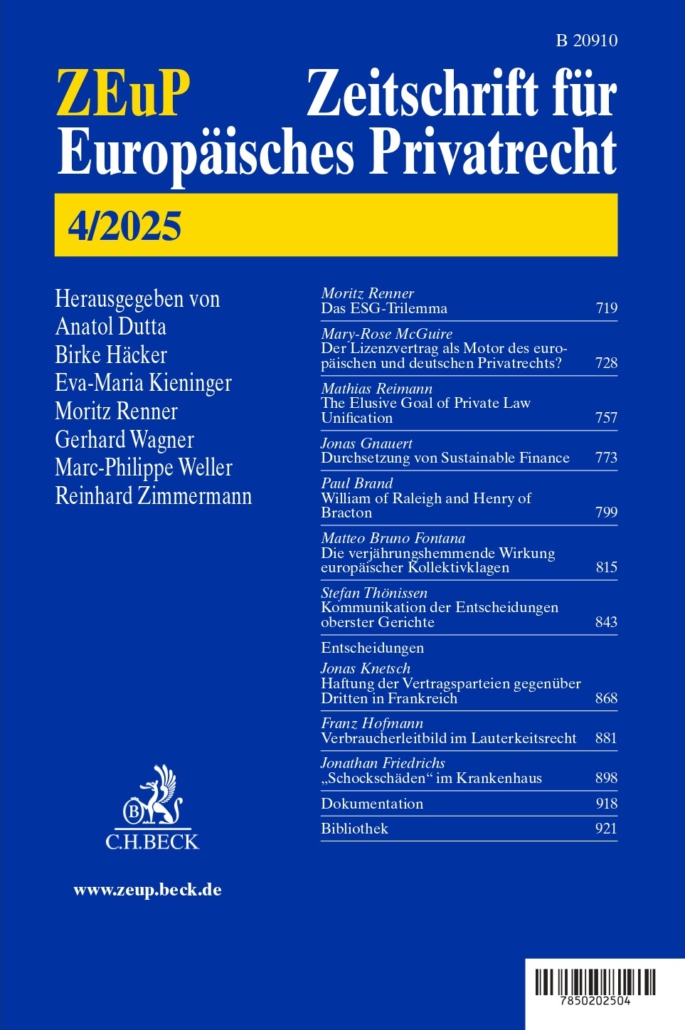
The following contributions might be of particular interest for the readers of this blog:
- Mathias Reimann: The Elusive Goal of Private Law Unification – The Creation, Implementation, and Effect of Uniform Laws in the United States and Potential as a Model for Europe
Mathias Reimann on The Elusive Goal of Private Law Unification – The Creation, Implementation, and Effect of Uniform Laws in the United States and Potential as a Model for Europe as an examination of how, in the United States, the core of private law is left to the individual states and thus often, and at times highly, diverse. A prominent vehicle for achieving greater uniformity has been the drafting and adoption of uniform and model laws, mainly under the auspices of the National Conference of Commissioners for Uniform State Laws (NCCUSL), now more commonly called the Uniform Law Commission (ULC). Since its foundation in 1892, this institution has produced hundreds of such laws and presented them to the state legislatures for enactment. While some have been (almost) universally adopted, most notoriously the Uniform Commercial Code, such success is far more the exception than the rule – the majority of uniform laws have been enacted by, at best, a small minority of states and, thus, failed significantly to enhance legal uniformity. Even where a statute’s text has been widely adopted, it is unclear how much uniformity that has created in terms of actual practical outcomes. On the whole, the uniform law movement has somewhat diminished, but it has not broadly overcome, the diversity of American private law. Its mediocre track record suggests that the uniform law approach would scarcely be a suitable model for the unification of private law in Europe; this is especially true since the conditions for producing, adopting, and uniformly interpreting such laws are much less favorable here than in the United States. - Stefan Thönissen: Die Kommunikation der obersten Gerichte
Stefan Thönissen on Die Kommunikation der obersten Gerichte as an exploration of how the relevance of supreme courts’ communication of their decisions is closely connected with the purpose of contributing to legal development and unification. Although this purpose is – to different degrees – common to all supreme courts, the way they communicate through their decisions significantly differs. In recent years, there have been substantial developments. However, these developments have not necessarily led to a convergence. - Matteo Bruno Fontana: Die verjährungshemmende Wirkung europäischer Kollektivklagen nach Umsetzung der Verbandsrichtlinie
Matteo Bruno Fontana on Die verjährungshemmende Wirkung europäischer Kollektivklagen nach Umsetzung der Verbandsrichtlinie as an analysis of how the new Consumer Rights Enforcement Act (VDuG) empowers consumer associations to bring representative redress actions (Sec. 14 et seq. VDuG). While the suspension of the limitation period by representative actions brought before a domestic German court is addressed in detail in Sec. 204a (1) German Civil Code (BGB), the suspensory effect of a foreign collective action is only partially governed by Sec. 204a (2) BGB. Against the backdrop of the discussion on the suspensory effect of individual actions brought in a foreign forum, this article lays out why foreign collective redress actions should be deemed to have a suspensory effect on the limitation period under German substantive law.
The volume also features to book reviews related to private international law:
- Alan Brown reviews Jens M. Scherpe/Stephen Gilmore (eds): Family Matters: Essays in Honour of John Eekelaar (Intersentia 2022)
- Tobias Lutzi reviews Eva Jueptner: A Hague Convention on Jurisdiction and Judgments. Why did the Judgments Project (1992–2001) Fail? (Intersentia 2024)