


Views
The Supreme People’s Court of the People’s Republic of China issued the Notice on Procedural Matters Related to Civil Cases Involving Foreign State Immunity
(This is written by Xiaoxuan Gu, a PhD student in School of Law, University of Macau)
The Foreign State Immunity Law of the People’s Republic of China (CFSIL) took effect on January 1, 2024.[i] To ensure its proper implementation and guide courts nationwide in lawfully and efficiently adjudicating civil cases involving foreign state immunity, the Supreme People’s Court (SPC) formulated supporting procedural rules. On March 26, 2025, the SPC issued the Notice on Procedural Matters Related to Civil Cases Involving Foreign State Immunity (hereinafter the “Notice”), which provides definitive guidance to courts at all levels in handling such novel foreign-related cases.
The Notice stipulates provisions on key procedural matters, including case acceptance criteria, centralized jurisdiction mechanisms, service of process rules, jurisdictional immunity review procedures, and protocols for obtaining evidentiary certifications from the Ministry of Foreign Affairs. Read more
Caught Between Legal Boundaries: Child Custody Disputes Across Japan and Bangladesh
I would like to express my sincere gratitude to MD Sanwar HOSSAIN, LLB (Hons) Wolverhampton University, MSS (Dhaka University), PgDiP (Northumbria University), Barrister at law (Hon’ble Society of Lincoln’s Inn), Advocate (Appellate Division) Supreme Court of Bangladesh and Managing Partner, S Hossain & Associates law office, for bringing the Bangladesh courts’ decisions to my attention.

I. Introduction
The breakdown of an international marriage often leads to complex cross-border disputes, especially when children are involved. Tensions can intensify if one parent decides to take the children to their home country, often without the consent of the other parent.
In such cases, when the countries involved are signatories to the HCCH 1980 Child Abduction Convention, the Convention’s mechanisms are designed to facilitate the prompt return of children to their country of habitual residence. This framework aims to prevent unilateral relocations that could have lasting impacts on the child’s stability. However, when one or both countries are not parties to the Convention, resolving such cases becomes significantly more challenging. In such cases, national courts are compelled to address competing custody claims, assess allegations of wrongful removal, and determine whether they have jurisdiction to hear the case, all while balancing, often quite differently, the best interests of the children involved.
The case presented here is just one of many unreported cases where a romance relationship turns sour, leading to lengthy and contentious legal battles across jurisdictions. This note will focus on the Bangladeshi court’s treatment of the case, as it offers useful insights into the court’s approach to handling such complex cross-border disputes.
Anti-Suit Injunctions and Dispute Resolution Clauses
By Adeline Chong, Singapore Management University
- Introduction
In two decisions decided within a fortnight of each other, the Singapore Court of Appeal considered anti-suit injunctions pursued to restrain proceedings allegedly brought in breach of arbitration agreements. The first case, Asiana Airlines, Inc v Gate Gourmet Korea Co, Ltd (‘Asiana Airlines’)[1] dealt with whether A could rely on an arbitration agreement between A and B to restrain B’s proceedings against C, a third party. The second case, COSCO Shipping Specialized Carriers Co, Ltd v PT OKI Pulp & Paper Mills (‘COSCO Shipping’)[2] considered whether an arbitration agreement covered a tortious claim. To put it in another way, Asiana Airlines mainly concerned the ‘party scope’ of an arbitration agreement while COSCO Shipping concerned the ‘subject matter’ scope of an arbitration agreement.[3] Where the anti-suit application is to restrain foreign proceedings brought in breach of an arbitration or choice of court agreement, ordinarily it would be granted unless ‘strong cause’ is shown by the respondent.[4] This provides an easier path for the anti-suit claimant compared to the alternative requirement of establishing that the foreign proceedings are vexatious or oppressive in nature. Read more
News
Publication and Webinar: ELI Report on the EU Parenthood Proposal
Yesterday, the Project Report of the ELI Project “Enhancing Child Protection: Private International Law on Filiation and the European Commission’s Proposal COM/2022/695 final”
It contains constructive amendments to the original Commission’s Parenthood Proposal and intends to bring it more in line with the acquis and general considerations of EU PIL. Furthermore, it puts the best interest of the child in the focus of the analysis.

Recent Publication: Towards Universal Parenthood in Europe
The recently published book Towards Universal Parenthood in Europe (Editoriale Scientifica, 2025), edited by Laura Carpaneto, Francesca Maoli, and Ilaria Queirolo, offers a timely and rigorous contribution to European private international law and family law scholarship.
This volume follows the convention reported at this blog here and likewise presents the results of the UniPAR – Towards Universal Parenthood in Europe project, an EU-co-funded research initiative that addresses some of the most complex legal challenges in cross-border parenthood. Bringing together expert authors from different universities across European Union, the book combines theoretical frameworks with practical insights into how parenthood is recognised and regulated across different Member States. Covering six EU jurisdictions (Spain, Belgium, Italy, Bulgaria, Croatia and Poland) the book provides comprehensive national reports and comparative analyses on key issues of jurisdiction, applicable law, adoption, recognition of decisions and birth certificates and judicial cooperation in parenthood matters. The contents are available here.
This scholarly work advances the debate on the need for coherence in legal frameworks governing parentage and family relationships in European Union, especially in contexts involving cross-border mobility, assisted reproductive technologies and the recognition of family statuses across Member States. The final conclusions and recommendations serve both academic and policy audiences, offering structured reflections on legislative gaps and potential paths towards harmonised rules in EU private international law.This is an essential resource that deepens understanding of the legal implications of cross-border parenthood and strengthens the foundation for future legislative reform in European Union.
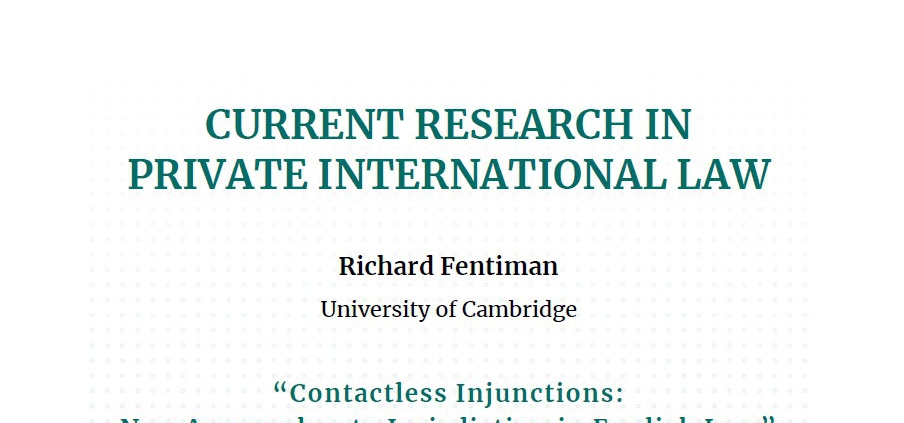
Richard Fentiman’s Lecture on Contactless Injunctions in English Law
Richard Fentiman will be speaking on “Contactless Injunctions: New Approaches to Jurisdiction in English Law” at the forthcomming virtual workshop in the Max Planck Institute for Comparative and International Private Law series “Current Research in Private International Law” to be held on on Tuesday, 3 March 2026, at 11:00 (CET).
Richard Fentiman is Professor Emeritus of Private International Law at the University of Cambridge. His research is especially concerned with the law and practice of international commercial litigation and in particular with issues concerning jurisdiction and interim remedies. He will be speaking about the practice of the English courts which regularly grant extraterritorial injunctions to freeze foreign assets or prevent foreign proceedings. In a departure from past practice they will now do so even in the absence of any material link with England. This reveals much about English law’s distinctive approach to injunctions and begs deeper questions about the appropriate grounds for exercising jurisdiction in private international law.
The virtual lecture will be held as a video conference via Zoom. Prior registions is necesarry by Monday, 2 March 2026, using this link.