


Views
CJEU’s first ruling on the conformity of asymmetric jurisdiction clauses with the Brussels I recast regulation and the 2007 Lugano Convention
by Guillaume Croisant, Claudia Cavicchioli, Nicole Rölike, Alexia Kaztaridou, and Julie Esquenazi (all Linklaters)
In a nutshell: reinforced legal certainty but questions remain
In its decision of yesterday (27 February 2025) in the Lastre case (Case C-537/23), the Court of Justice of the European Union (CJEU) handed down its long-awaited first judgment on the conformity of asymmetric jurisdiction clauses with the Brussels I recast regulation and the 2007 Lugano Convention.
 The Court ruled that the validity of asymmetric jurisdiction clauses is assessed in the light of the autonomous rules of Article 25 of the regulation (rather than Member States’ national laws) and confirmed their validity where the clause can be interpreted as designating courts of EU or Lugano States.
This decision dispels some of the previous uncertainties, particularly arising from the shifting case law of the French Supreme Court. The details of the decision and any possible impact, in particular the requirement for the clause to be interpreted as designating courts of EU or Lugano States, will need to be analysed more closely, but on the whole the CJEU strengthened foreseeability and consistency regarding unilateral jurisdiction clauses under the Brussels I regulation and the Lugano convention.
Besides other sectors, this decision is of particular relevance in international financing transactions, including syndicated loans and capital markets, where asymmetric jurisdiction clauses in favour of the finance parties have been a long-standing practice.
Going International: The SICC in Frontier Holdings
By Sanjitha Ravi, Jindal Global Law School, OP Jindal Global University, Sonipat, India
The Singapore International Commercial Court (“SICC”) in Frontier Holdings Ltd v. Petroleum Exploration (Pvt) Ltd overturned a jurisdictional ruling by an International Chamber of Commerce (“ICC”) arbitral tribunal, holding that the tribunal did, in fact, have jurisdiction to hear the dispute. The SICC’s decision focused on interpreting the arbitration provisions in the Petroleum Concession Agreements (“PCAs”) and Joint Operating Agreements (“JOAs”), which had created ambiguity regarding whether disputes between foreign parties, i.e., Foreign Working Interest Owners (“FWIOs”), and Pakistan parties, i.e., Pakistani Working Interest Owners (“PWIOs”), were subject to international arbitration. The arbitral tribunal, by majority, had concluded the PCAs restricted ICC arbitration to disputes between FWIOs inter se or between FWIOs and the President of Pakistan, thereby excluding disputes between FWIOs and PWIOs. The SICC rejected this reasoning and concluded that the provisions should be applied with necessary modifications to fit the JOAs’ context by conducting an in-depth construction of the dispute resolution provisions of the different agreements involved. The court found that a reasonable interpretation of these provisions indicated an intention to submit FWIO-PWIO disputes to ICC arbitration rather than Pakistani domestic arbitration. Read more
Enforcing Foreign Judgments in Egypt: A Critical Examination of Two Recent Egyptian Supreme Court Cases
 I. Introduction
The recognition and enforcement of foreign judgments in the MENA region can sometimes be challenging, as it often involves navigating complex legal frameworks (domestic law v. conventions). In addition, case law in this field has encountered difficulties in articulating the applicable guiding principles and is sometimes ambiguous, inconsistent, or even contradictory. Two recent decisions rendered by the Egyptian Supreme Court highlight this issue, alhoutgh – it must be admitted – the Court did provide some welcome clarifications. In any event, the cases reported here highlight some key issues in the recognition and enforcement of foreign judgment and offer valuable insights into the evolving landscape of this area of law in Egypt.
News
Hague Academy Collected Courses published in 2025
The following information was kindly shared with us by De Gryuter Brill.
The Hague Academy is a renowned international institution dedicated to the study and teaching of public and private international law. Supported and recognized by the United Nations, the Academy aims to foster rigorous and impartial analysis of legal issues arising from international relations. Its courses address both theoretical and practical dimensions of international law, including legislation and case law. In principle, all courses are published in the Collected Courses of The Hague Academy of International Law in the language in which they were originally delivered. The courses on private international law that were published in 2025 are:
- Volume 451: Garcimartin, F.: Responses to a Legally Fragmented World: A Private Law Perspective (General Course of Private International Law)
- Volume 449: Esplugues, C.: New Dimensions in the Application of Foreign Law by Courts (and Arbitrators) and Non-Judicial Authorities
- Volume 446: Dickinson, A.: Natural Justice in Recognition and Enforcement of Foreign Judgments
- Volume 446: McLachlan, C.: On the Interface Between Public and Private International Law (General Course on International Law)
- Volume 445: Rodríguez Benot, A.: Le régime économique des couples en droit international privé
For a full listing, including the courses on public international law and international arbitration, please visit The Hague Academy Collected Courses Online / Recueil des cours de l’Académie de La Haye en ligne.
Virtual Workshop (in English) on February 3, 2026: Stellina Jolly on “Forging a Path for Climate Justice: Integrating Public and Private International Law in Transboundary Litigation in India”

On Tuesday, February 3, 2026, the Hamburg Max Planck Institute will host its monthly virtual workshop Current Research in Private International Law at 11:00 a.m. – 12:30 p.m. (CEST). Stellina Jolly (South Asian University) will speak, in English, about the topic
“Forging a Path for Climate Justice: Integrating Public and Private International Law in Transboundary Litigation in India”
Cross-border climate litigation, gaining traction globally, requires active engagement with private international law for effective dispute adjudication. Although Indian climate jurisprudence has not yet substantively addressed cross-border disputes, emerging trends suggest that this scenario may soon evolve. The talk analyses three plausible litigation scenarios involving Indian and foreign parties to assess the readiness of Indian private international law in addressing transboundary climate harm. Firstly, Indian plaintiffs filing cases in foreign jurisdictions against transnational corporations headquartered abroad, alleging climate-related harm caused within India; secondly, foreign plaintiffs filing cases before Indian courts for the harm caused by Indian transnational corporations in their jurisdictions; thirdly, foreign plaintiffs filing cases before Indian courts for the transboundary harm caused by Indian companies as a result of their Greenhouse gas (GHG) emissions. The talk evaluates the adequacy of Indian private international law in addressing cross-border climate cases and proposes incorporating environmental and human rights considerations in the determination of choice of law.
The presentation will be followed by open discussion. All are welcome. More information and sign-up here.
If you want to be invited to these events in the future, please write to veranstaltungen@mpipriv.de.
New Book: La circolazione dello statuto personale / La circulation du statut personnel
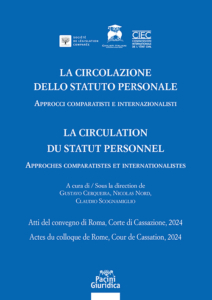 A new collective volume entitled “La circolazione dello statuto personale / La circulation du statut personnel” has recently been published by Pacini Giuridica. Edited by Gustavo Cerqueira (Nice), Nicolas Nord (Strasbourg) and Claudio Scognamiglio (Rome), the book brings together the proceedings of an international conference held on 19 January 2024 in Rome, in the prestigious Giallombardo Hall of the Italian Court of Cassation. Read more