


Views
Petronas Lubricants: ECJ confirms that Art 20(2) Brussels I can be used by employer for assigned counter-claim
Last Thursday, the ECJ rendered a short (and rather unsurprising) decision on the interpretation of Art 20(2) Brussels I (= 22(2) of the Recast Regulation). In Petronas Lubricants (Case C 1/17), the Court held that an employer can rely on the provision to bring a counter-claim in the courts chosen by the employee even where said claim has been assigned to the employer after the employee had initiated proceedings.
The question had been referred to the ECJ in the context of a dispute between an employee, Mr Guida, and his two former employers, Petronas Lubricants Italy and Petronas Lubricants Poland. Mr Guida’s parallel employment contracts with these two companies had been terminated among allegations of wrongly claimed reimbursements. Mr Guida, who is domiciled in Poland, had sued his Italian employer in Italy for wrongful dismissal and his employer had brought a counter-claim for repayment of the sums Mr Guida had allegedly wrongfully received, which had been assigned by the Polish employer.
Art 20(2) Brussels I contains an exception to the rule in Art 20(1), according to which an employee can only be sued in the courts of their country of domicile, to allow the employer to bring a counter-claim in the courts chosen by the employee. Similar exceptions can be found in Art 12(2) Brussels I (= Art 14(2) of the Recast; for insurance contracts) and Art 16(3) Brussels I (= Art 18(3) of the Recast; for consumer contracts), all of which incorporate the ground for special jurisdiction provided in Art 6 No 3 Brussels I (= Art 8(3) of the Recast). In the present case, the ECJ had to decide whether this exception would also be available for counter-claims that had been assigned to the employer after the employee had initiated proceedings.
The Court answered this question in the affirmative, pointing out that
[28] … provided that the choice by the employee of the court having jurisdiction to examine his application is respected, the objective of favouring that employee is achieved and there is no reason to limit the possibility of examining that claim together with a counter-claim within the meaning of Article 20(2) [Brussels I].
At the same time, the Court emphasised that a counter-claim can only be brought in the court chosen by the employee if it fulfils the more specific requirements of Art 6 No 3 Brussels I, according to which the counter-claim must have arisen ‘from the same contract or facts on which the original claim was based’. This has recently been interpreted by the ECJ (in Case C-185/15 Kostanjevec) as requiring that both claims have ‘a common origin’ (see [29]–[30] of the decision). Where this is the case – as it was here (see [31]–[32]) –, it does not matter that the relevant claims have only been assigned to the employer after the employee had initiated proceedings (see [33]).
Mareva injunctions under Singapore law
Whether the Singapore court has the jurisdiction or power to grant a Mareva injunction in aid of foreign court proceedings was recently considered by the Singapore High Court in PT Gunung Madu Plantations v Muhammad Jimmy Goh Mashun [2018] SGHC 64. Both plaintiff and defendant were Indonesian and the claim related to alleged breaches of duties which the defendant owed to the plaintiff. The plaintiff had obtained leave to serve the writ in Indonesia on the defendant. The defendant thereupon applied, inter alia, to set aside service of the writ and for a declaration that the court has no jurisdiction over him. In response, the plaintiff applied for a Mareva injunction against the defendant in respect of the defendant’s assets in Singapore. The plaintiff had, after the Singapore action was filed, commenced actions in Malaysia and Indonesia covering much the same allegations against the defendant.
Under Singapore law (excluding actions commenced in the Singapore International Commercial Court where different rules apply), leave to serve the writ on the defendant abroad may be granted at the court’s discretion if the plaintiff is able to show: (i) a good arguable case that the claim falls within one of the heads of Order 11 of the Rules of court; (ii) a serious issue to be tried on the merits; and (iii) Singapore is forum conveniens. On the facts, the parties were Indonesian and the alleged misconduct occurred in Indonesia. As the plaintiff was unable to satisfy the third requirement, the court discharged the order for service out the writ out of the jurisdiction. Other orders made in pursuant of the order for service out were also set aside.
On the Mareva injunction, the Singapore High Court adopted the majority approach in the Privy Council decision of Mercedes Benz v Leiduck [1996] 1 AC 284. Lord Mustill had distinguished between two questions, to be approached sequentially: first, the question of whether the court has in personam jurisdiction over the defendant; secondly, the question of whether the court has a power to grant a Mareva injunction to restrain the defendant from disposing of his local assets pending the conclusion of foreign court proceedings. Valid service is required to found in personam jurisdiction under Singapore law. In PT Gunung Madu Plantations, as in Mercedes Benz itself, as the answer to the first question was in the negative, the second question did not arise.
Justice Woo was cognisant of the difficulties caused by hewing to the traditional approach of viewing Mareva relief as strictly ancillary to local proceedings but stated ‘that is a matter that has to be left to a higher court or to the legislature’ (para 54). His Honour referenced developments in the UK and Australia, where freestanding asset freezing orders in aid of foreign proceedings are permitted. Further, the Singapore International Arbitration Act was amended in 2010 to give the court the power to grant an interim injunction in aid of a foreign arbitration. It is likely that legislative intervention will be required to develop Singapore law on this issue.
The judgment may be found here: http://www.singaporelaw.sg/sglaw/laws-of-singapore/case-law/free-law/high-court-judgments/23135-pt-gunung-madu-plantations-v-muhammad-jimmy-goh-mashun
Nori Holdings: England & Wales High Court confirms ‘continuing validity of the decision in West Tankers’ under Brussels I Recast
Earlier this month, the English High Court rendered an interesting decision on the (un-)availability of anti-suit injunctions in protection of arbitration agreements under the Brussels I Recast Regulation (No 1215/2012). In Nori Holdings v Bank Otkritie [2018] EWHC 1343 (Comm), Males J critically discussed (and openly disagreed with) AG Wathelet’s Opinion on Case C-536/13 Gazprom and confirmed that such injunctions continue to not be available where they would restrain proceedings in another EU Member State.
Read more
News
Book Launch: Blockchain & Private International Law – New Date
The event organized to celebrate the launch of the book Blockchain & Private International Law, originally scheduled for 5 October, will now take place on 20 December 2023 at 18.15, both physically at the Université de Lausanne (AULA, IDHEAP Building) and online (Zoom link).
New Edition of Leading Canadian Conflict of Laws Treatise
A loose-leaf publication tends to stay as current as the most recent set of insert pages, and so identifying it either by its initial year of publication or its edition number can be misleading. For many years the leading Canadian work on private international law has been the 6th edition of Castel & Walker Canadian Conflict of Laws, with that edition first appearing in 2005. For nearly two decades, then, it has had the same year of publication and edition number, but as a loose-leaf (and as available through an electronic subscription) it has been kept quite up-to-date on a frequent basis. Now comes a new edition, the 7th, published in 2023 and with a revised title. The text is now called simply Canadian Conflict of Laws and its sole author, as was the case for the 6th edition, is Professor Janet Walker of Osgoode Hall Law School. The change in the title reflects the completion of a long process of transition from the original edition (1975) as written by Professor Jean-Gabriel Castel through some editions that were co-written by Professors Castel and Walker. Detailed information about the new edition is available here. It remains an indispensable resource in the Canadian context and beyond.
Book on the African Principles on the Law Applicable to International Commercial Contracts now available
Posted by Marlene Wethmar-Lemmer
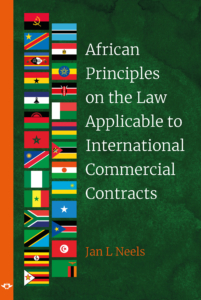
This booklet contains the first draft of the envisaged African Principles on the Law Applicable to International Commercial Contracts. The proposal could be used by national legislators on the continent and African economic integration organisations, particularly the African Union, in, respectively, domestic legislation and regional or supranational laws of a soft or binding nature. The existence of a reliable transnational legal infrastructure in respect of international commercial law, including commercial private international law, is a prerequisite for investor confidence, inclusive economic growth, sustainable development, and the ultimate alleviation of poverty on the African continent. The instrument may contribute to sustainable growth on a long-term basis. The regulation of private international law of contract is essential to the further development of the African Continental Free Trade Area.
Jan L Neels is professor of private international law and director of the Research Centre for Private International Law in Emerging Countries at the University of Johannesburg.
ISBNs
978-1-7764474-0-4 (Paperback)
978-1-7764474-1-1 (PDF)
978-1-7764474-2-8 (EPUB)
978-1-7764474-3-5 (XML)
DOI: https://doi.org/10.36615/9781776447411
PRICE: R125 (print), OA (ebook)