


Views
Much-awaited US Supreme Court decision has been rendered: Animal Science Products, Inc. v. Hebei Welcome Pharmaceutical Co. Ltd.
The decision is available here and further documentation is available here. I would also like to refer to previous posts by fellow editors here and here. The US Supreme Court held that: “A federal court determining foreign law under Federal Rule of Civil Procedure 44.1 should accord respectful consideration to a foreign government’s submission, but the court is not bound to accord conclusive effect to the foreign government’s statements.”
In a nutshell, the US Supreme Court said that the weight to be given to foreign government statements depends on the circumstances of the case. In particular, it notes that “[t]he appropriate weight [a federal court determining foreign law should give to the views presented by a foreign government] in each case, however, will depend upon the circumstances; a federal court is neither bound to adopt the foreign government’s characterization nor required to ignore other relevant materials. No single formula or rule will fit all cases, but relevant considerations include the statement’s clarity, thoroughness, and support; its context and purpose; the transparency of the foreign legal system; the role and authority of the entity or official offering the statement; and the statement’s consistency with the foreign government’s past positions.”
One thing of note is that the US Supreme Court refers to Société Nationale Industrielle Aérospatiale v. United States Dist. Court for Southern Dist. of Iowa, 482 U. S. 522, which is a very important case in the context of the Hague Evidence Convention.
The concept of ‘right of access’ under Brussels II bis encompasses grandparents
In the judgment C-335/17 of 31 May 2018, the CJEU confirms that the autonomous concept of ‘right of access’ under Brussels II bis Regulation encompasses the rights of access of grandparents to their grandchildren. Read more
The “Coman” Case (C-673/16): Some reflections from the point of view of private international law
Written by Dr. iur. Baiba Rudevska (Latvia)
On 5 June 2018, the ECJ rendered a judgment in the Coman case (C-673/16). For the first time the ECJ had the opportunity to rule, on the concept of ‘spouse’ within the meaning of the Directive 2004/38/EC of the European Parliament and of the Council of 29 April 2004 on the right of citizens of the Union and their family members to move and reside freely within the territory of the Member States (Directive 2004/38) in the context of a same-sex marriage. Even if the Directive only covers questions related to the entry and residence in the European Union (EU), this judgment could be of interest for Private International lawyers as well. Read more
News
University of Geneva: Executive Training on Civil Aspects of International Child Protection (ICPT) – from December 2023 to April 2024
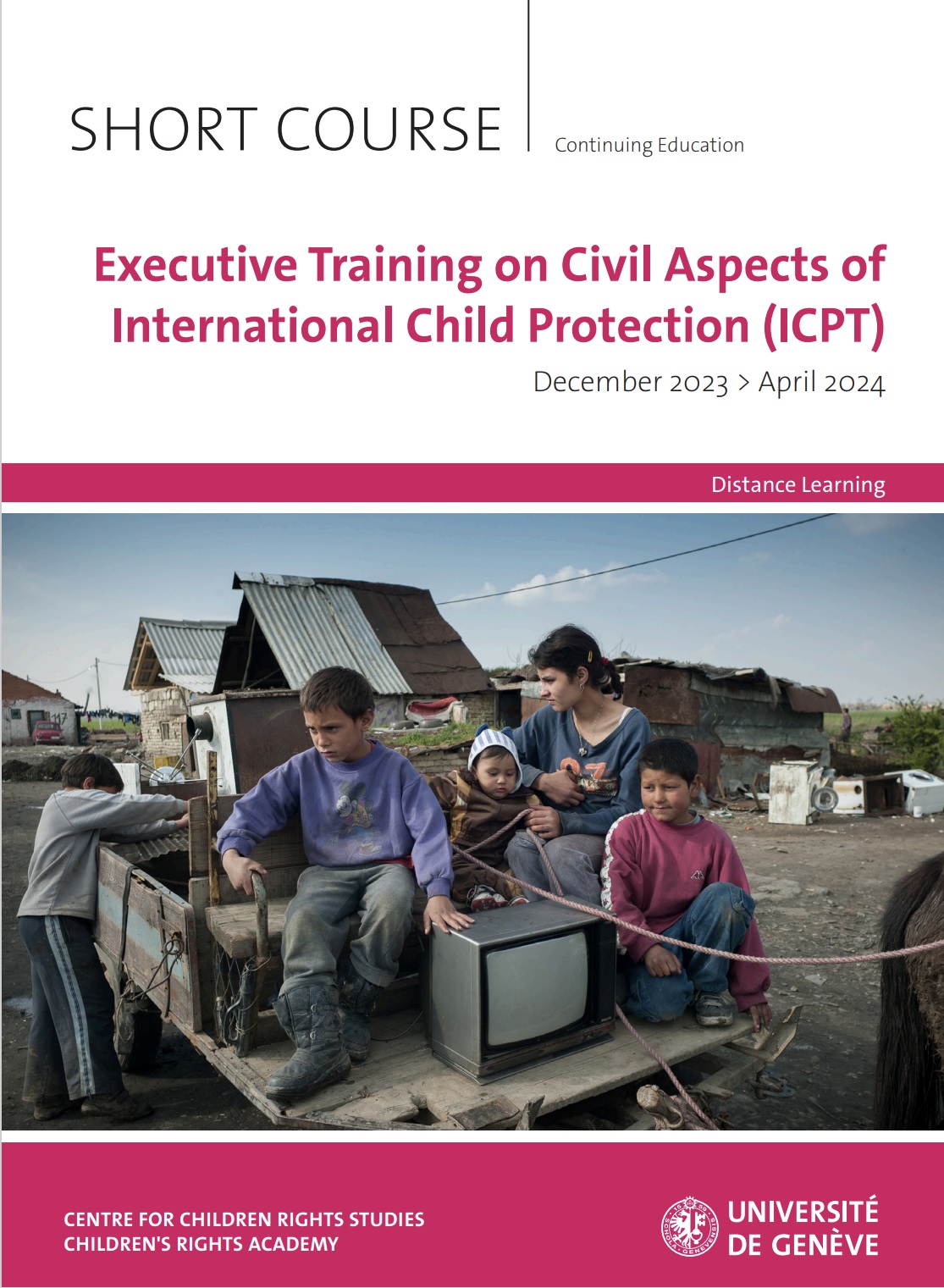
The Children’s Rights Academy of the University of Geneva is organising an online Executive Training on Civil Aspects of International Child Protection (ICPT) from December 2023 to April 2024. For more information, click here.
The training is divided into four modules and is being coordinated by Dr. Vito Bumbaca. There is a registration fee (for the full programme or per module). Click here to register (registration is possible until 18 January 2024).
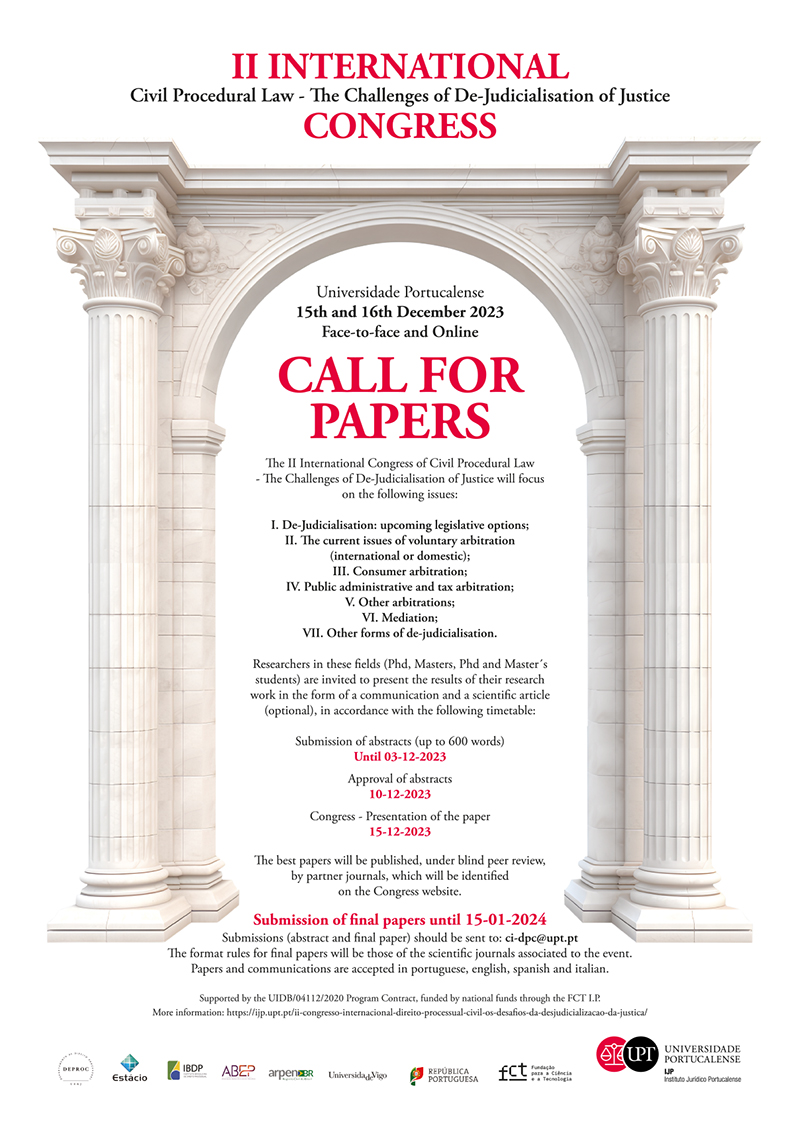
Call for Papers: 2nd International Congress of Civil Procedural Law (15/16 Dec 23; hybrid)
The Universidade Portucalense (UPT) will be hosting the 2nd International Congress of Civil Procedural Law on 15 and 16 December 2023. The hybrid event will focus on “The Challenges of De-Judicialisation of Justice”.
The organizers have been so kind as to share the call for papers with us. Further information can also be found here.
UK to Join HCCH Judgments Convention ‘as Soon as Practicable’
Yesterday, the UK Government published its response to a consultation on the prospect of joining the 2019 HCCH Judgments Convention. After summarising the responses received during the consultation, the Government concludes:
16. It is clear from the responses received for questions 1, 2 and 5 that respondents consider the merits of Hague 2019 to outweigh any potential downsides. This corresponds with the feedback that the Government received from stakeholders during round-table engagement sessions on this matter.
17. Having carefully considered the responses received and wider stakeholder feedback, the Government has decided that the UK will sign Hague 2019 as soon as practicable. […]
The Government also addresses the question of possible reservations under Articles 14, 16, 18, and 19 and a possible notification under Article 29:
49. Declarations under Articles 14, 16, 18 and 19 can be made upon signature, ratification, or at any time thereafter, and may be subsequently modified or withdrawn at any time. Having carefully considered the responses to question 9, the Government is of the view that there were no sufficiently strong policy reasons raised by respondents to this Consultation to warrant the UK making declarations under the relevant articles of Hague 2019 at this time.
[…]
52. The Government will keep questions of declarations under review as it proceeds to signature and implementation, and in future as the Convention comes into force between the UK and current and future Contracting States.
53. The Government has considered the concerns in relation to the Russian Federation having signed Hague 2019 and considers that UK should sign the Convention with the understanding that a future notification in relation to the Russian Federation under Article 29 would be available to prevent the Convention applying between the UK and Russia, should there be any development in the latter’s ratification of Hague 2019.
The decision has already been welcomed by the President of the Law Society.