


Views
Enforcing Consent-to-Jurisdiction Clauses in U.S. Courts
Guest Post by John Coyle, the Reef C. Ivey II Distinguished Professor of Law at the University of North Carolina School of Law
One tried-and-true way of obtaining personal jurisdiction over a foreign person that otherwise lacks minimum contacts with a particular U.S. state is to require the person to agree ex ante to a forum selection clause. This strategy only works, however, if the forum selection clause will be enforced by the courts in the chosen state. To date, scholars have written extensively about the enforceability of “outbound” forum selection clauses that redirect litigation from one court to another. They have devoted comparatively less attention to the enforceability of “inbound” forum selection clauses that purport to provide a basis for the chosen court’s assertion of personal jurisdiction over a foreign defendant.
In a recent paper, Katherine Richardson and I seek to remedy this deficit. We reviewed 371 published and unpublished cases from the United States where a state court was asked to assert personal jurisdiction over an out-of-state defendant on the basis of an “inbound” consent-to-jurisdiction clause. In conducting this review, we documented the existence of several different enforcement frameworks across states. The state courts in New York, for example, take a very different approach to determining whether such a clause is enforceable than the state courts in Florida, which in turn take a very different approach to this question than the state courts in Utah.
These differences in enforcement frameworks notwithstanding, we found that consent-to-jurisdiction clauses are routinely given effect. Indeed, our data suggest that such clauses are enforced by state courts approximately 85% of the time. When the courts refuse to enforce these clauses, moreover, they tend to cite just a handful of predictable reasons. First, the courts may refuse to enforce when the clause fails to provide proper notice to the defendant of the chosen forum. Second, the courts may conclude that the clause should not be given effect because the parties lack a connection to the chosen forum or that litigating in that forum would be seriously inconvenient. Third, a clause may go unenforced because it is contrary to the public policy of a state with a close connection to the parties and the dispute.
After mapping the relevant terrain, we then proceed to make several proposals for reform. We argue that the courts should generally decline to enforce consent-to-jurisdiction clauses when they are written into contracts of adhesion and deployed against unsophisticated counterparties. We further argue that the courts should decline to enforce such clauses in cases where the defendant was never given notice as to where, exactly, he was consenting to jurisdiction. Finally, we argue that the courts should retain the flexibility to decide whether to dismiss on the basis of forum non conveniens even when a forum selection clause specifically names the jurisdiction where the litigation is brought. Each of these reforms would, in our view, produce fairer and more equitable results across a wide range of cases.
Although our research focused primarily on state courts, our reform proposals are relevant to federal practice as well. Federal courts sitting in diversity are required by Federal Rule of Civil Procedure 4(k)(1)(a) to follow the law of the state in which they sit when they are called upon to determine whether to enforce a consent-to-jurisdiction clause. If a given state were to revise or reform its rules on this topic along the lines set forth above, the federal courts sitting in that state would be obliged to follow suit.
Introduction to the Elgar Companion to the Hague Conference on Private International Law (HCCH) — Part I
The following entry is the first of two parts that provide an introduction to the Elgar Companion to the Hague Conference on Private International Law (HCCH). Together, the parts will offer readers an overview of the structure of the Companion (Part I) as well as of the core themes as they emerged from the 35 Chapters (Part II). Both parts are based on, and draw from, the Editors’ Introduction to the Elgar Companion to the HCCH, which Elgar kindly permitted.
Introduction
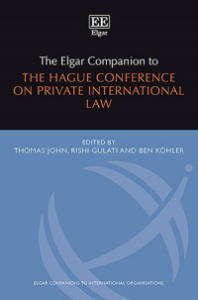
The Elgar Companion to the HCCH will be launched on 15 December 2020 as part of a 1 h long virtual seminar. The Companion, edited by Thomas John, Dr Rishi Gulati and Dr Ben Koehler, is a unique, unprecedented and comprehensive insight into the HCCH, compiling in one source accessible and thought-provoking contributions on the Organisation’s work. Written by some of the world’s leading private international lawyers, all of whom have directly or indirectly worked closely with the HCCH, the result is a collection of innovative and reflective contributions, which will inform shaping the future of this important global institution.
The Companion is timely: for more than 125 years, the HCCH has been the premier international organisation mandated to help achieve global consensus on the private international law rules regulating cross-border personal and commercial relationships. The organisation helps to develop dedicated multilateral legal instruments pertaining to personal, family and commercial legal situations that cross national borders and has been, and continues to be, a shining example of the tangible benefits effective and successful multilateralism can yield for people and businesses globally.
Approach to private international law
The Companion approaches private international law classically, that is, by understanding the subject matter with reference to its three dimensions: jurisdiction, applicable law, and the recognition and enforcement of foreign judgments. But, as the contributions in this work show, since its inception, and in particular since the 1980s, the HCCH has helped to reach international consensus concerning a further, a “fourth” dimension of private international law: cross-border legal cooperation.
In line with this development, and with the firm belief that such cooperation is crucial to the private international law of the 21st century, the Companion has adopted a strong focus on cross-border legal cooperation, including by an increased use of technology. This deliberate choice was fortuitous: the global pandemic is testing the domestic and international justice sector like never before, bringing into sharp focus the often non-existing or still arcane methods prevalent especially in the area of cross-border legal cooperation.
Structure of the Companion
The Companion comprises 35 Chapters that are organised into three Parts.
Part I of the Companion: Institutional perspectives
Part I consists of three Sections. Section 1 considers the HCCH as an international organisation and the contributions trace the development of the Organisation from its inception in 1893 until the present day, including its trajectory towards a truly global organisation. The initial Chapters specifically concern the history of the HCCH; its institutional setting, especially in terms of the HCCH’s privileges and immunities; as well as a contribution on the relationship between the HCCH, and the other two international organisations dealing with international private law issues, i.e., UNCITRAL and UNIDROIT, often also referred to as the HCCH’s ‘Sister Organisations’.
The following Section is dedicated to the HCCH as an organisation with global reach. The Chapters demonstrate how the HCCH is evolving from an organisation whose membership was historically European-based into an increasingly global institution. The HCCH currently has 86 Members (as of December 2020), comprising 85 States and the EU. Perhaps other Regional Economic Integration Organisations (REIO) may also become members one day, and this should be encouraged. Remarkably, since the turn of the century, the HCCH has added 39 New Members (or 45% of its current membership), including six South American States, two States from North America, one in Oceania, fourteen in Asia, eleven in Europe and five in Africa.[1] Since 3 December, the HCCH has a further Candidate State: Mongolia, which has applied for membership and for which the six-month voting period is now running. Importantly, this Section considers the HCCH’s expanded reach, including thoughtful contributions on the organisation’s work in Latin America and the Caribbean; Africa; and in the Asia Pacific. The Chapters also reflect on the work of the HCCH’s Regional Offices, namely, the Regional Office for Asia and the Pacific (ROAP), which is based in Hong Kong and commenced its work in 2012; as well as the Regional Office for Latin America and the Caribbean (ROLAC), operating out of Buenos Aires since 2005.
Part I’s final Section looks at the HCCH as a driver of private international law. The Chapters contain stimulating contributions concerning some of the contemporary philosophical dimensions of private international law as shaped by globalisation, and the ways in which the HCCH can be understood in this context; the role the Organisation can play in shaping private international law into the future; considering whether the 2015 Choice of Law Principles establish a good framework for regulatory competition in contract law; what role the HCCH can play in further strengthening legal cooperation across borders; and the concept of public order, including its relationship with mandatory law.
Part II of the Companion: Current instruments
Part II of the Companion concerns contributions on existing HCCH instruments. It traces the evolution, implementation, and effectiveness of each of those instruments, and looks forward in terms of how improvements may be achieved. The contributors not only provide a record of the organisation’s successes and achievements, but also provide a critical analysis of the HCCH’s current work. They canvassed the traditional tripartite of private international law, including forum selection, choice of law and the recognition and enforcement of judgments. In addition, they also provided their thoughts on the fourth dimension of private international law, i.e. cross-border legal cooperation, tracing the pioneering, as well as championing, role of the HCCH in this regard, resulting in cooperation being a quintessential feature, in particular of more modern conventions, developed and adopted by the HCCH.
Part II is organised following the three pillars of the HCCH: (1) family law; (2) international civil procedure, cross-border litigation and legal cooperation; and (3) commercial and financial law.
The first Section of Part II addresses HCCH instruments in the family law sphere. Contributions include an analysis of the HCCH and its instruments relating to marriage; the 1980 Child Abduction Convention; the 1993 Intercountry Adoption Convention; a Chapter on the challenges posed by the 1996 Child Protection Convention in South America; the 2000 Adult Protection Convention; a contribution on HCCH instruments in the area of maintenance Obligations; the work of the HCCH in the field of mediation in international children’s cases; and a contribution overviewing the interaction between various HCCH instruments concerning child protection.
The second Section concerns HCCH instruments that are some of its major successes. But as the Chapters show, more work needs to be done given the ever-increasing cross-border movement of goods, services and people, and the need to better incorporate the use of technology in cross border legal cooperation. Contributions concern the 1961 Apostille Convention; the 1965 Service and 1970 Evidence Conventions; the 2005 Choice of Court Convention; and finally, the 2019 Judgments Convention which was decades in the making.
The final Section in Part II consists of contributions on HCCH commercial and finance instruments. Contributions specifically focus on the 1985 Trusts Convention; the 2006 Securities Convention; and the 2015 Choice of Law Principles, which constitute a soft law instrument demonstrating versatility in the kind of instruments HCCH has helped negotiate.
Part III – Current and possible future priorities
Part III of the Companion consists of Chapters that discuss the substantive development of private international law focusing on current and possible future priorities for the HCCH. In that regard, this Companion seeks to bridge the HCCH’s past and its future.
The first Section focuses on current priorities. It consists of contributions on a highly difficult and sensitive area of international family law, i.e. parentage and international surrogacy and how the HCCH may assist with its consensual solutions; how the HCCH may play a global governance role in the area of the protection of international tourists; and how the exercise of civil jurisdiction can be regulated. Specifically, this Chapter shows how the doctrine of forum non conveniens is increasingly being influenced by access to justice considerations, a matter borne out by comparative analysis.
The second Section of Part III, and of the Companion, contemplates possible future priorities for the HCCH. Contributions concern how private international law rules ought to be developed in the context of FinTech; what role the HCCH may play in setting out the private international law rules in the sphere of international commercial arbitration; how the digitisation of legal cooperation ought to reshape the fourth dimension of private international law; the potential development of special private international law rules in the context of complex contractual relationships; how the HCCH can engage with and embrace modern information technology in terms of the development of private international law; and finally, what role there is for the HCCH in developing a regulatory regime for highly mobile international employees. It is hoped that in addition to providing ideas on how progress may be made on its current priorities, the contributions in Part III can also provide a basis for the HCCH’s future work.
Concluding remarks and outlook
The editors, who collaboratively prepared this entry, chose this structure for the Companion to provide the reader with an easy access to a complex organisation that does complex work. The structure also makes accessible the span of time the Companion bridges, chronicling the HCCH’s history, reaching back to 1893, while looking forward into its future.
The second entry on Conflict-of-Laws.net will outline the editor’s reflections on the 35 Chapters, drawing out some of the key themes that emerged from the Companion, including the HCCH’s contribution to access to justice and multilateralism.
[1] HCCH, ‘Members & Parties’ <https://www.hcch.net/en/states> accessed 6 December 2020. The latest Member State is Nicaragua for which the Statute of the HCCH entered into force on 21 October 2020.
Ulla Liukkunen on Chinese private international law, comparative law and international commercial arbitration – launch of Ius Comparatum
Guest post by Ulla Liukkunen, Professor of Labour Law and Private International Law at the University of Helsinki and Director of the Finnish Center of Chinese Law and Chinese Legal Culture
The International Academy of Comparative Law launched a new open access publication in November 2020. Volume no 1 on the use of comparative law methodology in international arbitration contains articles by Emmanuel Gaillard, Sebastián Partida, Charles-Maurice Mazuy, S.I. Strong, Johannes Landbrecht, Morad El Kadmiri, Marco Torsello, Ulla Liukkunen, Alyssa King, Alexander Ferguson, Dorothée Goertz and Luis Bergolla as well as introductory remarks on the topic by the Secretary-General of the Academy, Diego P. Fernández Arroyo.
The volume no 1 is available on aidc-iacl.org/journal.
The article “Chinese context and complexities — comparative law and private international law facing new normativities in international commercial arbitration” was written by Ulla Liukkunen, Professor of Labour Law and Private International Law at the University of Helsinki and Director of the Finnish Center of Chinese Law and Chinese Legal Culture.
Professor Liukkunen examines international commercial arbitration from the perspective of Chinese developments, noting that, in global terms, the organization of cross-border dispute resolution is changing as a part of the Belt and Road Initiative (BRI) development. With the BRI, Chinese interest in international commercial arbitration has gained a new dimension as BRI promotes the expansion of Chinese dispute resolution institutions and their international competitiveness.
According to Liukkunen, these developments challenge the current narrative of international arbitration. She explores private international law as a framework for unfolding noteworthy characteristics of the Chinese legal system and legal culture that are present in international commercial arbitration and can be linked to an assessment of the role of the BRI in shaping the arbitration regime. A rethink of comparative methodology is proposed in order to promote an understanding of Chinese law in the arbitration process.
Moreover, Liukkunen argues that considerations of the Chinese private international law and arbitration regime speak for a broader comparative research perspective towards international commercial arbitration. In the international commercial arbitration frame under scrutiny, we can see the conception of party autonomy placed in a Chinese context where the state is shaping the still relatively young private international law frame for exercise of that freedom and certain institutional structures are advocated where party autonomy is placed. Chinese development underlines the connection between the legal regime of arbitration and endeavours by the state, thereby requiring assessment of party autonomy from the perspective of the regulatory framework of private international law that expresses the complex dichotomy between private and public interests.
News
China’s Cause of Foreign-related Rule of Law
(drafted by Liu Zuozhen and revised by Tu Guangjian)
In recent years, China has put much emphasis on foreign-related rule of law. It is believed that enhancing the construction of foreign-related rule of law is vital for promoting the nation’s comprehensive development and rejuvenation through Chinese-style modernization, high-level opening up, and responding to external risks. China’s top legislature has prioritized and made significant progress in foreign-related legislations across various legal domains, including civil, commercial, economic, administrative, and procedural laws. Two salient examples are the Law on Foreign Relations of the People’s Republic of China and the Foreign State Immunity Law of the People’s Republic of China, both of which were adopted in 2023 and have now entered into force.
Against this background, many official and academic activities have been launched and conducted for foreign-related rue of law. Across the country, in quite a few of universities, research institutes for foreign-related rule of law are established at various levels, some of which are even higher than the faculties.
With China’s increasing foreign trade, the influx of foreign-invested enterprises, and the expansion of Chinese enterprises abroad, there is, of course, a growing demand for foreign-related legal services as well. In Guangzhou, the Capital city of Guangdong Province, which has always been the forefront of the opening-up policy and international business center, with approval from the Guangzhou Municipal Justice Bureau, a local law firm, namely Guangdong Everwin Law Office even established its own foreign-related legal service research institute. It is not common for a law firm to have an internal research institute in China and many more might be on the way to come.
It seems that the Chinese story of foreign-related rule of law has just started and not reached its climax yet.
Praxis des Internationalen Privat- und Verfahrensrechts (IPRax) 4/2024: Abstracts
The latest issue of the „Praxis des Internationalen Privat- und Verfahrensrechts“ (IPRax) features the following articles:
AMEDIP: Annual seminar to take place from 23 to 25 October 2024 (in Spanish)

The Mexican Academy of Private International and Comparative Law (AMEDIP) will be holding its annual XLVII Seminar entitled “The teaching, research and promotion of private international law in Mexico” (La enseñanza, investigación y difusión del Derecho Internacional Privado en México) from 23 to 25 October 2024. The venue of the seminar will be the Universidad Panamericana (campus Guadalajara, Mexico) – and online.
Potential speakers are invited to submit a paper in Spanish, English or Portuguese by 29 July 2024. Papers must comply with the criteria established by AMEDIP and will be evaluated accordingly. Selected speakers will be required to give their presentations preferably in Spanish as there will be no interpretation services but some exceptions may be made by the organisers upon request for presentations in English and Portuguese. For more information on the requirements, click here
Contributions will be published in the Revista Perspectiva Jurídica of the Universidad Panamericana.
There is a fee for participation both in person and online. For in-person participation, click here. For online participation, please contact seminario@amedip.org.