


Views
Territorial Jurisdiction relating to Succession and Administration of Estates under Nigerian Private International Law
Issues relating to succession and administration of estate of a deceased person raise significant issues in Nigerian private international law (or conflict of laws), whether a person dies testate or intestate. In the very recent case of Sarki v Sarki & Ors,[1] the Nigerian Court of Appeal considered the issue of what court had territorial jurisdiction in a matter of succession and administration of estate of a deceased person’s property under Nigerian conflict of laws dealing with inter-state matters. While this comment agrees with the conclusion reached by the Court of Appeal, it submits that the rationale for the Court’s decision on the issue of territorial jurisdiction for succession and administration of estates under Nigerian private international law in inter-state matters is open to question.
In Sarki, the claimants/respondents were the parents of the deceased person, while the defendant/appellant was the wife of the deceased person. The defendant/appellant and her late husband were resident in Kano State till the time of his death. The deceased was intestate, childless, and left inter alia immovable properties in some States within Nigeria – Bauchi State, Gombe State, Plateau State, Kano State, Jigawa State and the Federal Capital Territory, Abuja. The deceased’s family purported to distribute his property in accordance with Awak custom (the deceased’s personal law) with an appreciable proportion to the defendant/appellant. The defendant/appellant was apparently not pleased with the distribution and did not cooperate with the deceased’s family, who tried to gain access to the deceased’s properties. The claimants/respondents brought an action against the defendant/appellant before the Gombe State High Court. The claimants/respondents claimed inter alia that under Awak custom, which was the personal law of the deceased person, they are legitimate heirs of his property, who died childless and intestate; a declaration that the distribution made on 22 August 2015 by the deceased’s family in accordance with Awak custom, giving an appreciable sum of the property to the defendant/appellant is fair and just; an order compelling the defendant/appellant to produce and hand over all the original title documents of the landed properties and boxer bus distributed by the deceased family on 22 August 2015; and cost of the action. In response, the defendant/appellant made a statement of defense and counter-claim to the effect that she and the deceased are joint owners of all assets and properties acquired during their marriage; a declaration that the estate of the deceased is subject to rules of inheritance as envisaged by marriage under the Marriage Act[2] and not native law and custom; a declaration that as court appointed Administratrix, she is entitled to administer the estate of the deceased person; an order of injunction restraining the claimants/respondents to any or all of the assets forming part of the estate of the deceased person based on custom and tradition; and costs of the action.
The Gombe State High Court held that the Marriage Act was applicable in distributing the estate of the deceased person and not native law and custom. However, the Court distributed the property evenly between the claimants/respondents and defendant/appellants on the basis that it will be unfair for the claimants/respondents as parents of the deceased not to have access to the deceased’s property. The defendant/appellant successfully appealed this ruling and won on the substantive aspect of the case. The private international law issue was whether the Gombe State High Court had territorial jurisdiction in this case, rather than the Kano State High Court where the defendant/appellant alleged the cause of action arose? The defendant/appellant argued that the cause of action arose exclusively in Kano State because that is where the deceased lived and died, and the defendant/appellant had obtained letters of administration issued by the Kano State High Court. The defendant/appellant lost on this private international law issue.
The Court of Appeal began on the premise that the issue of whether Gombe State or Kano State had jurisdiction was a matter of private international law, and not an issue of that was governed by a States’ civil procedures rules that governs dispute within a judicial division.[3] It also held that it is the plaintiff’s statement of claim that determines jurisdiction.[4] The Court of Appeal then approved its previous decisions that in inter-state matters of a private international law matter, a State High Court is confined to the location of the cause of action.[5] In this connection, the Court of Appeal rejected the argument of counsel for the defendant/appellant and held that the cause of action arose both in Kano and Gombe State – the latter State being the place where the dispute arose with the deceased’s family on the distribution of the deceased’s estate. Thus, both the Kano State High Court and Gombe State High Court could assume jurisdiction over the matter.[6] The Court of Appeal further held that other States such as Kano, Bauchi and Plateau could also assume jurisdiction because letters of administration were granted by the State High Courts of these jurisdictions.[7] In the final analysis, the Court of Appeal held that the claimants/respondents could either institute its action in either Gombe, Kano, Bauchi and Plateau – being the place where the cause of action arose, but procedural economy (which leads to convenience, saving time, saving costs, and obviates the risk of conflicting orders) encouraged the claimants/respondents to concentrate its proceedings in one of these courts – Gombe State High Court in this case.[8] Accordingly, this private international law issue was resolved in favour of the claimants/respondents.
There are three comments that could be made about the Court of Appeal’s judgments. First, it appears the issue of territorial jurisdiction was raised for the first time on appeal. It does not appear that this issue was raised at the lower court. If this is the case, it is submitted that the defendant/appellant should have been deemed to have waived its procedural right on jurisdiction on the basis that it submitted to the jurisdiction of the Gombe State High Court. Matters of procedural jurisdiction can be waived by the parties but not substantive jurisdiction such as jurisdiction mandatorily prescribed by the constitution or enabling statutes in Nigeria.[9] The issue of territorial jurisdiction among various State High Courts was a procedural matter and should have been raised promptly by the defendant/appellant or it would be deemed to have waived its right to do so by submitting to the jurisdiction of the Gombe State High Court.
Second, the Court of Appeal appeared to miss the point that there are Nigerian Supreme Court authorities that addressed the issue before it. According to the Supreme Court of Nigeria, in matters of succession and administration of states, the lex situs is given a predominant role for matters of jurisdiction purposes so that a Nigerian court would ordinarily not assume jurisdiction over foreign property, whether in an international or inter-state matter. Nigerian courts, as an exception, apply the rule to the effect that, where the Court has jurisdiction to administer an estate or trust, and the property includes movables or immovables situated in Nigeria and immovables situated abroad, the court has jurisdiction to determine questions of title to the foreign immovables for the purpose of administration. Again Nigerian courts apply this rule both in inter-State and international matters.[10] This rule established by the Nigerian Supreme Court in accordance with the English common law doctrine should have guided the Court of Appeal to hold that since it had jurisdiction over the deceased immovable properties in Gombe State, it also had jurisdiction over other immovable properties constituting the deceased’s estate in other States in Nigeria. The issue of where the cause of action arose was clearly irrelevant.
This brings me to the third and final comment – where the cause of action arose – the issue of territorial jurisdiction. The Nigerian Supreme Court has held in some decided cases that in inter-state matters, a State High Court cannot assume jurisdiction over a matter where the cause of action is exclusively located in another State, irrespective of whether the defendant is resident and willing to submit to the court’s jurisdiction.[11] This current approach by the Supreme Court may have influenced the Court of Appeal to be fixated on the issue of territorial jurisdiction and confining itself to where the cause of action arose. Looking at the bigger picture, the current approach of the Nigerian Supreme Court in relation to matters of action in personam demonstrates a clear misunderstanding of applying common law private international law matters of jurisdiction in inter-state matters.[12] If a defendant is resident in a State and/or willing to submit, it shouldn’t matter where the cause of action arose in inter-state and international matters. Indeed, there is no provision of the Nigerian 1999 Constitution or enabling statute that prohibits a State High Court from establishing extra-territorial jurisdiction in inter-state or international matters, provided the defendant is resident and/or wiling to submit to the Court’s jurisdiction. The current approach of the Nigerian Supreme Court unduly circumscribes the jurisdiction of the State High Courts in inter-state matters, and also risks making Nigerian courts inaccessible in matters of international commercial litigation in matters that occur exclusively outside Nigeria, thereby making the Nigerian court commercially unattractive for litigation, and resulting in injustice.[13] Therefore it is time for the Supreme Court to overrule itself and revert to its earlier approach that held that in inter-state or international matters a Nigerian court can establish jurisdiction, irrespective of where the cause of action arose, provided the defendant is resident and/or submits to the jurisdiction of the Nigerian court.[14]
In my final analysis, I would state that the Court of Appeal in Sarki reached the right conclusion on the issue of private international law, but the rationale for its decision is open to question. Moreover, though this private international law issue was resolved against the defendant/appellant, it substantially won on the substantive issues in the case. If this case goes on appeal to the Supreme Court, it should be an opportunity for the Supreme Court to set the law right again on the concept of jurisdiction in matters of succession and administration and estates, and overrule itself where it held that in inter-state matters, a State High Court is restricted to the place where the cause of action arose, irrespective of whether the defendant is resident and/or willing to submit to its jurisdiction.
[1] (2021) LPELR – 52659 (CA).
[2] Cap 218 LFN 1990.
[3]Sarki (n 1) 13-14.
[4] Ibid 14.
[5] Ibid 14-18, approving Lemit Engineering Ltd v RCC Ltd (2007) LPELR-42550 (CA).
[6] Sarki (n 1) 21.
[7]Ibid 21-3.
[8] Ibid 23-5, approving Onyiaorah v Onyiaorah (2019) LPELR-47092 (CA).
[9] See generally Odua Investment Co Ltd v Talabi ( 1997 ) 10 NWLR (Pt. 523) 1 ; Jikantoro v Alhaji Dantoro ( 2004 ) 5 SC (Pt. II) 1, 21 . This is a point that has been stressed by Abiru JCA in recent cases such as Khalid v Ismail ( 2013 ) LPELR-22325 (CA ); Alhaji Hassan Khalid v Al-Nasim Travels & Tours Ltd ( 2014 ) LPELR-22331 (CA) 23 – 25 ; Nigerian National Petroleum Corporation v Zaria ( 2014 ) LPELR-22362 (CA) 58 – 60; Obasanjo Farms (Nig) Ltd v Muhammad ( 2016 ) LPELR-40199 (CA). See also The Vessel MT. Sea Tiger & Anor v Accord Ship Management (HK) Ltd (2020) 14 NWLR (Pt. 1745) 418.
[10] Ogunro v Ogedengbe (1960) 5 SC 137; Salubi v Nwariaku (2003) 7 NWLR 426.
[11] Capital Bancorp Ltd v Shelter Savings and Loans Ltd (2007) 3 NWLR 148; Dairo v Union Bank of Nigeria Plc (2007) 16 NWLR (Pt 1059) 99; Mailantarki v Tongo & Ors (2017) LPELR-42467; Audu v. APC & Ors (2019) LPELR – 48134.
[12]See generally Abiru JCA in Muhammed v Ajingi (2013) LPELR-20372 (CA) 23 – 25, 25 – 26; CSA Okoli and RF Oppong, Private International Law in Nigeria (1st edition, Hart, Oxford, 2020) 95-103; AO Yekini, “Comparative Choice of Jurisdiction Rules in Cases having a Foreign Element: are there any Lessons for Nigerian Courts?” (2013) 39 Commonwealth Law Bulletin 333; Bamodu O., “In Personam Jurisdiction: An Overlooked Concept in Recent Nigerian Jurisprudence” (2011) 7 Journal of Private International Law 273.
[13] See for example First Bank of Nigeria Plc v Kayode Abraham (2003) 2 NWLR 31 where the Court of Appeal held the lower court did not have jurisdiction because the cause of action arose exclusively outside Nigeria. This decision was however overturned by the Supreme Court in First Bank of Nigeria Plc v Kayode Abraham (2008) 18 NWLR (Pt 1118) 172 on other dubious grounds. For a critique, see CSA Okoli and RF Oppong, Private International Law in Nigeria (1st edition, Hart, Oxford, 2020) 90.
[14] See generally Nigerian Ports Authority v Panalpina World Transport (Nig) Ltd (1973) 1 ALR Comm 146, 172; British Bata Shoe Co v Melikan (1956) SCNLR 321. See also Barzasi v Visinoni (1973) NCLR 373., 381-2.
Global sales law in a global pandemic: The CISG as the applicable law to the EU-AstraZeneca Advance Purchase Agreement?
Written by Dr Ben Köhler, MPI Hamburg
Last week, following severe criticisms of its procurement strategy and a dispute with AstraZeneca over the delays in delivery of the vaccine, the EU Commission has published the Advance Purchase Agreement for the Production, Purchase and Supply of a Covid-19 Vaccine in the European Union (APA) it had concluded with AstraZeneca in August 2020. Although some important clauses were blackened at the request of AstraZeneca, the document gives interesting insights into the procurement practice of the EU and has incited a plethora of comments by the legal experts. Despite the broad coverage in legal and non-legal press, the issue of applicable law has received comparably little attention (but see Till Maier-Lohmann on the CISG’s potential applicability). In its first part, this post will argue that, as far as one can tell by the published document, the CISG is likely to be the applicable law to the contract, before outlining some of the consequences of the CISG’s potential application in the second part.
I. The CISG as the applicable law to the APA?
The issue of the applicable law would be considered by Belgian courts that are exclusively competent under the APA’s forum selection clause (§ 18.5 (b) APA). Since Belgium is a Contracting State to the CISG, Belgian courts are bound to apply the CISG’s provisions on its sphere of application that take precedence over the conflict rules in the Rome I-Regulation (Article 25 Rome I-Regulation). Pursuant to Article 1 (1) (a) CISG, the Convention applies to contracts of sale of goods between parties that have their places of business in different Contracting States.
-
- Vaccine procurement as a (private) contract for the sale of goods?
The CISG does not distinguish between private law and public law entities and is not limited to contracts between private parties.[1] It is therefore applicable to sales contracts concluded by public law entities such as States if these entities do not act in exercise of their sovereign powers but iure gestionis like a private person could act as well,[2] irrespective of whether a public law tender procedure has preceded the conclusion of the contract.[3] The tender process that precedes the conclusion of the contract also does not fall under the exclusion of sales by auction in Art. 2 (b) CISG.[4]
A more nuanced question is whether the APA is a contract for the sale of goods. The question may seem moot since the parties themselves have labelled the agreement Advance Purchase Agreement and the contract provides for the delivery of vaccines against payment. However, it also contains some other elements that may be relevant for the qualification as a sales contract under Articles 1, 3 CISG. The first question is whether the buyers’ involvement in the manufacturing process is relevant. Pursuant to Article 3 (1) CISG, the Convention applies to the sale of goods to be manufactured unless the party ordering the goods undertakes to supply a substantial part of the materials. Indeed, the APA contains an obligation of the buyers to “use Best Reasonable Efforts to assist AstraZeneca in securing the supply” of drug substances and other materials (§ 6.1 APA) as well as an obligation to provide funding to AstraZeneca in order to enable it to procure the necessary materials (§ 7.1 APA). However, this assistance and funding does not seem to amount to an undertaking to supply a substantial part of the materials, particularly as the contract stipulates that “AstraZeneca shall secure the supply of all drug substances […] and drug product capacity […] as well as components critical to the development, manufacture and supply of the Initial Europe Doses” (§6.1). The second question is whether the obligation to deliver vaccines is “the preponderant part of the obligations” of the seller under Article 3 (2) CISG. Here, it seems clear that the core of the contract is the delivery of the vaccines, not the provision of a service of any kind. Other obligations, such as the reporting obligations (§§ 6.3, 10.2 APA), only seem to serve a complementary purpose to ensure the successful delivery of effective vaccines.
Finally, the APA purports to be merely an advance agreement.[5] The decisive factor is, however, not the designation of the agreement but whether it already contains the essential features of a sales contract.[6] The APA contains obligations to produce and deliver the vaccine for AstraZeneca (using their ‘best reasonable efforts’ in the manufacturing) and obliges the Commission and the Participating Member States to acquire vaccines. The APA is thus a sales contract for the purposes of Article 1 (1) (a) CISG.[7]
2. Parties having their places of business in different Contracting States?
Pursuant to Article 1 (1) (a) CISG, the parties to the APA need to have places of business in different Contracting States. The first difficulty is thus to identify the parties to the APA.[8] According the APA, the parties are AstraZeneca AB and the European Commission “acting on behalf and in the name of the member states of the European Union”. The APA goes on to state that “[t]he Commission, the Participating Member States and AstraZeneca may each be referred to herein individually as a ‘Party’ and collectively as the ‘Parties’.” Taken at face value, this would mean that, on the side of the buyers, both the European Commission and the Participating Member States are the parties to the contract in terms of Article 1 (1) (a) CISG. This understanding is in line with the APA’s provisions that not only contain obligations of the Participating Member States but also of the Commission (see e.g. § 9.1 APA).
The parties to the APA need to have their respective places of business in different Contracting States, irrespective of where the goods are manufactured or whereto they are delivered.[9] As per the APA, AstraZeneca AB has its place of business in Sweden while the Commission has its place of business in Brussels. Both Belgium and Sweden are Contracting States. Questions arise only in relation to some of the 27 Participating Member States.[10] While most Participating Member States are Contracting States to the CISG, Ireland and Malta are not. Portugal recently acceded to the CISG but the Convention has not yet entered into force. Amongst the other Participating Member States, Sweden has its place of business in the same Contracting State as AstraZeneca, ie in Sweden,[11] and Finland and Denmark are Contracting States in general but have declared a reservation under Article 94 CISG that exempts sales contracts between parties with their places of business in different Scandinavian States from the CISG’s sphere of application.[12]According to the prevailing view, however, in cases of multiparty contracts, it is sufficient that one party on either side of the transaction have their respective places of business in different Contracting States for the whole contract to be governed by the CISG.[13] Given that the Commission and most of the Participating Member States have their respective places of business in Contracting States other than Sweden, Finland or Denmark, the CISG would be applicable. I have argued elsewhere that the prevailing view is too expansive and that, in cases of multiparty contracts, courts should apply Article 10 (a) CISG by analogy to the different parties (rather than merely to different places of business) on either side of the transaction.[14] Even if one were to follow this approach, the APA would arguably still fall within the sphere of application of the CISG, since the most closely connected place of business on the side of the buyers seems to be the place of business of the Commission that is acting on behalf and in the name of the Participating Member States. The Parties to the APA thus have their respective places of business in different Contracting States pursuant to Article 1 (1) (a) CISG.
However, even if one of the parties were considered to have its place of business in a non-Contracting State,[15] the Convention would still apply by virtue of Article 1 (1) (b) CISG since the Belgian conflict of laws rules, most notably Article 3 (1) Rome I-Regulation, would point to the law of Belgium as a Contracting State to the CISG.
3. Exclusion of the CISG by the Parties in the APA?
The Parties are free to exclude the CISG pursuant to Article 6 CISG. In their choice of law clause, the Parties have chosen the “laws of Belgium” to govern the APA. Although the question of whether the parties wished to exclude the Convention is to be decided on a case-by-case basis, it seems firmly established that, as a general matter, the choice of the law of a Contracting State does not amount to an exclusion of the Convention as the CISG forms part of the Contracting State’s law.[16] Importantly, Belgian courts have repeatedly held that the choice of Belgian law includes the Convention. The choice of law clause would thus in principle not impede the application of the Convention by Belgian courts.
An analysis of the publicly available documents seems to suggest that Belgian courts would indeed apply the CISG to the APA if a claim was brought.[17]
II. Some of the consequences of the CISG’s application
The question one might ask now is: does it matter at all whether the CISG is applicable? After all, there are a lot of detailed provisions in the contract, for instance on force majeure (§ 18.7 APA) and termination for cause (§ 12.3 APA), that take precedence over the default rules laid down in the Convention (Article 6 CISG). I will briefly outline two of the many consequences of the application of the CISG to the APA.
-
- Interpretation of contract
Many of the issues that are currently debated with respect to the contract are ultimately issues of interpretation of contract. For instance, the questions of whether AstraZeneca is only obliged to deliver vaccines that are produced in the EU or of how to apply the notion of ‘best reasonable efforts’ will turn on how different sections of the APA are interpreted. The relevant CISG provision here is Article 8 CISG, although the Convention’s rules on interpretation may, to a certain extent, be modified by the APA’s provisions, most notably by the clause on interpretation of the agreement (§ 18.1 APA) and the Entire Agreement-Clause (§ 18.9 APA). Pursuant to Article 8 (1), (2) CISG, the interpretation of the contract is controlled by a common intention of the parties and, lacking such intention, by the understanding of a reasonable third party.
-
- Allocation of vaccines amongst several buyers in cases of shortage of supply
It was reported that AstraZeneca limited its delivery to the EU while fulfilling its obligations towards other third-party buyers such as the United Kingdom. The allocation of scarce goods amongst competing buyers has been debated in CISG scholarship and the prevailing opinion seems to point to a pro rata delivery to the different buyers in proportion to their respective contractual entitlements.[18] Of course, this default position may need to be reconsidered in light of the provisions of the APA, eg the default allocation between Participating Member States on a pro rata basis reflecting the size of their respective populations (§ 8.3 (b)) or AstraZeneca’s warranties (§ 13 APA).
III. Conclusion
The above analysis may be surprising: Why should a Convention that is unknown even to many lawyers govern the arguably most important procurement contracts in recent European history? Conversely, however, one might ask which legal instrument should be more appropriate to govern an international sales contract between 29 Parties from 27 different States? More than forty years after its adoption, the CISG may face its first test on global centre stage – it will be up to the test!
[1] Peter Mankowski in: Mankowski (ed.), Commercial Law (C.H. Beck Hart Nomos, 2019), CISG, Art. 1, para. 31; Ulrich G. Schroeter, „Grenzfragen des Anwendungsbereichs und international einheitliche Auslegung des UN-Kaufrechts (CISG)“, IHR 2019, 133, 134.
[2] Mankowski (n 1) Art. 1, para. 31.
[3] Schroeter (n 1) 134.
[4] Ulrich Magnus in: Staudinger-BGB, CISG, [2018], Art.2, para. 34; Schroeter (n 1) 134; Frank Spohnheimer in: Kröll, Mistelis & Perales Viscasillas (eds), UN Convention on Contracts for the International Sale of Goods (CISG) (2nd edn, C.H. Beck Hart Nomos 2018), Art. 2, para. 30.
[5] Till Maier-Lohmann, “EU-AstraZeneca contract – applicability of the CISG?”.
[6] See Magnus (n 4) Art. 1, para. 13; Ingeborg Schwenzer & Pascal Hachem in: Schwenzer (ed.), Schlechtriem & Schwenzer Commentary on the UN Convention on the International Sale of Goods (CISG) (4th edn, C.H. Beck Oxford University Press 2016) Art. 1, para. 8.
[7] Maier-Lohmann (n 5); see, on the application of the CISG to purchase options, Magnus (n 4) Art. 1, para. 41; Schwenzer & Hachem (n 6) Art. 1, para. 10.
[8] Maier-Lohmann (n 5).
[9] See Clayton P. Gillette & Stephen D. Walt, The UN Convention on Contracts for the International Sale of Goods – Theory and Practice (2nd edn, Cambridge University Press 2016) 27; Magnus (n 4) Art. 1, para. 11, with further references.
[10] See APA, Schedule B.
[11] Maier-Lohmann (n 5), with the question of how this may affect the CISG’s applicability.
[12] According to the prevailing opinion, the reservation is also to be applied in other Contracting States such as Belgium, Johnny Herre in: Kröll et al. (n 4) Art. 94, para. 5; Schwenzer & Hachem (n 6) Art. 94, para. 7.
[13] Schweizerisches Bundesgericht, Entscheid vom 28.5.2019 – 4A_543/2018, CISG-online no. 4463, IHR 2019, 236; Ulrich G. Schroeter, „Irrtumsanfechtung nach nationalem Recht und Anforderungen an Ausschlussvereinbarungen bei Anwendbarkeit des UN-Kaufrechts (CISG)“, IHR 2019, 231, 232.
[14] Claude Witz & Ben Köhler, “Panorama Droit uniforme de la vente internationale de marchandises“, Recueil Dalloz 2020, 1074, 1077.
[15] See, the question of Maier-Lohmann (n 5), hinting at AstraZeneca’s presence in the UK.
[16] Maier-Lohmann (n 5); see, with further references, CISG Advisory Council Opinion no. 16: “Exclusion of the CISG under Article 6, Rapporteur: Lisa Spagnolo, Comment 4 (b) (i); Mankowski (n 5) Art. 6, para. 8.
[17] See also Maier-Lohmann (n 5): „the Convention’s applicability cannot be excluded from the outset”.
[18] Christoph Brunner in: Brunner & Gottlieb (eds), Commentary on the UN Sales Law (CISG) (Kluwer 2019) Art. 79, para. 12; Schwenzer in: Schwenzer (ed.) (n 6) Art. 79, para. 28; Ben Köhler, Die Vorteils- und Gewinnherausgabe im CISG (MohrSiebeck, forthcoming 2021) 225.
A centralized court for the EAPO Regulation in the Czech Republic?
Carlos Santaló Goris, Researcher at the Max Planck Institute Luxembourg for International, European and Regulatory Procedural Law and Ph.D. candidate at the University of Luxembourg, offers a summary and a compelling analysis of the Czech domestic legislation regarding the EAPO Regulation.
Introduction
On 22 January 2021, the Czech Chamber of Deputies approved “the government act amending Act No. 6/2002 Coll., on courts, judges, lay judges and the state administration of courts and amending certain other acts (the Courts and Judges Act), the wording of later regulations, and other related laws, according to the Chamber of Deputies 630 as amended by the Chamber of Deputies”. The reform is now pending before the Czech Senate.
The first legislative implementation of the EAPO Regulation in the Czech national law
This act introduces the very first amendment of the Czech domestic legislation regarding Regulation No 655/2014, establishing a European Account Preservation Order (“EAPO Regulation”).
The act foresees the concentration of all the applications for EAPOs in one single court, and namely the Prague 1 District Court (Obvodní soud pro Prahu 1). Nowadays, based on the information available in the e-justice portal, the competent court corresponds to the territorially competent court in the debtor’s domicile. However, if the debtor lives outside the Czech Republic, the competent court is the one of the district where the debtor is domiciled.
The upcoming reform envisaged with the act will also affect the application mechanism to gather information on the bank accounts established in Article 14 of the EAPO Regulation. Creditors can also request to investigate if debtors hold bank accounts in the other Member States. Each Member State has an information authority which is charge of searching for the information on the bank accounts. Member States had to notify the Commission with the names of the information authorities by 16 July 2016.
Currently, there is no central information authority in the Czech Republic. Any district court with territorial competence over the debtor’s domicile is an information authority for the purposes of the EAPO Regulation. When the debtor is not domiciled in the Czech Republic, the information authority is the competent court in the district where the bank, which holds the accounts, is located. This can result in challenges for the courts of other Member States searching the information. In case the creditor even ignores the name of the debtor’s bank, how can the competent authority to provide the information on the bank accounts be identified? One Luxemburgish judge has experienced this very dilemma.
The information on the bank accounts is obtained directly from the banks. Czech courts submit a request to “all banks in its territory to disclose, upon request by the information authority, whether the debtor holds an account with them” (Article 14(5)(b) of the EAPO Regulation).
Eventually, if the reform is approved by the Czech Senate, the information authority will also be centralized in the Prague 1 District Court.
The reasons behind the implementation
According to Dr. Katerina Valachová, the member of the Czech Chamber of Deputies who sponsored the amendments concerning the EAPO Regulation, the reform is due to “the complexity of the legislation on the EAPO, as well as the short deadlines set by the EAPO Regulation”. Having a single court for all the EAPO applications will help in terms of specialization. Furthermore, since most of the headquarters of the banks that operate in the Czech Republic are located within the area of the Prague 1 District Court when the court acts as an information mechanism, it can obtain the information on the bank accounts from the banks faster.
The Czech reform in the European context
Establishing a central authority to gather information on the bank accounts is the most common solution followed among those Member States in which the EAPO Regulation applies. Only four out of the twenty-six Member States (France, Finland, Latvia, and the Netherlands), have opted for a complete decentralized information authority. Two other Member States, Austria, and Italy adopted a hybrid approach: they have a central authority when the debtor is domiciled abroad and a decentralized authority when the debtor is domiciled in the country.
However, establishing a centralized court to handle all EAPO applications is a less common choice among other Member States. Only three countries have appointed centralized courts to issue EAPOs: Austria, Slovakia, and Finland.
The Czech Republic’s two neighbouring Member States, Slovakia and Austria, introduced a partial centralization of the EAPOs applications. In Slovakia, the Banská Bystrica District Court (Okresný súd Banská Bystrica) handles all the EAPO applications when the debtor’s “general territorial affiliation cannot be determined” within the Slovakian territory. In Austria, the Vienna Inner City District Court (Bezirksgericht Innere Stadt Wien) is responsible for issuing all the EAPOs when requested before initiation of the proceedings on the merits and before the enforcement of the judgment on the merits of the claim.
Finland has gone a step further than Austria and Slovakia. Similarly, to the ongoing Czech reform, it appointed one sole court – the district court of Helsinki – responsible for issuing all EAPOs.
Outside the EAPO Regulation scheme, we can also find examples of domestic “centralized courts” responsible for other European civil proceedings. For instance, in Germany the European Payment Order (“EPO”) was centralized in the Local Court in Wedding, Berlin. In 2019, France the French legislator approved the creation of a centralized court, which will handle all the EPO applications.
A more efficient application of the EAPO Regulation
Establishing a centralized court for the EAPO Regulation in Czechia is very welcome among those of us who want the EAPO Regulation to become a successful instrument. The future central court will become specialized with the EAPO Regulation, an instrument that can result too complex and requires a certain amount time for its adequate understanding. The centralization will also assure a coherent and uniform application of the EAPO Regulation at the Czech national level. Moreover, in case an issue on the interpretation of the text of that Regulation arises, that centralized court might be more willing to make a preliminary reference to the European Court of Justice (“ECJ”) than regular judges who might not encounter many applications for EAPOs. The ECJ has itself expressly acknowledged the benefits of the centralization in the context of the Maintenance Regulation. In fact, in C-400/13, Sanders and Huber, the ECJ affirmed that “a centralization of jurisdiction, such as that at issue in the main proceedings, promotes the development of specific expertise, of such a kind as to improve the effectiveness of recovery of maintenance claims, while ensuring the proper administration of justice and serving the interests of the parties to the dispute” (C-400/13, Sanders and Huber, 18 December 2014, ECLI:EU:C:2014:2461, para. 45).
Hopefully, in the future more Member States will follow the example of Czechia or Finland and will concentrate the application of the EAPO in a sole court in their territories.
News
Out now: RabelsZ, Volume 88 (2024), Issue 2
 The latest issue of RabelsZ has just been released. It contains the following contributions which are also available open access:
OBITUARY
Holger Fleischer, Heike Schweitzer: Ernst-Joachim Mestmäcker – † 22 April 2024, pp. 215–222, DOI: https://doi.org/10.1628/rabelsz-2024-0033
ESSAYS
Klaus Ulrich Schmolke: Das Prinzip der beschränkten Gesellschafterhaftung – Ein Streifzug durch die Debatten- und Argumentationsgeschichte, pp. 223–277, DOI: https://doi.org/10.1628/rabelsz-2024-0022
The Concept of Limited Shareholder Liability – A Walk Through History’s Debates and Lines of Argument. Today, the concept of limited shareholder liability is considered a core feature of the modern corporation. And indeed, limited liability has been continuously provided for in the corporate (and limited partnership) laws of western jurisdictions since the 19th century. However, limited liability is not such a matter of course as it is widely perceived today. Rather, it took tough disputes and hard-fought debates before the legislators of the major European jurisdictions of the time were able to bring themselves to provide for limited shareholder liability without tying it to prior state approval. Even after this breakthrough, the debate about the legitimacy and scope of limited liability flared up time and again. This is particularly true for the close corporation, in which the shareholders also exercise control over the management of the business. This article traces the historical dimension of the transnational debate and evaluates the arguments for and against limited shareholder liability that have been put forward over time. The insights gained thereby provide a basis for analysing and evaluating the currently revived criticism of limited shareholder liability.
Sandra Hadrowicz: Natural Restitution in a Comparative Legal Perspective –
An Underappreciated Remedy or an Unnecessary Relic?, pp. 278–306, DOI: https://doi.org/10.1628/rabelsz-2024-0030
Natural restitution is one of the permissible methods for remedying damage in numerous legal orders. However, this form of compensation is much less frequently used in practice than monetary compensation. While monetary compensation is a universally found method of reparation in major legal orders, the issue is more complex when it comes to natural restitution. In some countries (e. g. England, France, the Netherlands), natural restitution is used only by way of exception, in specific cases. In others (e. g. Poland), despite the injured party being given the right to choose the method of reparation, natural restitution is very rarely requested by injured parties. Even more intriguingly, in jurisdictions where natural restitution is theoretically upheld as a principle – including Germany, Austria, Portugal, and Spain – its actual adoption by courts remains relatively rare. The question then arises: Have courts and victims come to undervalue natural restitution or even forgotten of its existence? Or, conversely, does it represent an obsolete or unnecessary element of compensation law?
Domenico Damascelli: Determining the Applicable Law in Matrimonial Property Regimes –
On the Interpretation of Article 26 Regulation (EU) No 2016/1103 in the Absence of Choice-of-law and Common Habitual Residence, pp. 307–324, DOI: https://doi.org/10.1628/rabelsz-2024-0032
Wishing to remain faithful to the alleged principle of immutability of the law governing matrimonial property regimes, the literature interprets Art. 26 para. 1 Regulation (EU) No 2016/1103 such that if the spouses have their habitual residence in different States at the time of marriage, it is necessary to wait for a period of time to ascertain whether they will move it to the same State. If so, only the law of that State is to apply (retroactively); if not, one of the other two laws indicated in Art. 26 is to apply (once and for all). This position gives rise to uncertainty in the determination of the applicable law and is contradicted by literal, systematic and teleological interpretations of the Regulation, which show that, in the absence of a common habitual residence, the law governing the matrimonial property relationships is, depending on the circumstances, the one provided for in letters b or c of para. 1 of Art. 26. However, this law may change the moment the existence of a first common habitual residence is ascertained, regardless of whether it was established immediately, shortly, or long after the conclusion of the marriage.
María Mercedes Albornoz: Private International Law in Mexico’s New National Code of Civil and Family Procedure, pp. 325–354, DOI: https://doi.org/10.1628/rabelsz-2024-0031
In June 2023, Mexico enacted a National Code of Civil and Family Procedure that includes private international law provisions on procedural matters. The adoption of this Code constitutes a landmark reform in the Mexican legal system, modernizing and, for the first time, unifying civil and family procedural laws across the country. The Code’s primary objectives are to streamline legal processes, enhance judicial efficiency, and promote consistency in civil and family litigation. This article contains a study of the main rules that adjust the goals of the Code to cross-border cases. Some of those rules introduce significant innovations compared with previous bodies of procedural legislation in force in Mexico. It sets direct rules for international jurisdiction as well as novel provisions on foreign law, rules on international cooperation and recognition and enforcement of foreign judgments, and provisions on international child abduction. Furthermore, the Code promotes digital justice and thus expressly allows and promotes the use of technological resources in international cooperation. All these rules are expected to improve access to justice in private international law cases.
MATERIALS
Jürgen Samtleben: Mexiko: Nationales Zivil- und Familienprozessgesetzbuch 2023 (Auszug) [Mexico: National Code of Civil and Family Procedures 2023 (German Translation, Excerpt)], pp. 355–378, DOI: https://doi.org/10.1628/rabelsz-2024-0021
BOOK REVIEWS
As always, this issue also contains several reviews of literature in the fields of private international law, international civil procedure, transnational law, and comparative law (pp. 379–421).
ZEuP – Zeitschrift für Europäisches Privatrecht 3/2024
Issue 3/2024 of ZEuP – Zeitschrift für Europäisches Privatrecht has just been published. It includes contributions on EU private law, comparative law, legal history, uniform law, and private international law. The full table of content can be accessed here.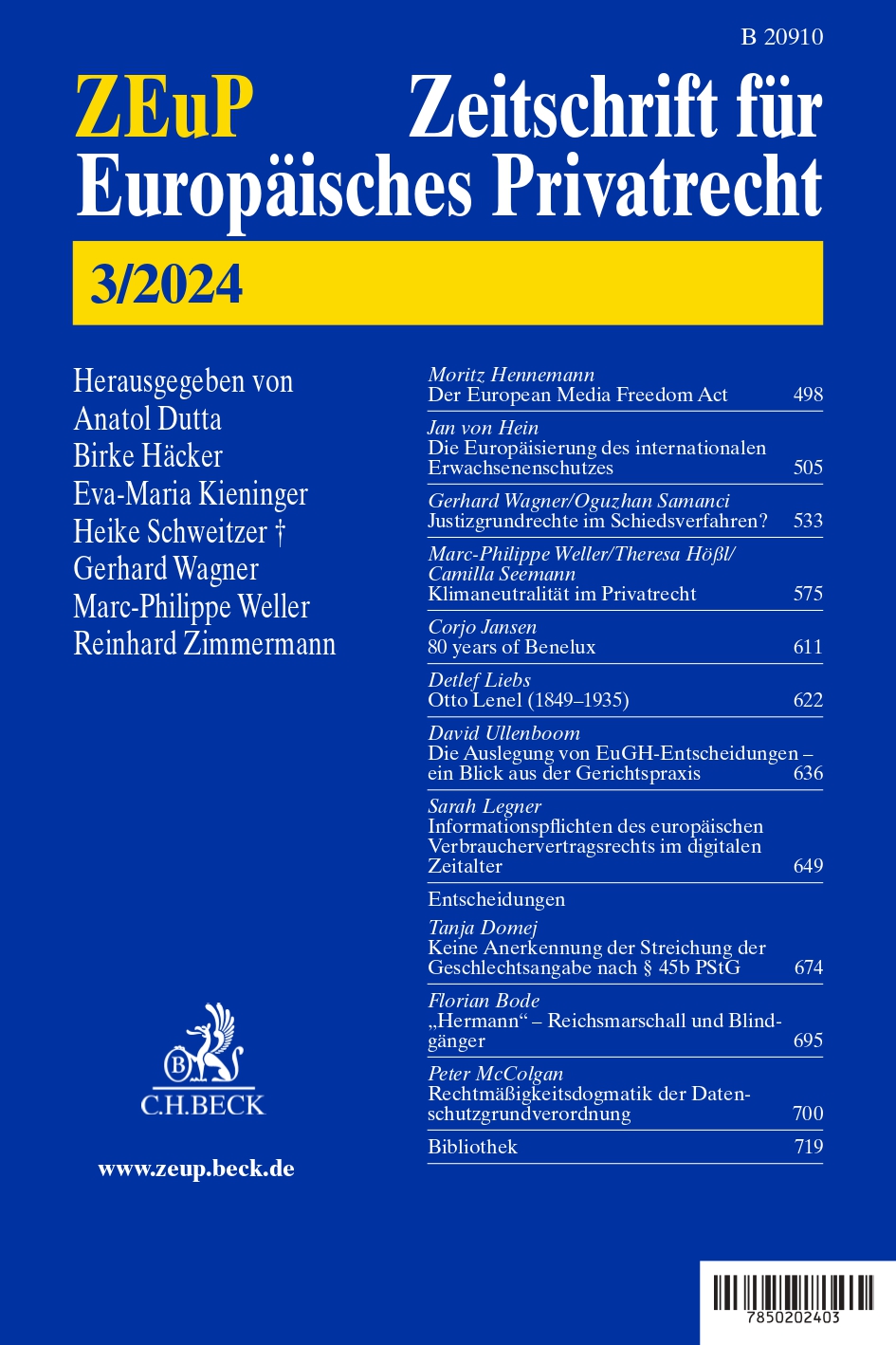
The following contributions might be of particular interest for the readers of this blog:
- Die Europäisierung des internationalen Erwachsenenschutzes
Jan von Hein on the proposal for a regulation on the international protection of adults: On 31.5.2023, the European Commission presented a proposal for a regulation on the international protection of adults. This proposal is closely intertwined with the Hague Convention on the international protection of adults. Therefore, the proposed regulation shall be accompanied by a Council decision authorising Member States to become or remain parties to the Hague Convention. The following contribution analyses the proposed regulation and its relationship with the Hague Convention. - Justizgrundrechte im Schiedsverfahren? – Pechstein und die Folgen fu?r die Handelsschiedsgerichtsbarkeit
Gerhard Wagner and Oguzhan Samanci on human rights and commercial arbitration: Does the ECHR and the German constitution require public hearings in arbitral proceedings, provided that one of the parties had the power to impose the arbitration agreement on the other through a contract of adhesion? This article analyzes the potential implications that the Pechstein decision of the Federal Constitutional Court and ist precursor in the jurisprudence of the ECHR may have for commercial arbitration. The focus is on arbitration clauses in general business terms and in contracts with undertakings that occupy a dominant position in a specific market. The conclusion is that, despite the broad formula employed by the Federal Constitutional Court, the right to a public hearing should remain limited to sports arbitration. - Die Auslegung von EuGH-Entscheidungen – ein Blick aus der Gerichtspraxis
David Ullenboom on the interpretation of CJEU decisions: This article examines the question whether a European methodology is needed to interpret judgments of the CJEU for judicial practice. It argues that judgments of the CJEU need to be interpreted in the same way as legal provisions and are therefore subject to a grammatical, systematic, genetic and teleological interpretation in order to determine their meaning for future legal cases. - Schweizerisches Bundesgericht, 8 June 2023, 5A_391/2021
Tanja Domej discusses a decision of the Swiss Federal Tribunal on the recognition of the deletion of a gender registration under German law.
OUT NOW!! New Book on Private International Law in BRICS: Convergence, Divergence, and Reciprocal Lessons (Stellina Jolly and Saloni Khanderia eds)
Hart Publishing, Oxford, UK is proud to announce the release of Private International Law in BRICS: Convergence, Divergence, and Reciprocal Lessons co-edited by Dr. Stellina Jolly, South Asian University, Delhi, India, and Professor Saloni Khanderia, O.P. Jindal Global University, Sonipat, India. The book forms part of Hart’s prestigious Private International Law Series with Professor Paul Beaumont, University of Stirling, as its Series Editor.
Authored by leading scholars and practitioners in private international law, the chapters draw on domestic legislation and case law interpretations in each of these emerging economies. They cover a wide array of topics, including contractual and non-contractual obligations, choice of court agreements, and personal matters such as marriage, divorce, matrimonial property, succession, and surrogacy—all within the context of increased cross-border movement of people.
As the title suggests, this book explores the intricate landscape of private international law within the BRICS countries—Brazil, Russia, India, China, and South Africa. Divided into six sections, each part of the book offers a thematic analysis of core private international law-related questions and an in-depth examination of the reciprocal lessons each BRICS country can share concerning each of three core conflict of law issues – the international jurisdiction of courts, the applicable law and the effectiveness of foreign decisions (both judgments and arbitral awards) overseas.
This book serves as an invaluable comparative resource for governments, legislators, traders, academics, researchers, and students interested in the intricate legal dynamics at play within the BRICS nations. With the BRICS countries collectively representing around 42% of the world’s population and approximately 23% of global GDP, the need for enhanced legal cooperation and harmonization is more critical than ever. Over the past decade, cross-border interactions within the BRICS bloc and beyond have escalated significantly. However, the diversity in political, legal, economic, and social structures, coupled with the lack of geographical proximity and historical connections, has posed challenges to effective cooperation and the ability of BRICS to play a proactive role in global governance. The 15 BRICS Summits held between 2009 and 2023 have primarily focused on economic cooperation, particularly in trade, investment, foreign affairs, and innovation. While these areas are crucial, they cannot be viewed in isolation. Increased trade and cooperation inevitably lead to the movement of persons, goods, and services across national boundaries, raising important legal questions. For instance, economic cooperation that facilitates the movement of people also impacts personal relationships. Scenarios such as marriage, divorce, adoption, surrogacy, and inheritance across borders create complex legal challenges that require a robust understanding of private international law. Will a marriage or divorce be recognized in the home country? How will the nationality of a child born through surrogacy or adopted abroad be determined? These questions, though critical, have not yet been thoroughly examined in the context of BRICS.
Recognizing this gap, our book seeks to explore and analyze the role of private international law in fostering enhanced cooperation among BRICS countries. In pursuit of its objectives, the project draws lessons from various multilateral and supranational instruments operating under the HCCH – Hague Conference on Private International Law and in the European Union, renowned for pioneering clear, predictable rules to regulate international disputes through the unification of laws.
Details of the book as well as purchase options can be found here!