


Views
Book review: Research Handbook on International Child Abduction: The 1980 Hague Convention (Edward Elgar Publishing, 2023) – Part I
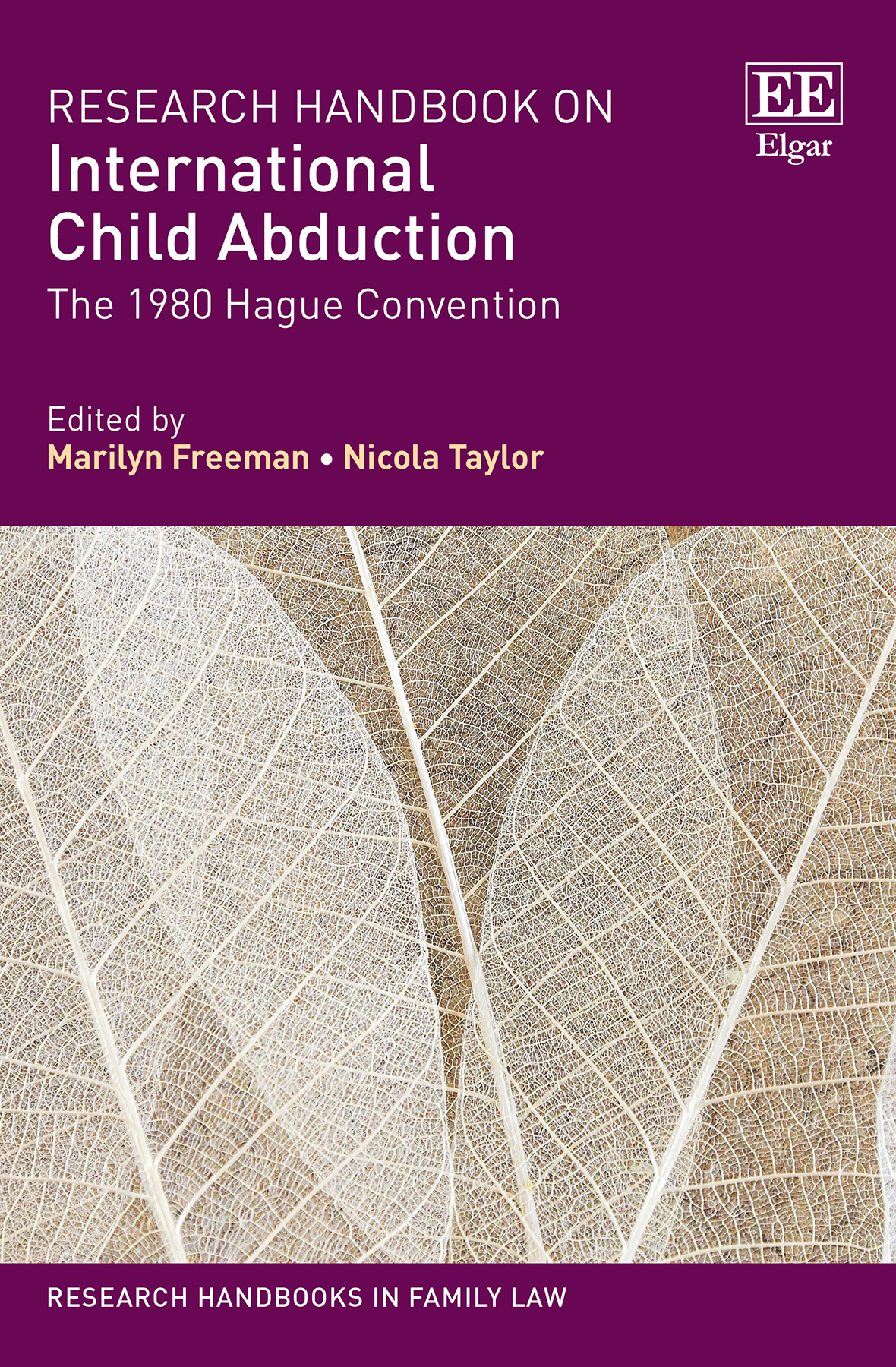
Written by Mayela Celis, Maastricht University
International child abduction is a topic that has given rise to an ever-increasing number of publications (our latest blog post attests to this trend). It easily sparks emotions among experts, sometimes triggering divergent views. However, from a global perspective, there is consensus on the basic principle: States should combat international child abductions and a child should be returned to the State of habitual residence, unless an exception is made out. In 2023, Elgar published the book entitled “Research Handbook on International Child Abduction: the 1980 Hague Convention”, eds. Marilyn Freeman and Nicola Taylor (Edward Elgar Publishing Limited, 2023). Although published a couple of years ago, it remains poignantly relevant.
This book brings together an adult who was abducted as a child, practitioners, judges, academics, NGO officials and central authority personnel. Many of the authors are at the forefront of this field and their contributions have left a long-lasting legacy in this area of law. While some topics are considered from an academic perspective, others have a more practical focus, striking the right balance between academia and practice. Read more
XLK v XLJ: Comity Beyond the Child Abduction Convention
By Haoxiang Ruan, PhD candidate at Hitotsubashi University (Tokyo, Japan). Haoxiang Ruan consistently maintains an interest in international family law, which led him to undertake the 2024-2025 academic stay at Kyoto University (Kyoto, Japan).
From the perspective of state participation, the Convention of 25 October 1980 on the Civil Aspects of International Child Abduction (the “Child Abduction Convention”) stands as one of the most successful instruments of the Hague Conference on Private International Law (HCCH), boasting 103 Contracting Parties to date. This widespread adherence is largely driven by the pervasive—and increasingly difficult-to-ignore—problem of international child abduction, which affects even non-Contracting States. China, a populous country deeply engaged in globalization, exemplifies this reality. A recent custody ruling in Singapore concerned a child who had been brought to the country by his father in breach of an order issued by a Chinese court—an incident underscoring how cross-border family disputes transcend the formal boundaries of the Convention.
Conflict of laws in the South African courts: a recent missed opportunity
Posted on behalf of Jason Mitchell, barrister at Maitland Chambers in London and at Group 621 in Johannesburg.
It’s rare for conflict of laws to come up in South African courts (with the notable exception of the Turkcell litigation from earlier this year; see the summary on this site at https://conflictoflaws.net/2025/south-africa-grapples-with-the-act-of-state-doctrine-and-choice-of-law-in-delict/).
News
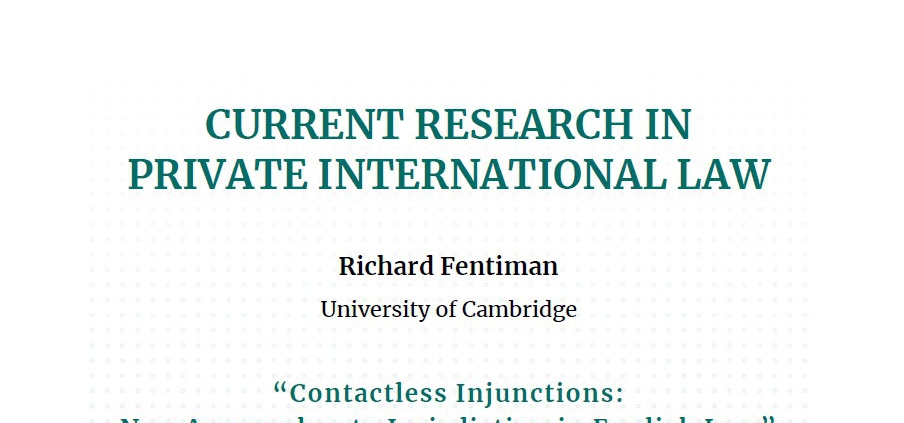
Richard Fentiman’s Lecture on Contactless Injunctions in English Law
Richard Fentiman will be speaking on “Contactless Injunctions: New Approaches to Jurisdiction in English Law” at the forthcomming virtual workshop in the Max Planck Institute for Comparative and International Private Law series “Current Research in Private International Law” to be held on on Tuesday, 3 March 2026, at 11:00 (CET).
Richard Fentiman is Professor Emeritus of Private International Law at the University of Cambridge. His research is especially concerned with the law and practice of international commercial litigation and in particular with issues concerning jurisdiction and interim remedies. He will be speaking about the practice of the English courts which regularly grant extraterritorial injunctions to freeze foreign assets or prevent foreign proceedings. In a departure from past practice they will now do so even in the absence of any material link with England. This reveals much about English law’s distinctive approach to injunctions and begs deeper questions about the appropriate grounds for exercising jurisdiction in private international law.
The virtual lecture will be held as a video conference via Zoom. Prior registions is necesarry by Monday, 2 March 2026, using this link.
Jurisdiction in the Middle Ages
Since not all readers of the blog can be presumed to be avid consumers of the Journal of Legal History, it may be worth pointing out that issue 46/1 (2025) (table of contents here) was dedicated to jurisdiction in the European Central Middle Ages. In their (open access) introduction, historians Danica Summerlin and Alice Taylor suggest explaining medieval law neither through the (rediscovered) Codex Justinianus as the basis of a ius commune, nor through the concept of legal pluralism, but instead through the emerging law of jurisdiction. Indeed, their approach deviates from earlier state-focused analyses on struggles between state and church and instead “foregrounds actors and performances as the means by which jurisdictions were asserted, defined and formalized – or, to put it another way, as the means by which jurisdiction came into being.” The issue emerges from a British Academy funded multi-year research project on Jurisdictions, political discourse, and legal community, 1050–1250 that brought together (legal) historians from Europe and North America – but not, it seems, conflict of laws scholars. The contributions are fascinating and relevant for those of us who want to understand conflict of laws through its history – and may perhaps even provide a basis for future collaborations across disciplines?
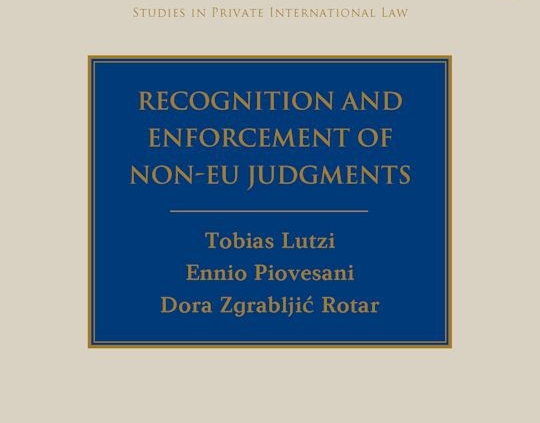
New Book Alert: Recognition and Enforcement of Non-EU Judgments
An upcoming milestone in private international law — Recognition and Enforcement of Non-EU Judgments (Bloomsbury / Hart Publishing, Feb. 19 2026), edited by Tobias Lutzi, Ennio Piovesani, and Dora Zgrabljic Rotar.
This is not just another doctrinal text, but the first comprehensive comparative deep dive into how EU Member States handle judgments from outside the EU, an area of law that has been notoriously fragmented and under-theorized.
The book contains country reports from 21 EU Member States on their national rules on recognition and enforcement of non-EU judgments in a unified framework, giving the reader both breadth and comparative depth. The editors pull these strands together in a detailed comparative report that highlights patterns of convergence and divergence across EU jurisdictions. Additionally, the book situates the Member State approaches in relation to the Brussels I regime and the 2019 HCCH Judgments Convention, which is itself reshaping global judicial cooperation. It had practical and scholarly appeal
The release date is 19 February 2026 and it is available for pre-order already at here.